Review
. 2011 Oct;3(10):1223-33.
doi: 10.2217/imt.11.100.

Naive, effector and memory CD8 T-cell trafficking: parallels and distinctions

Affiliations
Review

Naive, effector and memory CD8 T-cell trafficking: parallels and distinctions

Jeffrey C Nolz et al. Immunotherapy. 2011 Oct.

Abstract

Trafficking of CD8 T cells, in both the steady-state and during episodes of infection or inflammation, is a highly dynamic process and involves a variety of receptor-ligand interactions. A thorough, mechanistic understanding of how this process is regulated could potentially lead to disease prevention strategies, through either enhancing (for infectious diseases or tumors) or limiting (for autoimmunity) recruitment of antigen-specific CD8 T cells to areas of tissue inflammation. As CD8 T cells transition from naive to effector to memory cells, changes in gene expression will ultimately dictate anatomical localization of these cells in vivo. In this article, we discuss recent advances in understanding how antigenic stimulation influences expression of various trafficking receptors and ligands, and how this determines the tissue localization of CD8 T cells.


Figures
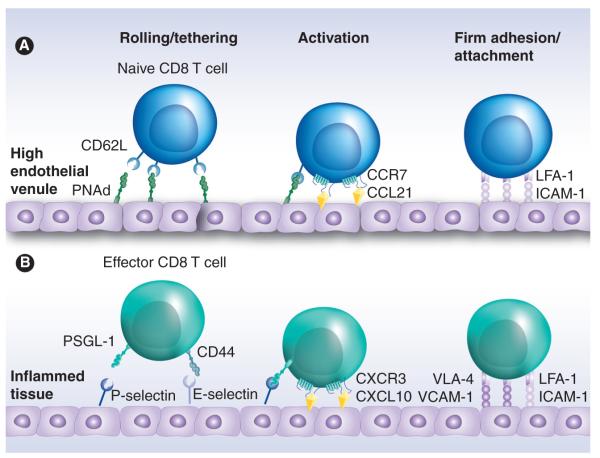
Figure 1
Figure 1. Trafficking of naive and effector CD8 T cells
(A) Naive CD8 T cells enter lymph nodes through the high endothelial venule. Rolling and tethering is mediated by interactions between L-selectin (CD62L) and PNAd, which allows the chemokine receptor CCR7 to interact with CCL19 or CCL21 displayed by the endothelial cells. CCR7 ligation results in polarization and activation of the integrin LFA-1, which will bind to its ligand ICAM-1 and cause the naive CD8 T cell to firmly adhere to the surface of the high endothelial venule before transmigrating across the endothelial layer. (B) Following antigenic stimulation, effector CD8 T cells express functional ligands such as PSGL-1 and CD44, that bind P-selectin and E-selectin expressed by inflamed tissues. Effector T cells also express chemokine receptors (such as CXCR3), which interact with inflammatory chemokines (such as CXCL10) that are produced by the inflamed tissues. This causes activation and polarization of LFA-1 on the effector T cell, as well as newly expressed integrins, such as VLA-4, which will bind to ICAM-1 and VCAM-1 on the inflamed tissue, respectively. These interactions result in firm adhesion, allowing the effector CD8 T cell to then transmigrate through the endothelial layer and into the inflamed tissue. LFA: Lymphocyte function-associated antigen; PNAd: Peripheral node addressin; PSGL: P-selectin glycoprotein ligand; VLA: Very-late antigen.
Figure 2
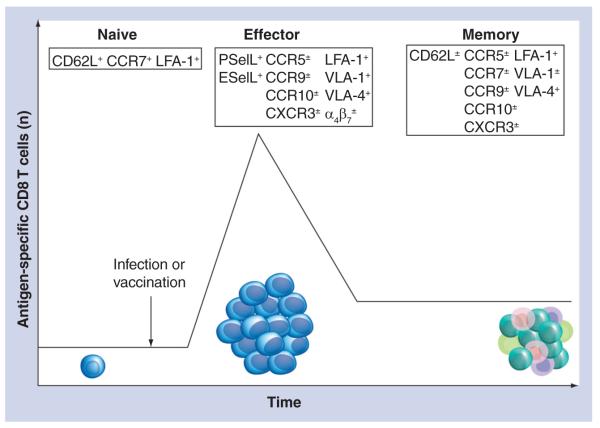
Figure 2. Expression of various trafficking molecules dynamically changes during the course of CD8 T-cell activation and progression into memory cells
Naive CD8 T cells express relatively few trafficking molecules (e.g., CD62L, CCR7 and LFA-1). However, following sufficient antigenic and costimulatory activation, CD8 T cells will rapidly proliferate and expand. In addition to this marked expansion, effector CD8 T cells lose expression of CD62L and CCR7, while gaining the expression of P- and E-selectin ligands, inflammatory chemokine receptors (e.g., CXCR3 and CCR5) and additional integrins (e.g., VLA-1, VLA-4, α4 and β7), resulting in efficient recruitment of these cells to inflamed tissues. Following contraction, 90–95% of the effector cells die via apoptosis. However, the CD8 T cells that survive the contraction phase are maintained long term and progress into memory cells. Collectively, memory CD8 T-cell populations contain a heterogeneous mixture of cells that express a variety of trafficking molecules, shared with both naive and effector CD8 T cells. ESelL: E-selectin ligands; LFA: Lymphocyte function-associated antigen; PSelL: P-selectin ligands; VLA: Very-late antigen.

References

    1. Ley K, Laudanna C, Cybulsky MI, Nourshargh S. Getting to the site of inflammation: the leukocyte adhesion cascade updated. Nat. Rev. Immunol. 2007;7(9):678–689. ■■A comprehensive review on the molecular regulation of leukocyte transmigration.

    1. Butler NS, Nolz JC, Harty JT. Immunologic considerations for generating memory CD8 T cells through vaccination. Cell Microbiol. 2011;13(7):925–933. - PMC - PubMed
    1. Sallusto F, Lanzavecchia A, Araki K, Ahmed R. From vaccines to memory and back. Immunity. 2010;33(4):451–463. - PMC - PubMed
    1. Kaech SM, Wherry EJ, Ahmed R. Effector and memory T-cell differentiation: implications for vaccine development. Nat. Rev. Immunol. 2002;2(4):251–262. - PubMed
    1. Badovinac VP, Harty JT. Programming, demarcating, and manipulating CD8+ T-cell memory. Immunol. Rev. 2006;211:67–80. - PubMed

Publication types