


Performance of a genetic risk score for CKD stage 3 in the general population
- PMID: 21995970
- PMCID: PMC3242901
- DOI: 10.1053/j.ajkd.2011.08.030
Performance of a genetic risk score for CKD stage 3 in the general population
Abstract
Background: Recent genome-wide association studies have identified multiple genetic loci that increase the risk of chronic kidney disease (CKD) in the general population. We hypothesized that knowledge of these loci might permit improved CKD risk prediction beyond that provided by traditional phenotypic risk factors.
Study design: Observational cohort study.
Setting & participants: Participants who attended the 15th (1977-1979) and 24th (1995-1998) examination cycles of the original cohort or the 6th (1995-1998) and 8th cycles (2005-2008) of the offspring cohort of the Framingham Heart Study (n = 2,489).
Predictors: Single-nucleotide polymorphisms at 16 stage 3 CKD loci were genotyped and used to construct a genetic risk score. Standard clinical predictors of incident stage 3 CKD also were used.
Outcomes & measurements: Incident stage 3 CKD was defined as estimated glomerular filtration rate <60 mL/min/1.73 m(2) at follow-up. Participants with baseline stage 3 CKD were excluded. Logistic regression was used to generate C statistics, which measured the power of the genetic risk score to discriminate risk of incident CKD stage 3 with and without traditional risk factors.
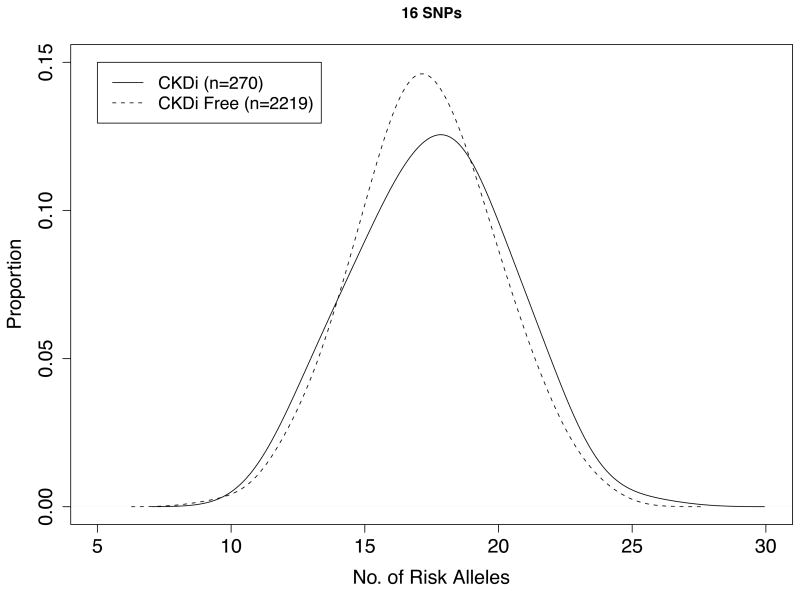
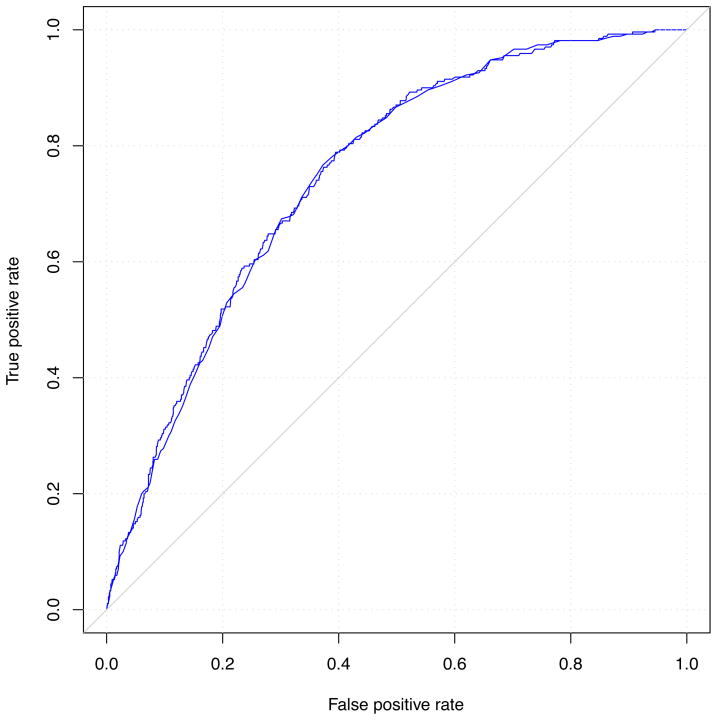
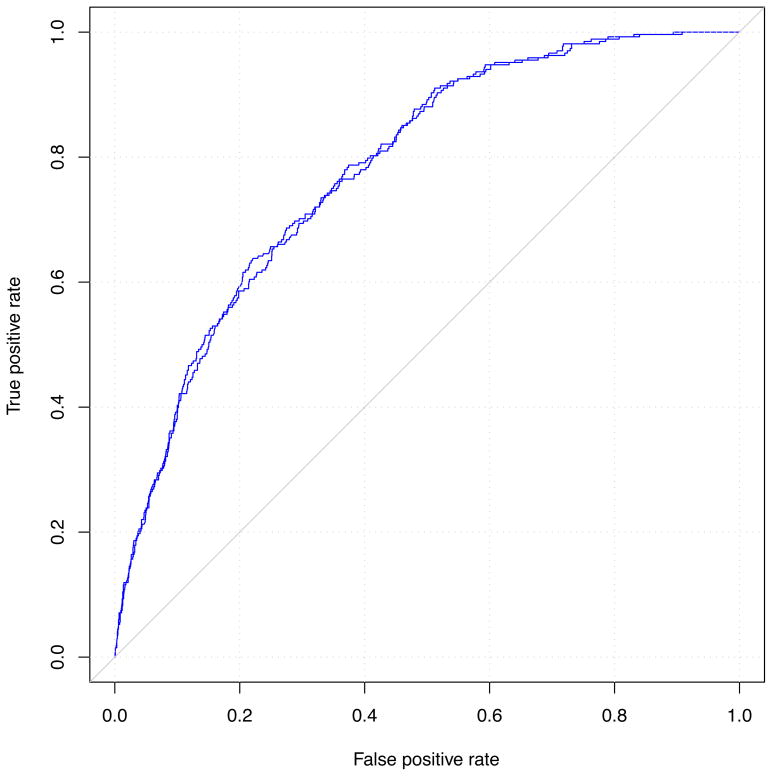
Results: There were 270 new stage 3 CKD cases during an average of 10.8 years of follow-up. Mean genetic risk score was 17.5 ± 2.8 (SD) for those who developed stage 3 CKD and 17.3 ± 2.6 for those who did not (P for genotype score difference = 0.2). The OR for stage 3 CKD was 1.06 (95% CI, 1.01-1.11; P = 0.03) per additional risk allele, adjusting for age and sex. In the age- and sex-adjusted model, the C statistic was 0.748 without the genotype score and 0.751 with the score (P difference = 0.3). The risk score was not statistically significant in a multivariable model adjusted for standard stage 3 CKD risk factors (P = 0.07).
Limitations: All participants were of European ancestry; the genotype score may not be valid in different ancestral groups.
Conclusions: A genetic score generated from 16 known CKD risk alleles did not predict new cases of stage 3 CKD in the community beyond knowledge of common clinical risk factors alone.
Published by Elsevier Inc.
Figures
Comment in
-
Genetic risk prediction for CKD: a journey of a thousand miles.Am J Kidney Dis. 2012 Jan;59(1):4-8. doi: 10.1053/j.ajkd.2011.11.011. Am J Kidney Dis. 2012. PMID: 22177444 Free PMC article. No abstract available.
References
-
- Coresh J, Selvin E, Stevens LA, et al. Prevalence of chronic kidney disease in the United States. JAMA. 2007 Nov 7;298(17):2038–2047. - PubMed
-
- Chadban SJ, Briganti EM, Kerr PG, et al. Prevalence of kidney damage in Australian adults: The AusDiab kidney study. J Am Soc Nephrol. 2003 Jul;14(7 Suppl 2):S131–138. - PubMed
-
- Chen J, Wildman RP, Gu D, et al. Prevalence of decreased kidney function in Chinese adults aged 35 to 74 years. Kidney Int. 2005 Dec;68(6):2837–2845. - PubMed
-
- Perkovic V, Cass A, Patel AA, et al. High prevalence of chronic kidney disease in Thailand. Kidney Int. 2008 Feb;73(4):473–479. - PubMed
Publication types
MeSH terms
Grants and funding
LinkOut - more resources
Full Text Sources
Medical
