


Postural tachycardia in children and adolescents: what is abnormal?
- PMID: 21996154
- PMCID: PMC3258321
- DOI: 10.1016/j.jpeds.2011.08.054
Postural tachycardia in children and adolescents: what is abnormal?
Abstract
Objectives: To evaluate whether the use of adult heart rate (HR) criteria is appropriate for diagnosing orthostatic intolerance (OI) and postural tachycardia syndrome (POTS) in children and adolescents, and to establish normative data and diagnostic criteria for pediatric OI and POTS.
Study design: A total of 106 normal controls aged 8-19 years (mean age, 14.5±3.3 years) underwent standardized autonomic testing, including 5 minutes of 70-degree head-up tilt. The orthostatic HR increment and absolute orthostatic HR were assessed and retrospectively compared with values in 654 pediatric patients of similar age (mean age, 15.5±2.3 years) who were referred to our Clinical Autonomic Laboratory with symptoms of OI.
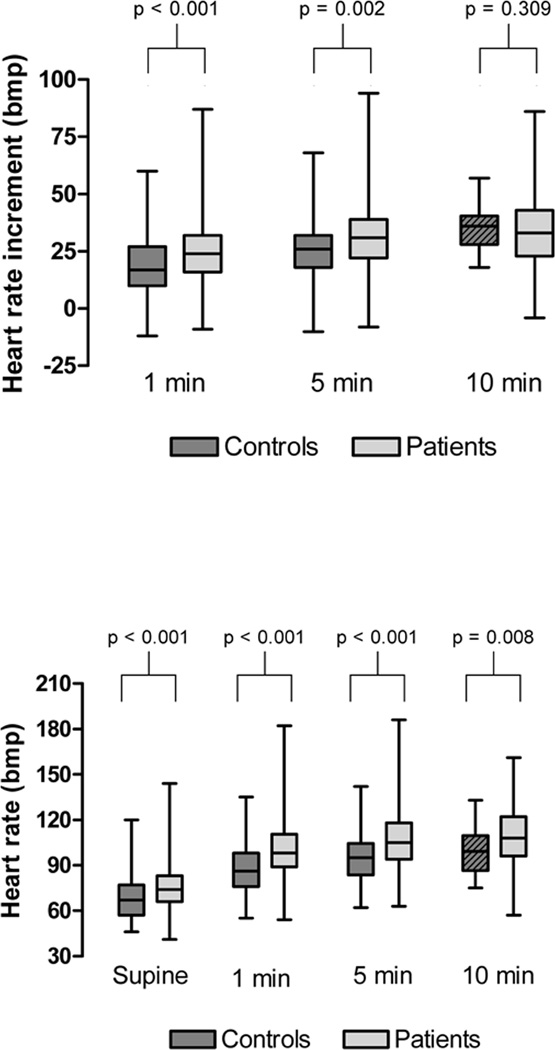
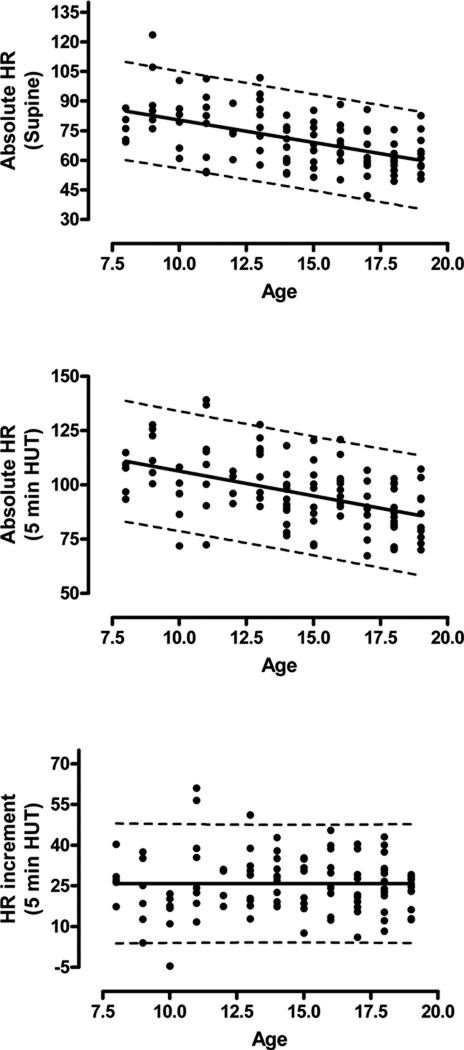
Results: The HR increment was mildly higher in patients referred for OI/POTS, but there was considerable overlap between the patient and control groups. Some 42% of the normal controls had an HR increment of ≥30 beats per minute. The 95th percentile for the orthostatic HR increment in the normal controls was 42.9 beats per minute. There was a greater and more consistent difference in absolute orthostatic HR between the 2 groups, although there was still considerable overlap.
Conclusion: The diagnostic criteria for OI and POTS in adults are unsuitable for children and adolescents. Based on our normative data, we propose new criteria for the diagnosis of OI and POTS in children and adolescents.
Copyright © 2012 Mosby, Inc. All rights reserved.
Conflict of interest statement
The authors declare no conflicts of interest.
Figures
References
-
- Low PA, Sandroni P, Joyner MJ, Shen WK. Postural Tachycardia Syndrome. In: Low PA, Benarroch EE, editors. Clinical Autonomic Disorders. 3rd ed. Philadelphia: Lippincott Williams & Wilkins; 2008. pp. 515–533.
-
- Low PA, Opfer-Gehrking TL, Textor SC, Benarroch EE, Shen WK, Schondorf R, et al. Postural tachycardia syndrome (POTS) Neurology. 1995;45:S19–S25. - PubMed
-
- Low PA, Opfer-Gehrking TL, Textor SC, Schondorf R, Suarez GA, Fealey RD, et al. Comparison of the postural tachycardia syndrome (POTS) with orthostatic hypotension due to autonomic failure. Journal of the autonomic nervous system. 1994;50:181–188. - PubMed
-
- Schondorf R, Low PA. Idiopathic postural orthostatic tachycardia syndrome: an attenuated form of acute pandysautonomia? Neurology. 1993;43:132–137. - PubMed
-
- Antiel RM, Risma JM, Grothe RM, Brands CK, Fischer PR. Orthostatic intolerance and gastrointestinal motility in adolescents with nausea and abdominal pain. Journal of pediatric gastroenterology and nutrition. 2008;46:285–288. - PubMed
Publication types
MeSH terms
Grants and funding
LinkOut - more resources
Full Text Sources
Other Literature Sources
Medical
