


A phase II evaluation of trabectedin in the treatment of advanced, persistent, or recurrent uterine leiomyosarcoma: a gynecologic oncology group study
- PMID: 21996263
- PMCID: PMC4497524
- DOI: 10.1016/j.ygyno.2011.09.019
A phase II evaluation of trabectedin in the treatment of advanced, persistent, or recurrent uterine leiomyosarcoma: a gynecologic oncology group study
Abstract
Objective: To estimate activity and safety of trabectedin 1.5 mg/m2 IV over 24 hours every 3 weeks (1 cycle) in uterine leiomyosarcoma.
Methods: Patients with chemotherapy naive, advanced, persistent or recurrent uterine leiomyosarcoma, acceptable organ function and PS≤2 were eligible. A two-stage design was utilized. Three responses were required in the first stage to initiate the second stage; the target sample size was 40 for the combined stages. If the true response rate was 10%, the study design provided a 95% chance of correctly classifying the treatment as "inactive." Conversely, if the true response rate was 30%, then the average probability of correctly classifying the treatment as active would be 90%.
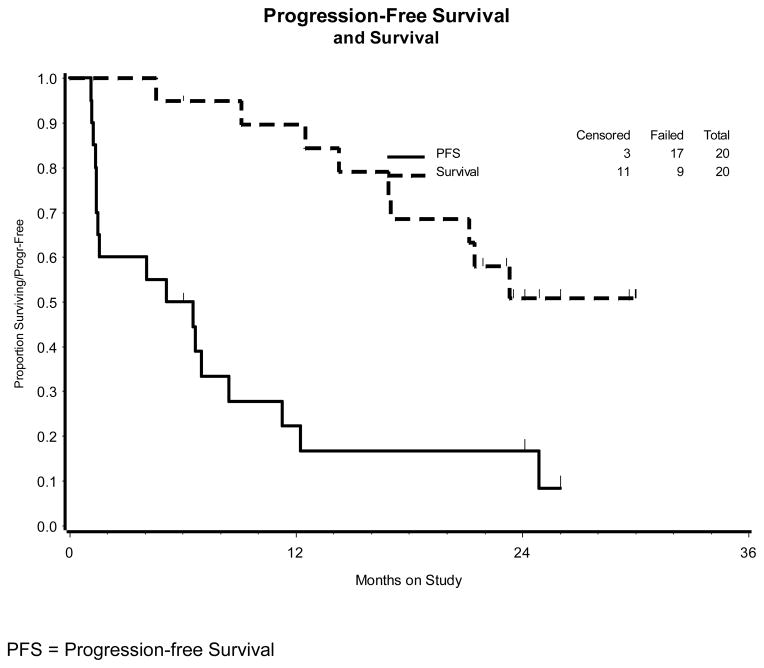
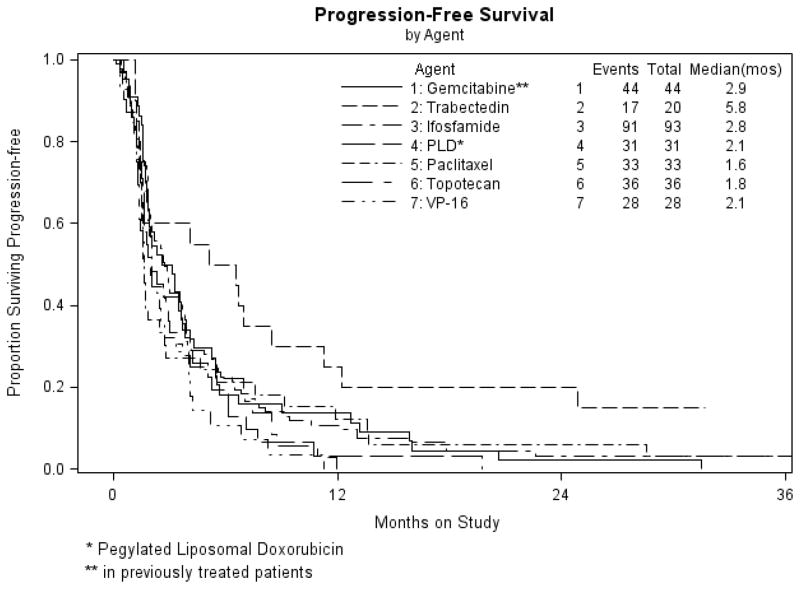
Results: Twenty patients were eligible and evaluable. The median number of cycles was 10 (123 total cycles, range 2-29). The number of patients with partial responses was 2 (10%; 95% confidence interval of 1.2%-31.7%). Response durations were 3.3 and 5.7 months. Ten patients had stable disease (50%). The median progression-free survival (PFS) and overall survival were 5.8 months and greater than 26.1 months (median not reached), respectively. Observed grade 3/4 toxicity included: neutropenia 16/20 (1 infection); thrombocytopenia 3/20; metabolic 3/20; anemia, gastrointestinal and vascular 1/20 each. There were no treatment related deaths nor cases of liver failure.
Conclusions: Although a second stage of accrual was not indicated based on the overall response rate, the drug was well tolerated.
Copyright © 2011 Elsevier Inc. All rights reserved.
Conflict of interest statement
Dr. Bradley Monk has an honoraria and research funding from Johnson & Johnson. All other co-authors have no conflicts of interest to declare.
Figures
References
-
- D’Angelo E, Prat J. Uterine sarcomas: a review. Gynecol Oncol. 2010;116:131–9. - PubMed
-
- Major FJ, Blessing JA, Silverberg SG, Morrow CP, Creasman WT, Currie JL, et al. Prognostic factors in early stage uterine sarcoma. Cancer. 1993;71:1702–9. - PubMed
-
- Kanjeekal S, Chambers A, Fung MF, Verma S. Systemic therapy for advanced uterine sarcoma: a systematic review of the literature. Gynecol Oncol. 2005;97:624–37. - PubMed
-
- Mahdavi A, Monk BJ, Ragazzo J, Hunter MI, Lentz SE, Vasilev SA, et al. Pelvic radiation improves local control after hysterectomy for uterine leiomyosarcoma: a 20-year experience. Int J Gynecol Cancer. 2009;19:1080–4. - PubMed
-
- Cuevas C, Francesch A. Development of Yondelis (trabectedin, ET-743). A semisynthetic process solves the supply problem. Nat Prod Rep. 2009;26:322–37. - PubMed
Publication types
MeSH terms
Substances
Grants and funding
LinkOut - more resources
Full Text Sources
Medical
