Review
. 2012 May 3;31(18):2247-57.
doi: 10.1038/onc.2011.442. Epub 2011 Sep 26.

Complex cellular functions of the von Hippel-Lindau tumor suppressor gene: insights from model organisms

Affiliations
Review

Complex cellular functions of the von Hippel-Lindau tumor suppressor gene: insights from model organisms

T Hsu. Oncogene. .

Abstract

The von Hippel-Lindau tumor suppressor gene (VHL) has attracted intensive interest not only because its mutations predispose carriers to devastating tumors, but also because it is involved in oxygen sensing under physiological conditions. VHL loss-of-function mutations result in organ-specific tumors, such as hemangioblastoma of the central nervous system and renal cell carcinoma, both untreatable with conventional chemotherapies. The VHL protein is best known as an E3 ubiquitin ligase that targets hypoxia-inducible factor-α (HIF-α), but many diverse, non-canonical cellular functions have also been assigned to VHL, mainly based on studies in cell culture systems. As such, although the HIF-dependent role of VHL is critical, the full spectrum of pathophysiological functions of VHL is still unresolved. Such understanding requires careful cross-referencing with physiologically relevant experimental models. Studies in model systems, such as Caenorhabditis elegans, Drosophila, zebrafish and mouse have provided critical in vivo confirmation of the VHL-HIF pathway, and verification of potentially important cellular functions including microtubule stabilization and epithelial morphogenesis. More recently, animal models have also suggested systemic roles of VHL in hematopoiesis, metabolic homeostasis and inflammation. In this review, the studies performed in model organisms will be summarized and placed in context with existing clinical and in vitro data.


Conflict of interest statement

Conflict of interest

The authors declare no conflict of interest.

Figures
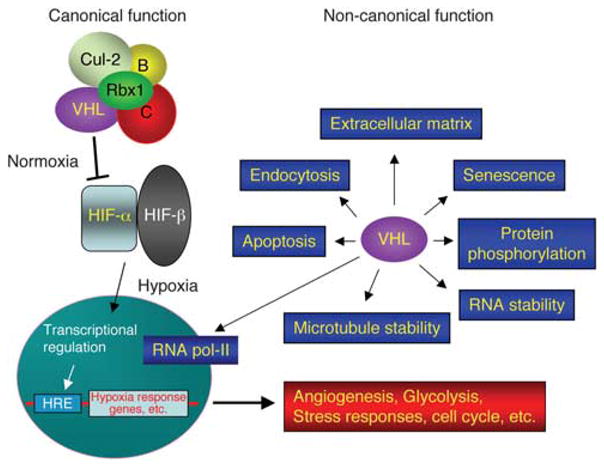
Figure 1
Figure 1
Pleiotropic VHL functions. See text for detail. Canonical VHL functions denote the degradation of HIF-α in normoxia through the E3 ubiquitin ligase activity. The E3 ligase complex contains VHL, Rbx1, cullin-2 (Cul-2) and elongin B and C (B, C). In hypoxia, HIF-α is stabilized, form active transcription factor complex with HIF-β and regulates gene expression via the hypoxia-responsive element (HRE). Non-canonical VHL functions denote those independent of HIF activity. Some, but not all, of these non-canonical functions are listed (in blue boxes).
Figure 2
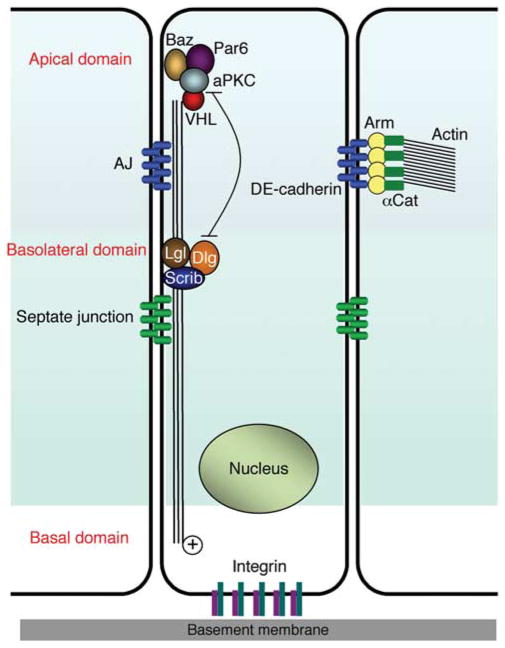
Figure 2
Microtubule-stabilizing function of dVHL contributes to epithelial morphogenesis. See Duchi et al. (2010) for detailed experimental evidence. Schematics showing polarized follicle cells. In many organ-associated epithelial cells such as the follicle cells, microtubules are not centrosome anchored, but are instead organized in cortical bundles parallel to the apicobasal axis, with the plus-end localized basally (Bartolini and Gundersen, 2006). VHL interacts with microtubule and aPKC. Microtubule bundles are stabilized by VHL and are important for proper localization of the aPKC–Par6–Baz complex. aPKC–Par6–Baz complex prevents apical spreading of the Dlg–Lgl–Scrib complex, which in turn restricts aPKC–Par6–Baz complex to the apical region. The opposing actions of aPKC–Par6–Baz complex and Dlg–Lgl–Scrib complex help define the location of adherens junction (AJ). AJ, adherens junction; Arm, Armadillo (Drosophila homolog of β-catenin); α-Cat, α-catenin; Baz, Bazooka; Dlg, discs large; Lgl, lethal giant larvae; Scrib, scribble. Septate junction is an adhesion complex similar in function to the mammalian tight junction.
Figure 3
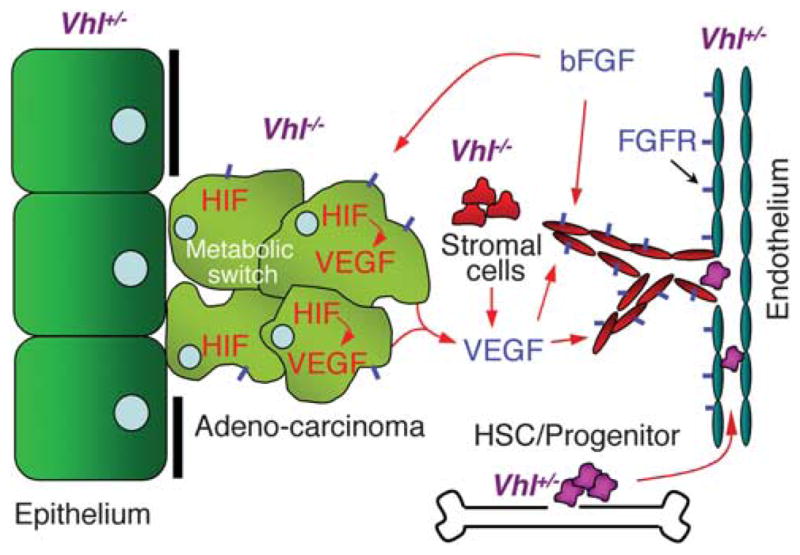
Figure 3
Epithelial–stromal interaction in VHL disease. The model is based on VHL functions verified in the model organisms and is focused on the epithelial and vascular phenotypes. Homozygous VHL mutant epithelial cells are shown losing epithelial characteristics (Duchi et al., 2010; Hsouna et al., 2010). These cells as well as heterozygous VHL mutant endothelial cells overexpress FGFR (short blue bar) on the surface, contributing to their increased response to the chemotactic bFGF ligand (Dammai et al., 2003; Champion et al., 2008; Hsouna et al., 2010). Mutant VHL cells overexpress HIF-α, leading to overproduction of VEGF, which in turn induces angiogenesis (van Rooijen et al., 2009, 2010) as well as metabolic switch that mimic hypoxic response (Bishop et al., 2004; Shen et al., 2005; Zehetner et al., 2008; van Rooijen et al., 2009). Homozygous VHL mutant ‘stromal cells’ neighboring the blood vessels, although not yet identified in model organisms, have been shown in human patients, presumably inducing angiogenesis via increased VEGF secretion (Vortmeyer et al., 1997; Park et al., 2007). Heterozygosity of VHL in the HSCs and resultant endothelial progenitor cells exhibit increased activity (Takubo et al., 2010; van Rooijen et al., 2010) and potentially can contribute to neovasculogenesis.

References

    1. Adryan B, Decker HJ, Papas TS, Hsu T. Tracheal development and the von Hippel-Lindau tumor suppressor homolog in Drosophila. Oncogene. 2000;19:2803–2811. - PubMed
    1. Akis N, Madaio MP. Isolation, culture, and characterization of endothelial cells from mouse glomeruli. Kidney Int. 2004;65:2223–2227. - PubMed
    1. Alexander A, Walker CL. The role of LKB1 and AMPK in cellular responses to stress and damage. FEBS Lett. 2011;585:952–957. - PubMed
    1. Arquier N, Vigne P, Duplan E, Hsu T, Therond PP, Frelin C, et al. Analysis of the hypoxia-sensing pathway in Drosophila melanogaster. Biochem J. 2006;393:471–480. - PMC - PubMed
    1. Aso T, Yamazaki K, Aigaki T, Kitajima S. Drosophila von Hippel-Lindau tumor suppressor complex possesses E3 ubiquitin ligase activity. Biochem Biophys Res Commun. 2000;276:355–361. - PubMed

Publication types

Substances