. 2012 May 10;31(19):2471-9.
doi: 10.1038/onc.2011.424. Epub 2011 Sep 26.

Adaptive upregulation of FOXD3 and resistance to PLX4032/4720-induced cell death in mutant B-RAF melanoma cells

Affiliations

Adaptive upregulation of FOXD3 and resistance to PLX4032/4720-induced cell death in mutant B-RAF melanoma cells

K J Basile et al. Oncogene. .

Abstract

Melanoma cells driven by mutant v-raf murine sarcoma viral oncogene homolog B1 (B-RAF) are highly resistant to chemotherapeutic treatments. Recent phase 1 results with PLX4032/RG7204/vemurafenib, which selectively inhibits B-RAF/mitogen-activated protein kinase kinase (MEK)/extracellular signal-regulated kinase (ERK)1/2 signaling in mutant B-RAF cells, has given encouragement to this struggling field. Nearly all patients in the phase 1-3 studies saw at least some response and the overall response rates ranged from 48 and 81%. However, despite initial tumor shrinkage, most responders in the trial experienced tumor relapse over time. These findings indicate that both intrinsic and acquired resistance may affect the clinical efficacy of PLX4032. It is critical to optimize PLX4032 activity to improve response rates and understand why some patients with the B-RAF mutation do not respond. We have previously shown that the stemness factor, Forkhead box D3 (FOXD3), is upregulated following inhibition of B-RAF-MEK signaling in mutant B-RAF melanoma cells. Here, we show that upregulation of FOXD3 following treatment with PLX4032 and PLX4720 (the non-clinical tool compound for PLX4032) confers resistance to cell death. Small interfering RNA-mediated knockdown of FOXD3 significantly enhanced the cell death response after PLX4032/4720 treatment in mutant B-RAF melanoma cell lines. Additionally, upregulation of FOXD3 after PLX4720 treatment was attenuated in non-adherent conditions and correlated with enhanced cell death. Ectopic expression of FOXD3 in non-adherent cells significantly reduced cell death in response to PLX4720 treatment. Together, these data indicate that upregulation of FOXD3 is an adaptive response to RAF inhibitors that promotes a state of drug resistance.


Conflict of interest statement

Disclosure of Potential Conflicts of Interest

The authors declare no conflict of interest.

Figures
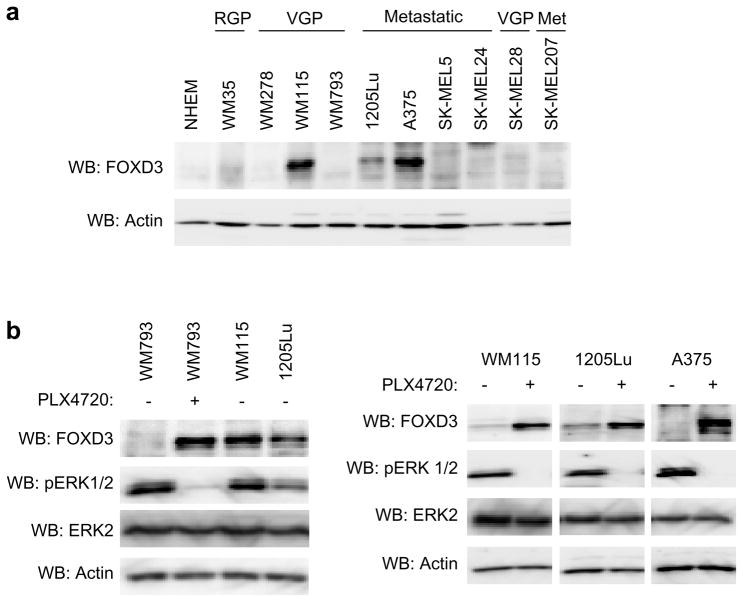
Figure 1
Figure 1
Basal and PLX4720-induced FOXD3 expression in melanoma cell lines. (a) Total cell lysates from a panel of mutant B-RAF melanoma cell lines were analyzed by Western blotting using antibodies to FOXD3 and actin (loading control). (b) WM793 cells (low basal FOXD3) were treated with DMSO (−) or 5 μM PLX4720 for 24 hrs. WM793 cell lysates were analyzed alongside WM115 and 1205Lu cell lysates from basal conditions for FOXD3, phosphoERK1/2, ERK2, and actin. WM115, 1205Lu and A375 cells were treated with DMSO (−) or 5 μM PLX4720 for 24 hrs. Cell lysates were similarly analyzed by Western blotting.
Figure 2
Figure 2
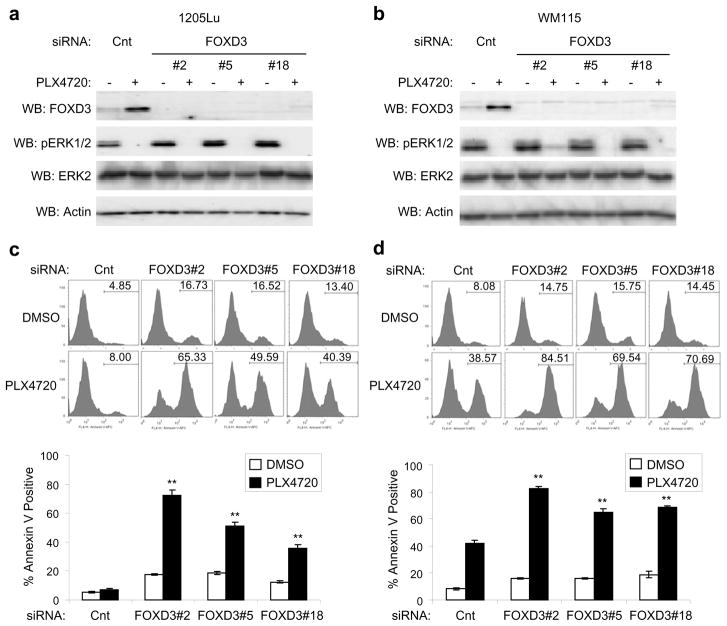
Knockdown of FOXD3 increases cell death after acute treatment with PLX4720. (a) 1205Lu cells were transfected with non-targeting control siRNA or three distinct FOXD3 siRNA sequences (#2, #5, and #18). After 72 hrs, fresh media containing either DMSO or 5 μM PLX4720 was added for an additional 24 hrs. Cell lysates were analyzed by Western blotting, as indicated. (b) Same as (a) except with WM115 cells. (c) Same as (a), except that cells were harvested and stained with Annexin V-APC for cell death analysis after 48 hrs of PLX4720 treatment. Representative traces are shown. X axis, fluorescence intensity; Y axis, cell counts, with percent of Annexin V-APC staining-positive cells indicated. Quantitation of data from three independent experiments is represented by the mean percentage of cells staining positive for Annexin V-APC. Error bars represent standard error. **p value<0.01 comparing PLX4720-treated, non-targeting control knockdown cells to PLX4720-treated FOXD3 knockdown cells based on unpaired Student t-test. (d) Same as (c), except that WM115 cells were analyzed.
Figure 3
Figure 3
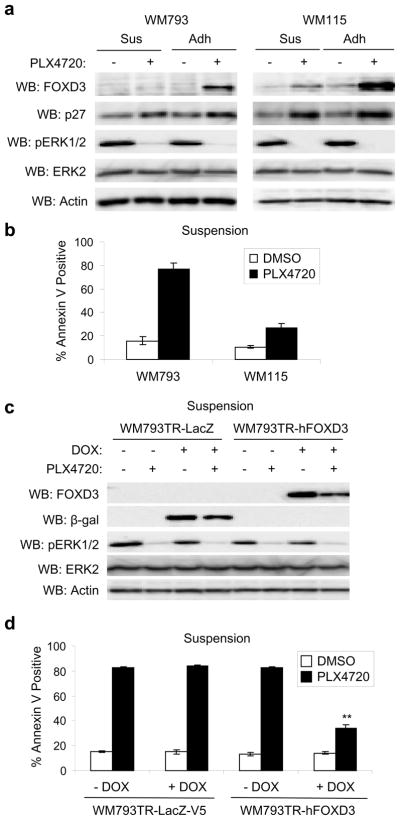
FOXD3 expression protects cells from anoikis after PLX4720 treatment. (a) WM793 and WM115 cells were maintained on plates coated with 2% Bactoagar (Sus) or allowed to adhere to uncoated plates (Adh) −/+ 5 μM PLX4720. After 24 hrs, cells were lysed in sample buffer and analyzed by Western blotting, as indicated. (b) Same as (a) except that cells were harvested and stained with Annexin V-APC for cell death analysis after 48 hrs of PLX4720 treatment. Quantitation of data from three independent experiments is represented by the mean percentage of cells staining positive for Annexin V-APC. Error bars represent standard error. (c) WM793TR cells harboring doxycycline-inducible β-galactosidase (β-gal; LacZ) or FOXD3 were induced with 100 ng/mL doxycycline for 72 hrs. Cells were then detached and maintained on 2% Bactoagar −/+ 5 μM PLX4720 for a further 24 hrs. Cells were lysed and lysates analyzed by Western blotting. (d) Same as (c), except that cells were harvested and stained with Annexin V-APC after 48 hrs. Quantitation of data from three independent experiments is represented by the mean percentage of cells staining positive for Annexin V-APC. Error bars represent standard error. **p value<0.01 comparing PLX4720-treated cells in the absence and presence of doxycycline based on unpaired Student t-test.
Figure 4
Figure 4
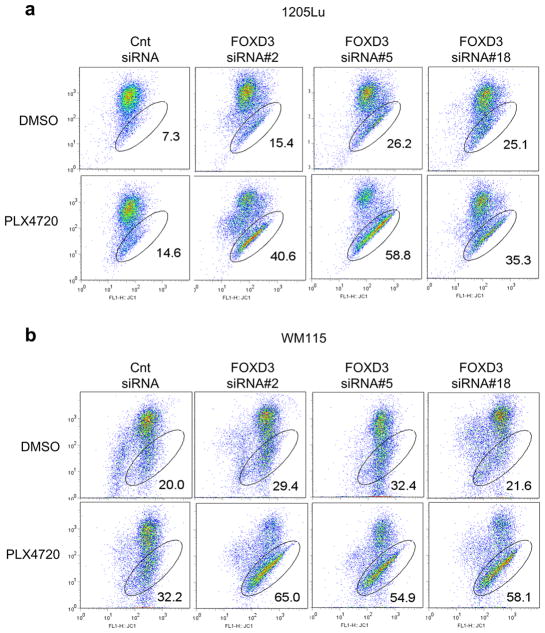
Knockdown of FOXD3 increases mitochondrial membrane depolarization after PLX4720 treatment. (a) 1205Lu cells were transfected for 72 hrs with the indicated siRNAs and then treated with DMSO or PLX4720 (5 μM) for an additional 24 hrs. Cells were then harvested and stained with JC-1 for analysis of mitochondrial membrane depolarization. Scatter plots are representative of three independent experiments. X axis, JC-1; Y axis, R-Phycoerythrin, with percent of cells showing mitochondrial membrane depolarization indicated. (b) Same as (a), except WM115 cells were analyzed.
Figure 5
Figure 5
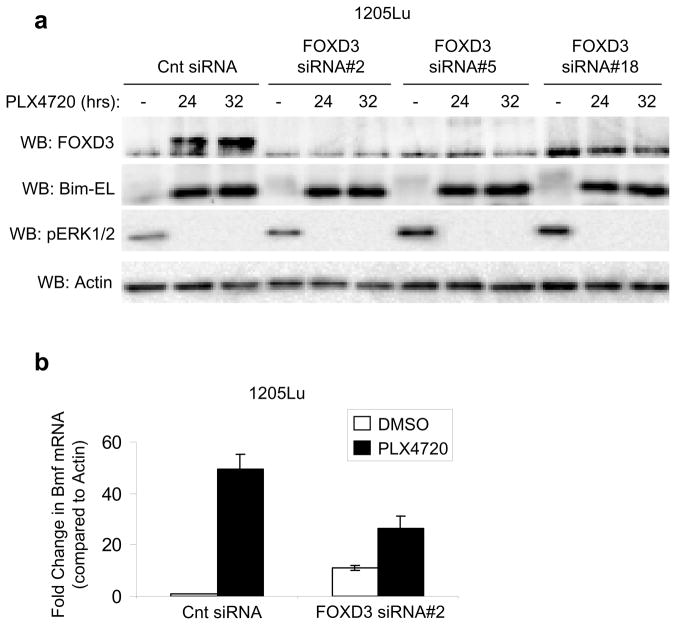
FOXD3 does not alter expression of Bim-EL and Bmf. (a) 1205Lu cells were transfected with the indicated siRNAs. After 72 hrs, fresh media containing either DMSO or 5 μM PLX4720 was added for indicated time points. Cell lysates were analyzed by Western blotting. (b) 1205Lu cells were transfected with control or FOXD3 siRNA#2 for 72 hrs and then treated with DMSO or PLX4720 (5 μM) for an additional 24 hrs. Cells were harvested for total RNA isolation and qRT-PCR analysis for Bmf and actin (control). Quantitation of data from three independent experiments is represented as the mean relative mRNA level of Bmf in each condition.
Figure 6
Figure 6
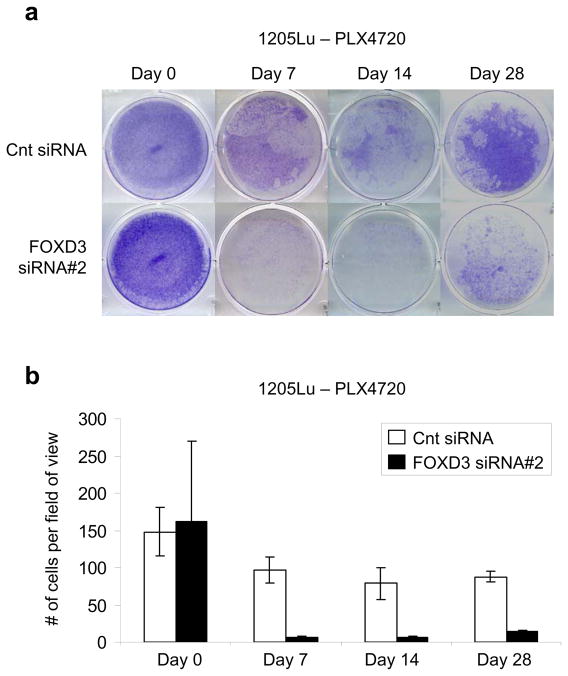
Depletion of FOXD3 impairs long-term resistance to PLX4720. (a) 1205Lu cells were transfected with the indicated siRNAs. After 72 hrs, a representative plate of each siRNA was stained with crystal violet (day 0). The remaining plates were treated with 5 μM PLX4720. Media was changed every 48 hrs and fresh PLX4720 was added. Remaining plates were stained with crystal violet after 7, 14 and 28 days. (b) Quantitation of data from two independent experiments is represented by the mean percentage of cells per field of view. Error bars represent standard deviation.

References

    1. Abel EV, Aplin AE. FOXD3 is a mutant B-RAF-regulated inhibitor of G1/S progression in melanoma cells. Cancer Res. 2010;70:2891–2900. - PMC - PubMed
    1. Aplin AE, Kaplan FM, Shao Y. Mechanisms of Resistance to RAF Inhibitors in Melanoma. J Invest Dermatol. 2011 Epub May 19. - PMC - PubMed
    1. Boisvert-Adamo K, Aplin AE. B-RAF and PI-3 kinase signaling protect melanoma cells from anoikis. Oncogene. 2006;25:4848–4856. - PubMed
    1. Bollag G, Hirth P, Tsai J, Zhang J, Ibrahim PN, Cho H, et al. Clinical efficacy of a RAF inhibitor needs broad target blockade in BRAF-mutant melanoma. Nature. 2010;467:596–599. - PMC - PubMed
    1. Chapman PB, Hauschild A, Robert C, Haanen JB, Ascierto P, Larkin J, et al. Improved survival with vemurafenib in melanoma with BRAF V600E mutation. N Engl J Med. 2011;364:2507–2516. - PMC - PubMed

Publication types

MeSH terms