. 2012 Apr;131(4):565-79.
doi: 10.1007/s00439-011-1094-6. Epub 2011 Oct 14.

A novel approach of homozygous haplotype sharing identifies candidate genes in autism spectrum disorder

Jillian P Casey  1 Tiago MagalhaesJudith M ConroyRegina ReganNaisha ShahRichard AnneyDenis C ShieldsBrett S AbrahamsJoana AlmeidaElena BacchelliAnthony J BaileyGillian BairdAgatino BattagliaTom BerneyNadia BolshakovaPatrick F BoltonThomas BourgeronSean BrennanPhil CaliCatarina CorreiaChristina CorselloMarc CoutancheGeraldine DawsonMaretha de JongeRichard DelormeEftichia DuketisFrederico DuqueAnnette EstesPenny FarrarBridget A FernandezSusan E FolsteinSuzanne FoleyEric FombonneChristine M FreitagJohn GilbertChristopher GillbergJoseph T GlessnerJonathan GreenStephen J GuterHakon HakonarsonRichard HoltGillian HughesVanessa HusRoberta IgliozziCecilia KimSabine M KlauckAlexander KolevzonJanine A LambMarion LeboyerAnn Le CouteurBennett L LeventhalCatherine LordSabata C LundElena MaestriniCarine MantoulanChristian R MarshallHelen McConachieChristopher J McDougleJane McGrathWilliam M McMahonAlison MerikangasJudith MillerFiorella MinopoliGhazala K MirzaJeff MunsonStanley F NelsonGudrun NygrenGuiomar OliveiraAlistair T PagnamentaKaterina PapanikolaouJeremy R ParrBarbara ParriniAndrew PicklesDalila PintoJoseph PivenDavid J PoseyAnnemarie PoustkaFritz PoustkaJiannis RagoussisBernadette RogeMichael L RutterAna F SequeiraLatha SooryaInês SousaNuala SykesVera StoppioniRaffaella TancrediMaïté TauberAnn P ThompsonSusanne ThomsonJohn TsiantisHerman Van EngelandJohn B VincentFred VolkmarJacob A S VorstmanSimon WallaceKai WangThomas H WassinkKathy WhiteKirsty WingKerstin WittemeyerBrian L YaspanLonnie ZwaigenbaumCatalina BetancurJoseph D BuxbaumRita M CantorEdwin H CookHilary CoonMichael L CuccaroDaniel H GeschwindJonathan L HainesJoachim HallmayerAnthony P MonacoJohn I Nurnberger JrMargaret A Pericak-VanceGerard D SchellenbergStephen W SchererJames S SutcliffePeter SzatmariVeronica J VielandEllen M WijsmanAndrew GreenMichael GillLouise GallagherAstrid VicenteSean Ennis
Affiliations

A novel approach of homozygous haplotype sharing identifies candidate genes in autism spectrum disorder

Jillian P Casey et al. Hum Genet. 2012 Apr.

Abstract

Autism spectrum disorder (ASD) is a highly heritable disorder of complex and heterogeneous aetiology. It is primarily characterized by altered cognitive ability including impaired language and communication skills and fundamental deficits in social reciprocity. Despite some notable successes in neuropsychiatric genetics, overall, the high heritability of ASD (~90%) remains poorly explained by common genetic risk variants. However, recent studies suggest that rare genomic variation, in particular copy number variation, may account for a significant proportion of the genetic basis of ASD. We present a large scale analysis to identify candidate genes which may contain low-frequency recessive variation contributing to ASD while taking into account the potential contribution of population differences to the genetic heterogeneity of ASD. Our strategy, homozygous haplotype (HH) mapping, aims to detect homozygous segments of identical haplotype structure that are shared at a higher frequency amongst ASD patients compared to parental controls. The analysis was performed on 1,402 Autism Genome Project trios genotyped for 1 million single nucleotide polymorphisms (SNPs). We identified 25 known and 1,218 novel ASD candidate genes in the discovery analysis including CADM2, ABHD14A, CHRFAM7A, GRIK2, GRM3, EPHA3, FGF10, KCND2, PDZK1, IMMP2L and FOXP2. Furthermore, 10 of the previously reported ASD genes and 300 of the novel candidates identified in the discovery analysis were replicated in an independent sample of 1,182 trios. Our results demonstrate that regions of HH are significantly enriched for previously reported ASD candidate genes and the observed association is independent of gene size (odds ratio 2.10). Our findings highlight the applicability of HH mapping in complex disorders such as ASD and offer an alternative approach to the analysis of genome-wide association data.


Figures
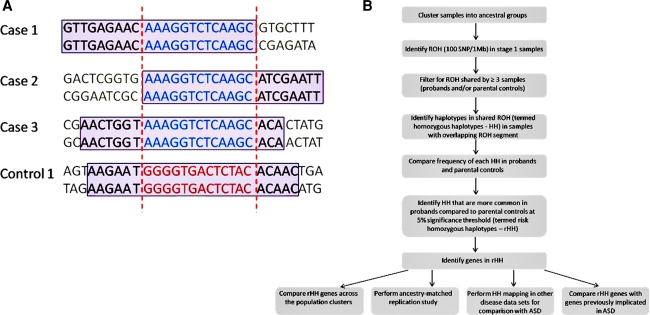
Fig. 1
Fig. 1
The principles and analytical approach of homozygous haplotype mapping. a The schematic outlines the principle of homozygous haplotype (HH) mapping. SNP genotype data is collected on each case and control. Homozygous and heterozygous SNPs are shown in black and grey respectively. Firstly, runs of homozygosity (ROH) are identified in the samples (outlined in purple boxes). The overlapping ROH region shared by a minimum of three individuals (shown between red dashed lines) is considered for the HH analysis. The haplotypes within the overlapping ROH region are identified and a Fisher’s exact test applied to determine if a particular HH is significantly more common in ASD cases compared to parental controls. Only the haplotypes of those individuals who have an ROH in the region in question are considered. In the above example all four individuals (3 ASD cases and 1 parental control) have an overlapping ROH. However, the haplotype in the overlapping ROH may differ. The 3 ASD cases have haplotype A (blue) while the parental control has haplotype B (red). Haplotype A is shared at a higher frequency in ASD cases compared to parental controls (apply Fisher’s test) and is termed a risk homozygous haplotype (rHH). This is an example of a rHH that is specific to ASD probands; b Flowchart of homozygous haplotype analysis of ASD cohort. The discovery analysis was performed on 1,402 AGP trios from the AGP stage 1 collection. The replication study involved an additional 1,182 AGP trios from the stage 2 collection. The stage 1 and 2 samples were clustered together to (1) separate stage 1 and 2 individuals into population clusters of similar ancestry and (2) classify stage 2 individuals into the joint ancestry-matched population clusters for the stage 2 replication study. The same rHH mapping strategy was applied to the discovery (stage 1) and replication (stage 2) data sets independently. The genes located in homozygous haplotypes significantly more common in ASD cases compared to parental controls were identified in each analysis. The rHH candidate genes were then compared for the ancestry-matched groups that had at least 50 probands in both the discovery and replication sample sets. To assess the contribution of genomic architecture to the rHH findings in ASD, the same strategy was applied to two additional disease data sets; bipolar disorder (BD) and coronary artery disease (CAD). The location of the rHH in ASD, BD and CAD were compared
Fig. 2
Fig. 2
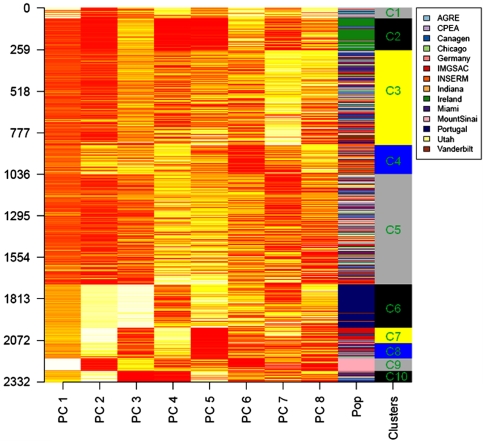
Genetic ancestry of AGP sample set. Principal component analysis (PCA) of 2,584 ASD proband samples (discovery stage 1 = 1,402 samples, replication stage 2 = 1,182 samples) was performed in EIGENSOFT. Tracy–Widom statistics indicated that the first eight principal components (PCs) were significantly contributing to the genetic variation of the sample set (Supplementary Table 2). The Hopach hierarchical clustering algorithm was applied to eigenvalues (y-axis) from the first eight PCs (x-axis) (van der Laan and Pollard 2002). In the ‘Pop’ column each sample is coloured according to the AGP site at which it was collected (see legend). Hopach clustering, non-parametric bootstrapping and genetic distance calculations (Supplementary Table 3) identified ten ancestral population clusters labelled C1 to C10. The five population clusters with a minimum of 50 probands (C2–C6) were used in the discovery analysis (n = 1,019 trios)
Fig. 3
Fig. 3
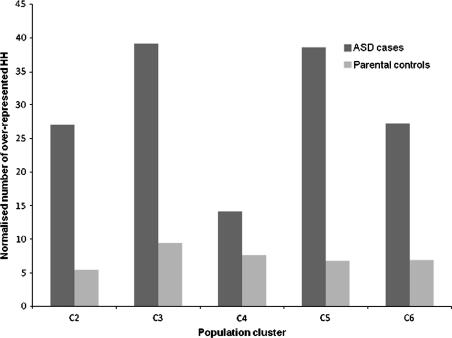
Comparison of HH sharing in ASD cases and parental controls. The normalised number of rHH (HH that are more common in one group compared to the other) in five population clusters with a minimum of 50 probands. The dark grey bars represent the number of HH that are more common (Fisher’s exact test right p value <0.05) in ASD probands compared to parental controls. Such regions are referred to as rHH throughout the paper. The light grey bars denote the number of HH that are more common (Fisher’s exact test left p value <0.05) in parental controls compared to ASD probands. To account for differences in sample size, counts have been normalised to a group of 100 samples (Supplementary Material 1). The number of rHH identified in ASD probands is significantly greater than the number of rHH identified in parental controls across the five population clusters (paired t test p value = 0.008)
Fig. 4
Fig. 4
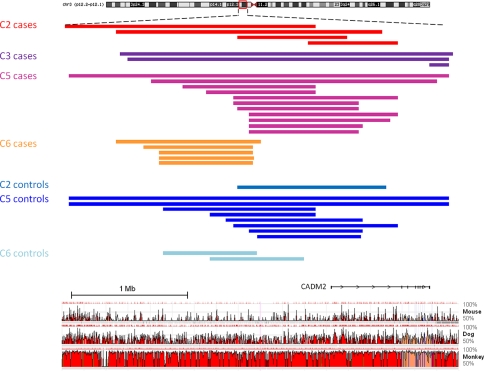
rHH identified in four population clusters in the vicinity of CADM2. An rHH located in a non-coding evolutionary-conserved region on 3p12.1 was identified in four of the five population clusters. The coloured bars represent the run of homozygosity in each patient/parental control carrying the rHH. For each population cluster, the rHH is the shared ROH segment. The ROH profile is presented with a conservation plot (ECR browser; conservation throughout mouse, dog and rhesus monkey of fragments >350 bp at 75% identity indicated in red). rHH adjacent to CADM2 were identified in 23/1019 ASD cases and 11/2031 parental controls [Yates’ corrected χ2 p value = 1.9 × 10−5, OR = 4.26 (2.1, 8.6)]

References

    1. Arking DE, Cutler DJ, Brune CW, Teslovich TM, West K, Ikeda M, Rea A, Guy M, Lin S, Cook EH, Chakravarti A. A common genetic variant in the neurexin superfamily member CNTNAP2 increases familial risk of autism. Am J Hum Genet. 2008;82:160–164. doi: 10.1016/j.ajhg.2007.09.015. - DOI - PMC - PubMed
    1. Bahlo M, Stankovich J, Speed TP, Rubio JP, Burfoot RK, Foote SJ. Detecting genome wide haplotype sharing using SNP or microsatellite haplotype data. Hum Genet. 2006;119:38–50. doi: 10.1007/s00439-005-0114-9. - DOI - PubMed
    1. Barrett JC, Fry B, Maller J, Daly MJ. Haploview: analysis and visualization of LD and haplotype maps. Bioinformatics. 2005;21:263–265. doi: 10.1093/bioinformatics/bth457. - DOI - PubMed
    1. Benko S, Fantes JA, Amiel J, Kleinjan DJ, Thomas S, Ramsay J, Jamshidi N, Essafi A, Heaney S, Gordon CT, McBride D, Golzio C, Fisher M, Perry P, Abadie V, Ayuso C, Holder-Espinasse M, Kilpatrick N, Lees MM, Picard A, Temple IK, Thomas P, Vazquez MP, Vekemans M, Roest Crollius H, Hastie ND, Munnich A, Etchevers HC, Pelet A, Farlie PG, Fitzpatrick DR, Lyonnet S. Highly conserved non-coding elements on either side of SOX9 associated with Pierre Robin sequence. Nat Genet. 2009;41:359–364. doi: 10.1038/ng.329. - DOI - PubMed
    1. Betancur C, Sakurai T, Buxbaum JD. The emerging role of synaptic cell-adhesion pathways in the pathogenesis of autism spectrum disorders. Trends Neurosci. 2009;32:402–412. doi: 10.1016/j.tins.2009.04.003. - DOI - PMC - PubMed

Publication types

Grants and funding