


Birth weight and prenatal exposure to polychlorinated biphenyls (PCBs) and dichlorodiphenyldichloroethylene (DDE): a meta-analysis within 12 European Birth Cohorts
- PMID: 21997443
- PMCID: PMC3279442
- DOI: 10.1289/ehp.1103767
Birth weight and prenatal exposure to polychlorinated biphenyls (PCBs) and dichlorodiphenyldichloroethylene (DDE): a meta-analysis within 12 European Birth Cohorts
Abstract
Objectives: Exposure to high concentrations of persistent organochlorines may cause fetal toxicity, but the evidence at low exposure levels is limited. Large studies with substantial exposure contrasts and appropriate exposure assessment are warranted. Within the framework of the EU (European Union) ENRIECO (ENvironmental Health RIsks in European Birth Cohorts) and EU OBELIX (OBesogenic Endocrine disrupting chemicals: LInking prenatal eXposure to the development of obesity later in life) projects, we examined the hypothesis that the combination of polychlorinated biphenyls (PCBs) and dichlorodiphenyldichloroethylene (DDE) adversely affects birth weight.
Methods: We used maternal and cord blood and breast milk samples of 7,990 women enrolled in 15 study populations from 12 European birth cohorts from 1990 through 2008. Using identical variable definitions, we performed for each cohort linear regression of birth weight on estimates of cord serum concentration of PCB-153 and p,p´-DDE adjusted for gestational age and a priori selected covariates. We obtained summary estimates by meta-analysis and performed analyses of interactions.
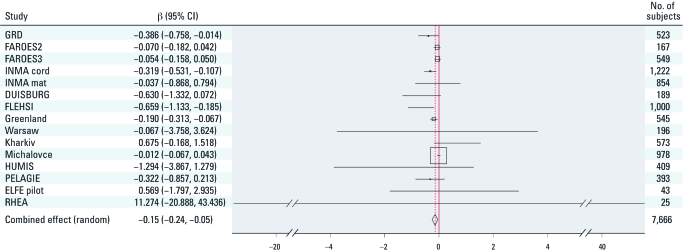
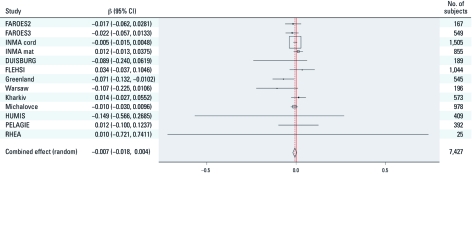
Results: The median concentration of cord serum PCB-153 was 140 ng/L (range of cohort medians 20-484 ng/L) and that of p,p´-DDE was 528 ng/L (range of cohort medians 50-1,208 ng/L). Birth weight decreased with increasing cord serum concentration of PCB-153 after adjustment for potential confounders in 12 of 15 study populations. The meta-analysis including all cohorts indicated a birth weight decline of 150 g [95% confidence interval (CI): -250, -50 g] per 1-µg/L increase in PCB-153, an exposure contrast that is close to the range of exposures across the cohorts. A 1-µg/L increase in p,p´-DDE was associated with a 7-g decrease in birth weight (95% CI: -18, 4 g).
Conclusions: The findings suggest that low-level exposure to PCB (or correlated exposures) impairs fetal growth, but that exposure to p,p´-DDE does not. The study adds to mounting evidence that low-level exposure to PCBs is inversely associated with fetal growth.
Conflict of interest statement
The authors declare they have no actual or potential competing financial interests.
Figures
References
-
- Aneck-Hahn NH, Schulenburg GW, Bornman MS, Farias P, de Jager C. Impaired semen quality associated with environmental DDT exposure in young men living in a malaria area in the Limpopo Province, South Africa. J Androl. 2007;28:423–434. - PubMed
-
- Ayotte P, Giroux S, Dewailly É, Hernandez AM, Farias P, Danis R, et al. DDT spraying for malaria control and reproductive function in Mexican men. Epidemiology. 2001;12(3):366–367. - PubMed
-
- Bailey BA, Byrom AR. Factors predicting birth weight in a low-risk sample: the role of modifiable pregnancy health behaviors. Matern Child Health J. 2007;11:173–179. - PubMed
-
- Blazer S, Moreh-Waterman Y, Miller-Lotan R, Tamir A, Hochberg Z. Maternal hypothyroidism may affect fetal growth and neonatal thyroid function. Obstet Gynecol. 2003;102(2):232–241. - PubMed
Publication types
MeSH terms
Substances
LinkOut - more resources
Full Text Sources
Medical
Research Materials
Miscellaneous