


Treatment of early postoperative infections after THA: a decision analysis
- PMID: 21997783
- PMCID: PMC3210286
- DOI: 10.1007/s11999-011-2119-0
Treatment of early postoperative infections after THA: a decision analysis
Abstract
Background: The treatment for an early postoperative periprosthetic infection after cementless THA that results in the highest quality of life after the control of infection is unknown. Although common treatments include irrigation and débridement with component retention, a one-stage exchange, or a two-stage exchange, it is unclear whether any of these provides a higher quality of life after the control of infection.
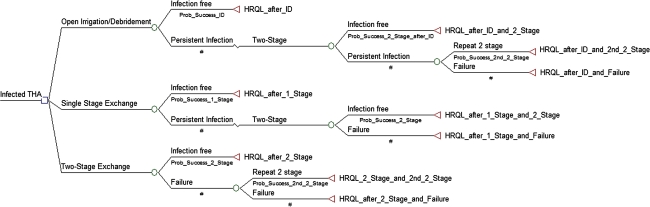
Questions/purposes: We projected, through decision-analysis modeling, the possible estimated final health states defined as health-related quality of life based on quality-of-life studies of an early postoperative periprosthetic infection after cementless THA treated by irrigation and débridement, one-stage exchange, or two-stage exchange.
Methods: Publications addressing early postoperative infections after THA were analyzed for the estimated rate of infection control and quality-of-life measures after a specific treatment. Decision analysis was used to model the different treatments and describe which, if any, treatment results in the greatest quality of life after early THA infection.
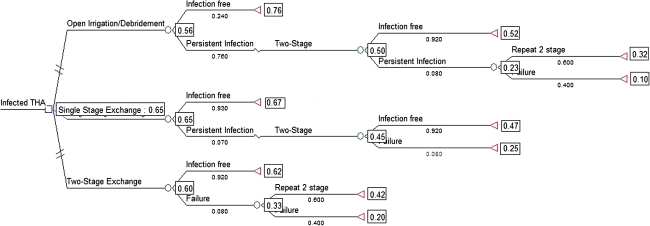
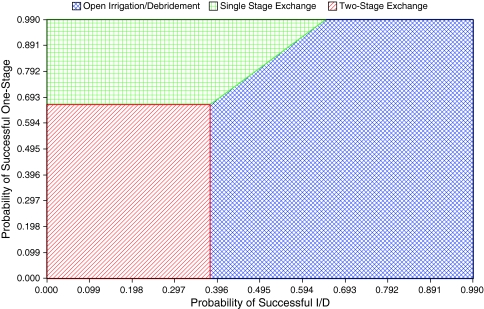
Results: In the model, a one-stage exchange was the treatment for early THA infection that maximized quality-of-life outcomes if the probability of controlling the infection exceeded 66% with this procedure. If the probability of infection control of a one-stage exchange was less than 66% or that of irrigation and débridement was greater than 60%, then irrigation and débridement appeared to result in the greatest quality-of-life outcome.
Conclusions: A decision analysis using estimates of infection control rate and quality-of-life outcomes after different treatments for an early postoperative infection after THA showed possible outcomes for each treatment.
Level of evidence: Level II, economic and decision analyses. See Guidelines for Authors for a complete description of levels of evidence.
Figures
Comment in
-
Letter to the editor: Treatment of early postoperative infections after THA: a decision analysis.Clin Orthop Relat Res. 2012 Jun;470(6):1792; author reply 1793-4. doi: 10.1007/s11999-012-2359-7. Clin Orthop Relat Res. 2012. PMID: 22528387 Free PMC article. No abstract available.
References
-
- Bratzler DW, Houck PM; Surgical Infection Prevention Guidelines Writers Workgroup; American Academy of Orthopaedic Surgeons; American Association of Critical Care Nurses; American Association of Nurse Anesthetists; American College of Surgeons; American College of Osteopathic Surgeons; American Geriatrics Society; American Society of Anesthesiologists; American Society of Colon and Rectal Surgeons; American Society of Health-System Pharmacists; American Society of PeriAnesthesia Nurses; Ascension Health; Association of periOperative Registered Nurses; Association for Professionals in Infection Control and Epidemiology; Infectious Diseases Society of America; Medical Letter; Premier; Society for Healthcare Epidemiology of America; Society of Thoracic Surgeons; Surgical Infection Society. Antimicrobial prophylaxis for surgery: an advisory statement from the National Surgical Infection Prevention Project. Clin Infect Dis. 2004;38:1706–1715. - PubMed
MeSH terms
LinkOut - more resources
Full Text Sources
Medical
Research Materials
