


A novel aldehyde dehydrogenase-3 activator leads to adult salivary stem cell enrichment in vivo
- PMID: 21998334
- PMCID: PMC3544360
- DOI: 10.1158/1078-0432.CCR-11-0179
A novel aldehyde dehydrogenase-3 activator leads to adult salivary stem cell enrichment in vivo
Abstract
Purpose: To assess aldehyde dehydrogenase (ALDH) expression in adult human and murine submandibular gland (SMG) stem cells and to determine the effect of ALDH3 activation in SMG stem cell enrichment.
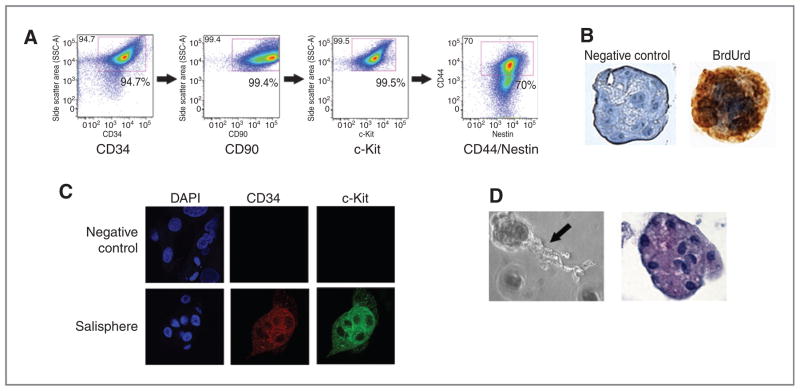
Experimental design: Adult human and murine SMG stem cells were selected by cell surface markers (CD34 for human and c-Kit for mouse) and characterized for various other stem cell surface markers by flow cytometry and ALDH isozymes expression by quantitative reverse transcriptase PCR. Sphere formation and bromodeoxyuridine (BrdUrd) incorporation assays were used on selected cells to confirm their renewal capacity and three-dimensional (3D) collagen matrix culture was applied to observe differentiation. To determine whether ALDH3 activation would increase stem cell yield, adult mice were infused with a novel ALDH3 activator (Alda-89) or with vehicle followed by quantification of c-Kit(+)/CD90(+) SMG stem cells and BrdUrd(+) salispheres.
Results: More than 99% of CD34(+) huSMG stem cells stained positive for c-Kit, CD90 and 70% colocalized with CD44, Nestin. Similarly, 73.8% c-Kit(+) mSMG stem cells colocalized with Sca-1, whereas 80.7% with CD90. Functionally, these cells formed BrdUrd(+) salispheres, which differentiated into acinar- and ductal-like structures when cultured in 3D collagen. Both adult human and murine SMG stem cells showed higher expression of ALDH3 than in their non-stem cells and 84% of these cells have measurable ALDH1 activity. Alda-89 infusion in adult mice significantly increased c-Kit(+)/CD90(+) SMG population and BrdUrd(+) sphere formation compared with control.
Conclusion: This is the first study to characterize expression of different ALDH isozymes in SMG stem cells. In vivo activation of ALDH3 can increase SMG stem cell yield, thus providing a novel means for SMG stem cell enrichment for future stem cell therapy.
©2011 AACR.
Conflict of interest statement
No potential conflicts of interest were disclosed.
Figures


References
-
- Cotrim AP, Sowers AL, Lodde BM, Vitolo JM, Kingman A, Russo A, et al. Kinetics of tempol for prevention of xerostomia following head and neck irradiation in a mouse model. Clin Cancer Res. 2005;11:7564–8. - PubMed
-
- Tran SD, Wang J, Bandyopadhyay BC, Redman RS, Dutra A, Pak E, et al. Primary culture of polarized human salivary epithelial cells for use in developing an artificial salivary gland. Tissue Eng. 2005;11:172–81. - PubMed
-
- Lombaert IM, Wierenga PK, Kok T, Kampinga HH, deHaan G, Coppes RP. Mobilization of bone marrow stem cells by granulocyte colony-stimulating factor ameliorates radiation-induced damage to salivary glands. Clin Cancer Res. 2006;12:1804–12. - PubMed
Publication types
MeSH terms
Substances
Grants and funding
LinkOut - more resources
Full Text Sources
Other Literature Sources
Research Materials
Miscellaneous
