


Economic returns to investment in AIDS treatment in low and middle income countries
- PMID: 21998648
- PMCID: PMC3187775
- DOI: 10.1371/journal.pone.0025310
Economic returns to investment in AIDS treatment in low and middle income countries
Abstract
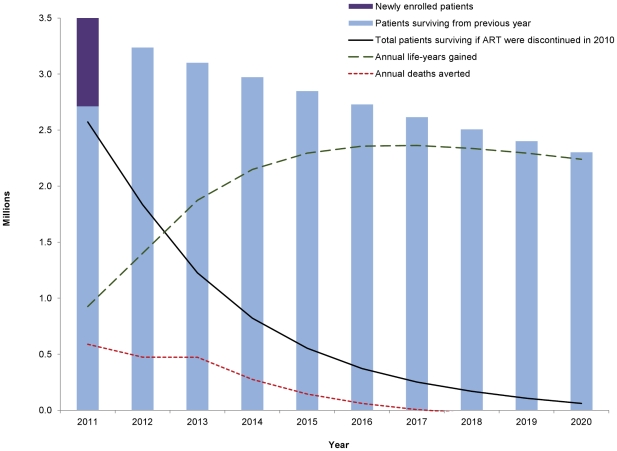
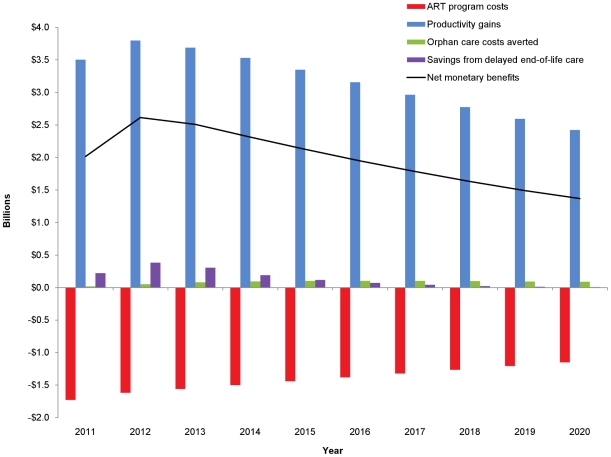
Since the early 2000s, aid organizations and developing country governments have invested heavily in AIDS treatment. By 2010, more than five million people began receiving antiretroviral therapy (ART)--yet each year, 2.7 million people are becoming newly infected and another two million are dying without ever having received treatment. As the need for treatment grows without commensurate increase in the amount of available resources, it is critical to assess the health and economic gains being realized from increasingly large investments in ART. This study estimates total program costs and compares them with selected economic benefits of ART, for the current cohort of patients whose treatment is cofinanced by the Global Fund to Fight AIDS, Tuberculosis and Malaria. At end 2011, 3.5 million patients in low and middle income countries will be receiving ART through treatment programs cofinanced by the Global Fund. Using 2009 ART prices and program costs, we estimate that the discounted resource needs required for maintaining this cohort are $14.2 billion for the period 2011-2020. This investment is expected to save 18.5 million life-years and return $12 to $34 billion through increased labor productivity, averted orphan care, and deferred medical treatment for opportunistic infections and end-of-life care. Under alternative assumptions regarding the labor productivity effects of HIV infection, AIDS disease, and ART, the monetary benefits range from 81 percent to 287 percent of program costs over the same period. These results suggest that, in addition to the large health gains generated, the economic benefits of treatment will substantially offset, and likely exceed, program costs within 10 years of investment.
Conflict of interest statement
Figures
References
-
- UNAIDS. Global Report: UNAIDS report on the global AIDS epidemic. 2010. Available: http://www.unaids.org/globalreport/Global_report.htm Accessed: 2011 September 13.
-
- World Health Organization. Antiretroviral therapy for HIV infection in adults and adolescents – recommendations for a public health approach. 2010. Available: http://whqlibdoc.who.int/publications/2010/9789241599764_eng.pdf Accessed: 2011 August 4. - PubMed
-
- World Health Organization HIV/AIDS Programme, UNAIDS, UNICEF. Towards Universal Access: Scaling up priority HIV/AIDS interventions in the health sector. Geneva: World Health Organization; 2010.
-
- UNAIDS. AIDS epidemic update : November 2009. Geneva: UNAIDS; 2009.
-
- Bishai D, Colchero A, Durack DT. The cost effectiveness of antiretroviral treatment strategies in resource-limited settings. AIDS. 2007;21:1333–1340. - PubMed
Publication types
MeSH terms
Substances
LinkOut - more resources
Full Text Sources
Medical
