


Contralateral cruciate survival in dogs with unilateral non-contact cranial cruciate ligament rupture
- PMID: 21998650
- PMCID: PMC3187768
- DOI: 10.1371/journal.pone.0025331
Contralateral cruciate survival in dogs with unilateral non-contact cranial cruciate ligament rupture
Abstract
Background: Non-contact cranial cruciate ligament rupture (CrCLR) is an important cause of lameness in client-owned dogs and typically occurs without obvious injury. There is a high incidence of bilateral rupture at presentation or subsequent contralateral rupture in affected dogs. Although stifle synovitis increases risk of contralateral CrCLR, relatively little is known about risk factors for subsequent contralateral rupture, or whether therapeutic intervention may modify this risk.
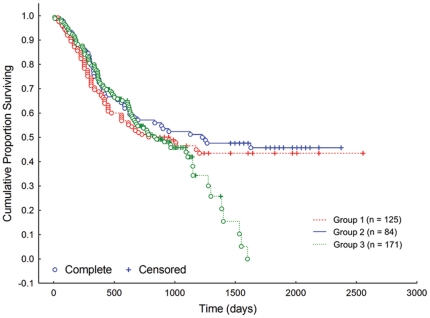
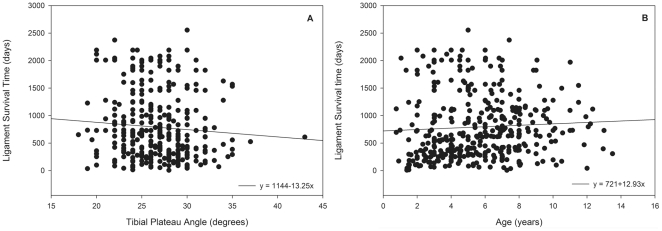
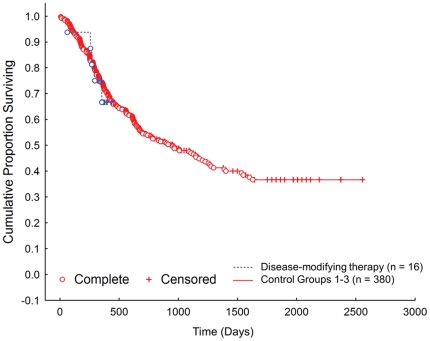
Methodology/principal findings: We conducted a longitudinal study examining survival of the contralateral CrCL in client-owned dogs with unilateral CrCLR in a large baseline control population (n = 380), and a group of dogs that received disease-modifying therapy with arthroscopic lavage, intra-articular hyaluronic acid and oral doxycycline (n = 16), and were followed for one year. Follow-up in treated dogs included analysis of mobility, radiographic evaluation of stifle effusion and arthritis, and quantification of biomarkers of synovial inflammation. We found that median survival of the contralateral CrCL was 947 days. Increasing tibial plateau angle decreased contralateral ligament survival, whereas increasing age at diagnosis increased survival. Contralateral ligament survival was reduced in neutered dogs. Our disease-modifying therapy did not significantly influence contralateral ligament survival. Correlative analysis of clinical and biomarker variables with development of subsequent contralateral rupture revealed few significant results. However, increased expression of T lymphocyte-associated genes in the index unstable stifle at diagnosis was significantly related to development of subsequent non-contact contralateral CrCLR.
Conclusion: Subsequent contralateral CrCLR is common in client-owned dogs, with a median ligament survival time of 947 days. In this naturally occurring model of non-contact cruciate ligament rupture, cranial tibial translation is preceded by development of synovial inflammation. However, treatment with arthroscopic lavage, intra-articular hyaluronic acid and oral doxycycline does not significantly influence contralateral CrCL survival.
Conflict of interest statement
Figures
References
-
- Wilke VL, Robinson DA, Evans RB, Rothschild MF, Conzemius MG. Estimate of the annual economic impact of treatment of cranial cruciate ligament injury in dogs in the United States. J Am Vet Med Assoc. 2005;227:1604–1607. - PubMed
-
- Cabrera SY, Owen TJ, Mueller MG, Kass PH. Comparison of tibial plateau angles in dogs with unilateral versus bilateral cranial cruciate ligament rupture: 150 cases (2000–2006). J Am Vet Med Assoc. 2008;232:889–892. - PubMed
-
- Buote N, Fusco J, Radasch R. Age, tibial plateau angle, sex, and weight as risk factors for contralateral rupture of the cranial cruciate ligament in Labradors. Vet Surg. 2009;38:481–489. - PubMed
-
- Hayashi K, Manley PA, Muir P. Cranial cruciate ligament pathophysiology in dogs with cruciate disease: a review. J Am Anim Hosp Assoc. 2004;40:385–390. - PubMed
-
- de Bruin T, de Rooster H, Bosmans T, Duchateau L, van Bree H, et al. Radiographic assessment of the progression of osteoarthrosis in the contralateral stifle joint of dogs with a ruptured cranial cruciate ligament. Vet Rec. 2007;161:745–750. - PubMed
Publication types
MeSH terms
Substances
LinkOut - more resources
Full Text Sources
Other Literature Sources
Molecular Biology Databases
