


Age-specific incidence data indicate four mutations are required for human testicular cancers
- PMID: 21998737
- PMCID: PMC3188587
- DOI: 10.1371/journal.pone.0025978
Age-specific incidence data indicate four mutations are required for human testicular cancers
Abstract
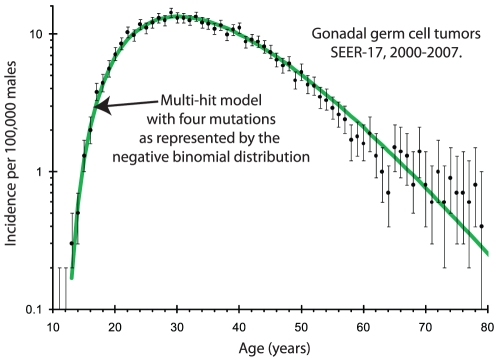
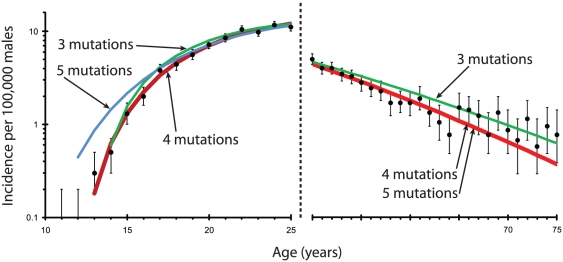
Normal human cells require a series of genetic alterations to undergo malignant transformation. Direct sequencing of human tumors has identified hundreds of mutations in tumors, but many of these are thought to be unnecessary and a result of, rather than a cause of, the tumor. The exact number of mutations to transform a normal human cell into a tumor cell is unknown. Here I show that male gonadal germ cell tumors, the most common form of testicular cancers, occur after four mutations. I infer this by constructing a mathematical model based upon the multi-hit hypothesis and comparing it to the age-specific incidence data. This result is consistent with the multi-hit hypothesis, and implies that these cancers are genetically or epigenetically predetermined at birth or an early age.
Conflict of interest statement
Figures
References
-
- Fearon ER, Hamilton SR, Vogelstein B. Clonal analysis of human colorectal tumors. Science. 1987;238:193–197. - PubMed
-
- Fearon ER, Vogelstein B. A genetic model for colorectal tumorigenesis. Cell. 1990;61:759–767. - PubMed
-
- Vogelstein B, Kinzler KW. The multistep nature of cancer. Trends Genet. 1993;9:138–141. - PubMed
-
- Hanahan D, Weinberg RA. The hallmarks of cancer. Cell. 2000;100:57–70. - PubMed
-
- Hahn WC, Weinberg RA. Modelling the molecular circuitry of cancer. Nat Rev Cancer. 2002;2:331–341. - PubMed
