


Changes in magnetic resonance imaging disease measures over 3 years in mildly disabled patients with relapsing-remitting multiple sclerosis receiving interferon β-1a in the COGnitive Impairment in MUltiple Sclerosis (COGIMUS) study
- PMID: 21999142
- PMCID: PMC3214173
- DOI: 10.1186/1471-2377-11-125
Changes in magnetic resonance imaging disease measures over 3 years in mildly disabled patients with relapsing-remitting multiple sclerosis receiving interferon β-1a in the COGnitive Impairment in MUltiple Sclerosis (COGIMUS) study
Abstract
Background: Conventional magnetic resonance imaging (MRI) has improved the diagnosis and monitoring of multiple sclerosis (MS). In clinical trials, MRI has been found to detect treatment effects with greater sensitivity than clinical measures; however, clinical and MRI outcomes tend to correlate poorly.
Methods: In this observational study, patients (n = 550; 18-50 years; relapsing-remitting MS [Expanded Disability Status Scale score ≤4.0]) receiving interferon (IFN) β-1a therapy (44 or 22 µg subcutaneously [sc] three times weekly [tiw]) underwent standardized MRI, neuropsychological and quality-of-life (QoL) assessments over 3 years. In this post hoc analysis, MRI outcomes and correlations between MRI parameters and clinical and functional outcomes were analysed.
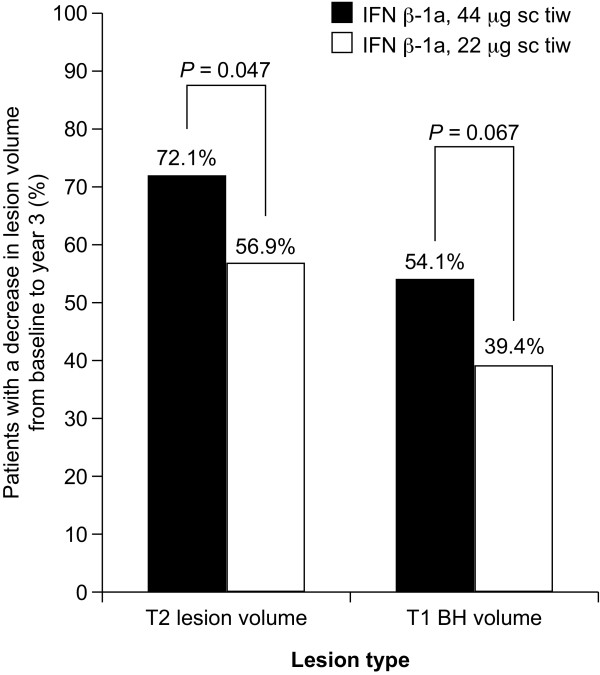
Results: MRI data over 3 years were available for 164 patients. T2 lesion and T1 gadolinium-enhancing (Gd+) lesion volumes, but not black hole (BH) volumes, decreased significantly from baseline to Year 3 (P < 0.0001). Percentage decreases (baseline to Year 3) were greater with the 44 μg dose than with the 22 μg dose for T2 lesion volume (-10.2% vs -4.5%, P = 0.025) and T1 BH volumes (-7.8% vs +10.3%, P = 0.002). A decrease in T2 lesion volume over 3 years predicted stable QoL over the same time period. Treatment with IFN β-1a, 44 μg sc tiw, predicted an absence of cognitive impairment at Year 3.
Conclusion: Subcutaneous IFN β-1a significantly decreased MRI measures of disease, with a significant benefit shown for the 44 µg over the 22 µg dose; higher-dose treatment also predicted better cognitive outcomes over 3 years.
Figures
References
-
- McDonald WI, Compston A, Edan G, Goodkin D, Hartung HP, Lublin FD, McFarland HF, Paty DW, Polman CH, Reingold SC, Sandberg-Wollheim M, Sibley W, Thompson A, van den Noort S, Weinshenker BY, Wolinsky JS. Recommended diagnostic criteria for multiple sclerosis: guidelines from the International Panel on the Diagnosis of Multiple Sclerosis. Ann Neurol. 2001;50:121–127. doi: 10.1002/ana.1032. - DOI - PubMed
-
- IFNB Multiple Sclerosis Study Group. Interferon beta-1b is effective in relapsing-remitting multiple sclerosis. I Clinical results of a multicenter, randomized, double-blind, placebo-controlled trial. Neurology. 1993;43:655–661. - PubMed
-
- Johnson KP, Brooks BR, Cohen JA, Ford CC, Goldstein J, Lisak RP, Myers LW, Panitch HS, Rose JW, Schiffer RB. Copolymer 1 reduces relapse rate and improves disability in relapsing-remitting multiple sclerosis: results of a phase III multicenter, double-blind placebo-controlled trial. Neurology. 1995;45:1268–1276. - PubMed
-
- Li DK, Paty DW. UBC MS/MRI Analysis Research Group, PRISMS Study Group. Magnetic resonance imaging results of the PRISMS trial: a randomized, double-blind, placebo-controlled study of interferon-beta1a in relapsing-remitting multiple sclerosis. Ann Neurol. 1999;46:197–206. doi: 10.1002/1531-8249(199908)46:2<197::AID-ANA9>3.0.CO;2-P. - DOI - PubMed
-
- Simon JH, Jacobs LD, Campion M, Wende K, Simonian N, Cookfair DL, Rudick RA, Herndon RM, Richert JR, Salazar AM, Alam JJ, Fischer JS, Goodkin DE, Granger CV, Lajaunie M, Martens-Davidson AL, Meyer M, Sheeder J, Choi K, Scherzinger AL, Bartoszak DM, Bourdette DN, Braiman J, Brownscheidle CM, Whitham RH. Magnetic resonance studies of intramuscular interferon beta-1a for relapsing multiple sclerosis. Ann Neurol. 1998;43:79–87. doi: 10.1002/ana.410430114. - DOI - PubMed
Publication types
MeSH terms
Substances
LinkOut - more resources
Full Text Sources
Medical
