


Which dressing do donor site wounds need?: study protocol for a randomized controlled trial
- PMID: 21999705
- PMCID: PMC3219559
- DOI: 10.1186/1745-6215-12-229
Which dressing do donor site wounds need?: study protocol for a randomized controlled trial
Abstract
Background: Donor site wounds after split-skin grafting are rather 'standard' wounds. At present, lots of dressings and topical agents for donor site wounds are commercially available. This causes large variation in the local care of these wounds, while the optimum 'standard' dressing for local wound care is unclear. This protocol describes a trial in which we investigate the effectiveness of various treatment options for these donor site wounds.
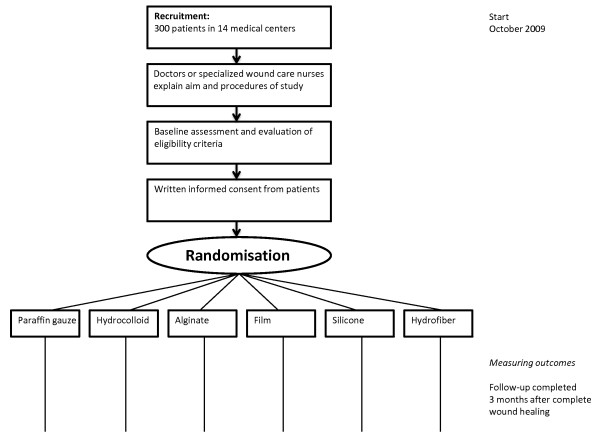
Methods: A 14-center, six-armed randomized clinical trial is being carried out in the Netherlands. An a-priori power analysis and an anticipated dropout rate of 15% indicates that 50 patients per group are necessary, totaling 300 patients, to be able to detect a 25% quicker mean time to complete wound healing. Randomization has been computerized to ensure allocation concealment. Adult patients who need a split-skin grafting operation for any reason, leaving a donor site wound of at least 10 cm2 are included and receive one of the following dressings: hydrocolloid, alginate, film, hydrofiber, silicone dressing, or paraffin gauze. No combinations of products from other intervention groups in this trial are allowed. Optimum application and changes of these dressings are pursued according to the protocol as supplied by the dressing manufacturers. Primary outcomes are days to complete wound healing and pain (using a Visual Analogue Scale). Secondary outcomes are adverse effects, scarring, patient satisfaction, and costs. Outcome assessors unaware of the treatment allocation will assess whether or not an outcome has occurred. Results will be analyzed according to the intention to treat principle. The first patient was randomized October 1, 2009.
Discussion: This study will provide comprehensive data on the effectiveness of different treatment options for donor site wounds. The dressing(s) that will prevail in effectiveness, satisfaction and costs will be promoted among clinicians dealing with such patients. Thus, we aim to contribute a well-designed trial, relevant to all clinicians involved in the care for donor site wounds, which will help enhance uniformity and quality of care for these patients.
Trial registration: http://www.trialregister.nl, NTR1849. Date registered: June 9, 2009.
References
Publication types
MeSH terms
LinkOut - more resources
Full Text Sources
Medical
