Multicenter Study
. 2011 Oct;17(10):1855-64.
doi: 10.3201/eid1710.110087.

Invasive non-Aspergillus mold infections in transplant recipients, United States, 2001-2006

Affiliations
Multicenter Study

Invasive non-Aspergillus mold infections in transplant recipients, United States, 2001-2006

Benjamin J Park et al. Emerg Infect Dis. 2011 Oct.

Abstract

Recent reports describe increasing incidence of non-Aspergillus mold infections in hematopoietic cell transplant (HCT) and solid organ transplant (SOT) recipients. To investigate the epidemiology of infections with Mucorales, Fusarium spp., and Scedosporium spp. molds, we analyzed data from the Transplant-Associated Infection Surveillance Network, 23 transplant centers that conducted prospective surveillance for invasive fungal infections during 2001-2006. We identified 169 infections (105 Mucorales, 37 Fusarium spp., and 27 Scedosporium spp.) in 169 patients; 124 (73.4%) were in HCT recipients, and 45 (26.6%) were in SOT recipients. The crude 90-day mortality rate was 56.6%. The 12-month mucormycosis cumulative incidence was 0.29% for HCT and 0.07% for SOT. Mucormycosis incidence among HCT recipients varied widely, from 0.08% to 0.69%, with higher incidence in cohorts receiving transplants during 2003 and 2004. Non-Aspergillus mold infections continue to be associated with high mortality rates. The incidence of mucormycosis in HCT recipients increased substantially during the surveillance period.


Figures
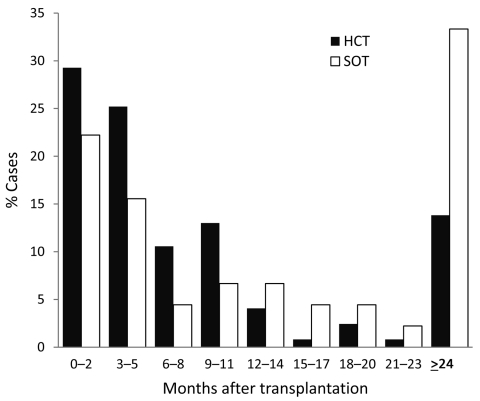
Figure 1
Figure 1
Months from transplant to development of invasive mucormycosis, fusariosis, or scedosporiosis among hematopoietic cell (HCT) and solid organ (SOT) transplant recipients as reported in the Transplant-Associated Infection Surveillance Network, United States, 2001–2006.
Figure 2
Figure 2
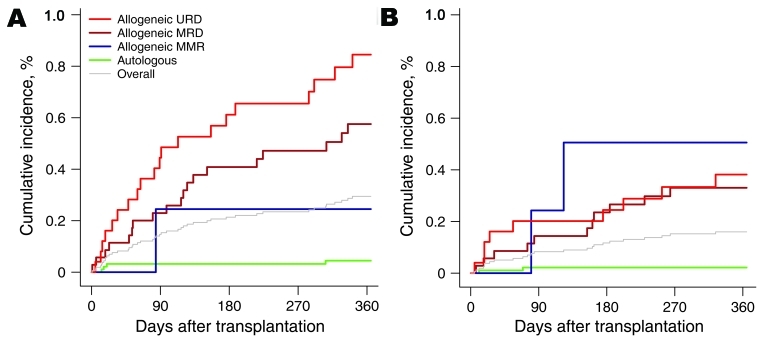
Twelve-month cumulative incidence for invasive A) Mucorales infections and B) combined Fusarium and Scedosporium spp. infections among donor types of hematopoietic cell transplant recipients reported in the Transplant-Associated Infection Surveillance Network, United States 2001–2006. Infection data by transplant type: allogenic URD, 2,483 patients, 20 with Mucorales infection, 9 with Fusarium or Scedosporium spp. infection; allogenic MRD, 3,499 patients, 19 with Mucorales infection, 11 with Fusarium or Scedosporium spp. infection; allogenic MMR, 427 patients, 1 with Mucorales infection, 2 with Fusarium or Scedosporium spp. infection; autologous, 9,326 patients, 4 with Mucorales infection, 2 with Fusarium or Scedosporium spp. infection; overall, 15,820 patients, 44 with Mucorales infection, 24 with Fusarium or Scedosporium spp. infection. URD, unrelated donor; MRD, matched related donor; MMR, mismatched related donor.
Figure 3
Figure 3
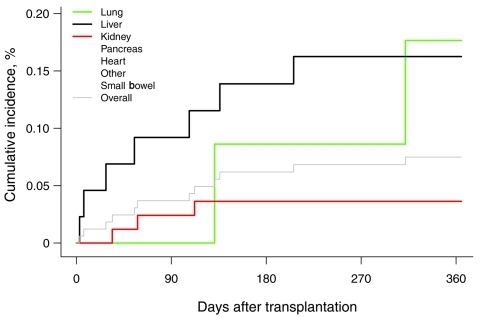
Twelve-month cumulative incidence for invasive Mucorales infections among solid organ transplant recipients reported in the Transplant-Associated Infection Surveillance Network, United States, 2001–2006. A total of 16,457 transplant patients had 12 Mucorales infections. Infection data by transplant type: lung, 1,179 patients, 2 with Mucorales infection; liver, 4,361 patients, 7 with Mucorales infection; kidney, 8,494 patients, 3 with Mucorales infection; pancreas, 1,174 patients, 0 with Mucorales infection; heart, 1,159 patients, 0 with Mucorales infection; other, 21 patients, 0 with Mucorales infection; small bowel, 69 patients, 0 with Mucorales infection.
Figure 4
Figure 4
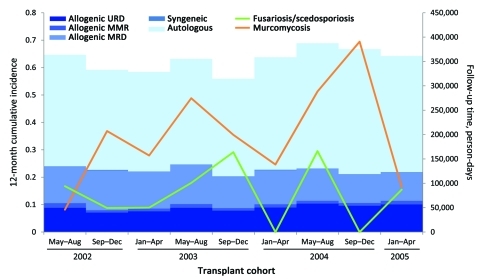
Changes in 12-month cumulative incidence for invasive Mucorales infections, compared with Fusarium and Scedosporium infections, reported in the Transplant-Associated Infection Surveillance Network, United States 2001–2005. Changes in the underlying hematopoietic cell transplant population, by transplant type, is shown for comparison. URD, unrelated donor; MMR, mismatched related donor; MRD, matched related donor.

References

    1. Husain S, Alexander BD, Munoz P, Avery RK, Houston S, Pruett T, et al. Opportunistic mycelial fungal infections in organ transplant recipients: emerging importance of non-Aspergillus mycelial fungi. Clin Infect Dis. 2003;37:221–9. 10.1086/375822 - DOI - PubMed
    1. Kontoyiannis DP, Lionakis MS, Lewis RE, Chamilos G, Healy M, Perego C, et al. Zygomycosis in a tertiary-care cancer center in the era of Aspergillus-active antifungal therapy: a case-control observational study of 27 recent cases [see comment]. J Infect Dis. 2005;191:1350–60. 10.1086/428780 - DOI - PubMed
    1. Marty FM, Cosimi LA, Baden LR. Breakthrough zygomycosis after voriconazole treatment in recipients of hematopoietic stem-cell transplants [comment]. N Engl J Med. 2004;350:950–2. 10.1056/NEJM200402263500923 - DOI - PubMed
    1. Trifilio SM, Bennett CL, Yarnold PR, McKoy JM, Parada J, Mehta J, et al. Breakthrough zygomycosis after voriconazole administration among patients with hematologic malignancies who receive hematopoietic stem-cell transplants or intensive chemotherapy. Bone Marrow Transplant. 2007;39:425–9. 10.1038/sj.bmt.1705614 - DOI - PubMed
    1. Kontoyiannis DP, Marr KA, Park BJ, Alexander BD, Anaissie EJ, Walsh TJ, et al. Prospective surveillance for invasive fungal infections in hematopoietic stem cell transplant recipients, 2001–2006: overview of the Transplant-Associated Infection Surveillance Network (TRANSNET) database. Clin Infect Dis. 2010;50:1091–100. 10.1086/651263 - DOI - PubMed

Publication types

Substances