


Genome-wide association study identifies susceptibility loci for dengue shock syndrome at MICB and PLCE1
- PMID: 22001756
- PMCID: PMC3223402
- DOI: 10.1038/ng.960
Genome-wide association study identifies susceptibility loci for dengue shock syndrome at MICB and PLCE1
Abstract
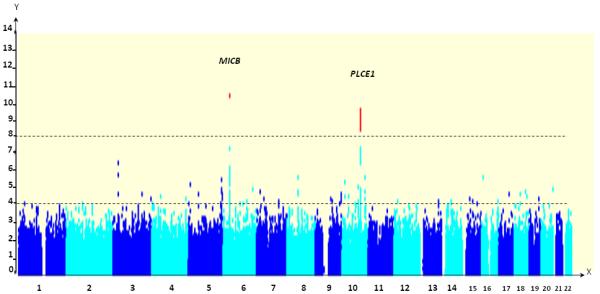
Hypovolemic shock (dengue shock syndrome (DSS)) is the most common life-threatening complication of dengue. We conducted a genome-wide association study of 2,008 pediatric cases treated for DSS and 2,018 controls from Vietnam. Replication of the most significantly associated markers was carried out in an independent Vietnamese sample of 1,737 cases and 2,934 controls. SNPs at two loci showed genome-wide significant association with DSS. We identified a susceptibility locus at MICB (major histocompatibility complex (MHC) class I polypeptide-related sequence B), which was within the broad MHC region on chromosome 6 but outside the class I and class II HLA loci (rs3132468, P(meta) = 4.41 × 10(-11), per-allele odds ratio (OR) = 1.34 (95% confidence interval: 1.23-1.46)). We identified associated variants within PLCE1 (phospholipase C, epsilon 1) on chromosome 10 (rs3765524, P(meta) = 3.08 × 10(-10), per-allele OR = 0.80 (95% confidence interval: 0.75-0.86)). We identify two loci associated with susceptibility to DSS in people with dengue, suggesting possible mechanisms for this severe complication of dengue.
Figures
References
-
- Thai KT, et al. Seroprevalence of dengue antibodies, annual incidence and risk factors among children in southern Vietnam. Trop Med Int Health. 2005;10:379–386. - PubMed
-
- Loke H, et al. Susceptibility to dengue hemorrhagic fever in vietnam: evidence of an association with variation in the vitamin d receptor and Fc gamma receptor IIa genes. Am J Trop Med Hyg. 2002;67:102–106. - PubMed
-
- Loke H, et al. Strong HLA class I--restricted T cell responses in dengue hemorrhagic fever: a double-edged sword? J Infect Dis. 2001;184:1369–1373. - PubMed
Publication types
MeSH terms
Substances
Grants and funding
LinkOut - more resources
Full Text Sources
Other Literature Sources
Medical
Molecular Biology Databases
Research Materials
