Review
. 2012 Mar;69(6):857-96.
doi: 10.1007/s00018-011-0844-x. Epub 2011 Oct 16.

The dynorphin/κ-opioid receptor system and its role in psychiatric disorders

Affiliations
Review

The dynorphin/κ-opioid receptor system and its role in psychiatric disorders

H A Tejeda et al. Cell Mol Life Sci. 2012 Mar.

Abstract

The dynorphin/κ-opioid receptor system has been implicated in the pathogenesis and pathophysiology of several psychiatric disorders. In the present review, we present evidence indicating a key role for this system in modulating neurotransmission in brain circuits that subserve mood, motivation, and cognitive function. We overview the pharmacology, signaling, post-translational, post-transcriptional, transcriptional, epigenetic and cis regulation of the dynorphin/κ-opioid receptor system, and critically review functional neuroanatomical, neurochemical, and pharmacological evidence, suggesting that alterations in this system may contribute to affective disorders, drug addiction, and schizophrenia. We also overview the dynorphin/κ-opioid receptor system in the genetics of psychiatric disorders and discuss implications of the reviewed material for therapeutics development.


Conflict of interest statement

The authors state that they have no conflicts of interest.

Figures
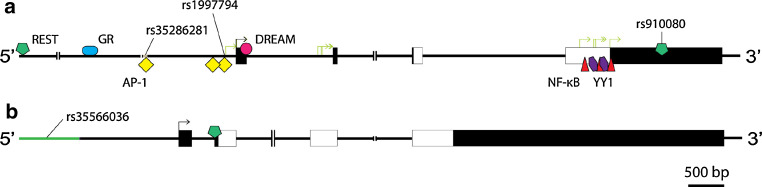
Fig. 1
Fig. 1
To scale schematics of PDYN (a) and OPRK1 (b). Shown are functional sequence variants associated with psychiatric disorders (e.g., rs35286281) and transcriptional control proteins implicated in the regulation of these genes (positioned relative to the transcription start sites). Transcriptional control proteins for which there is in vivo evidence of binding are depicted above the sequence (e.g., REST), and those for which only in vitro evidence is available below the sequence (e.g., AP-1). ║ genomic regions omitted for clarity, boxes exons, white boxes coding regions, black arrows transcription start sites, green arrows alternative transcription start sites
Fig. 2
Fig. 2
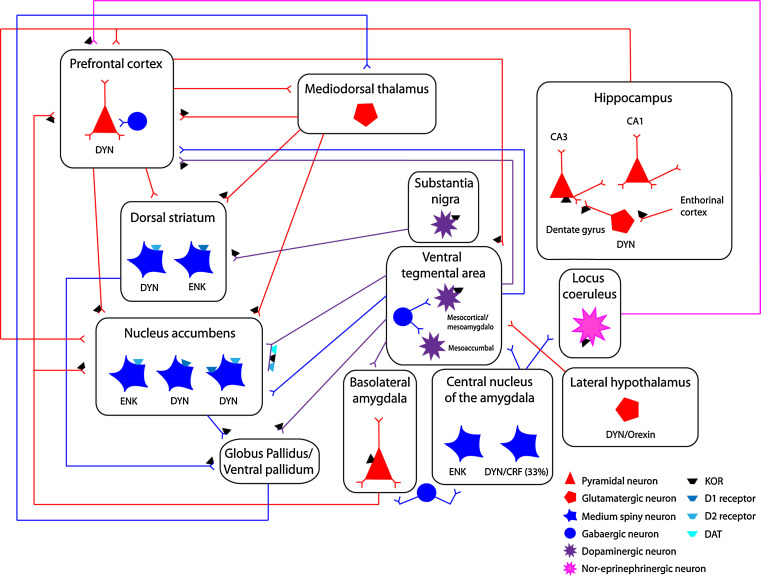
The figure depicts a simplified scheme of neuronal circuits implicated in psychiatric disorders that are modulated by DYN/KOR pathways. DYN-positive neurons are located in the hypothalamus, central nucleus of the amygdala, cortical, and striatal regions and innervate neural substrates rich in KORs. DYN-positive neurons are innervated by glutamatergic and monoaminergic fibers containing presynaptic KORs, providing a physiological substrate for DYN/KOR to modulate presynaptic monoaminergic neurotransmission. The inset provides a key of neuronal/fiber type and simplified scheme of localization of KORs and DYN-positive neurons

References

    1. WHO (2001) Mental health: new understanding, new hope. The world health report 2001
    1. Dani JA, Harris RA. Nicotine addiction and comorbidity with alcohol abuse and mental illness. Nat Neurosci. 2005;8:1465–1470. doi: 10.1038/nn1580. - DOI - PubMed
    1. Henriksen G, Willoch F. Imaging of opioid receptors in the central nervous system. Brain. 2008;131:1171–1196. doi: 10.1093/brain/awm255. - DOI - PMC - PubMed
    1. Chavkin C, James IF, Goldstein A. Dynorphin is a specific endogenous ligand of the kappa opioid receptor. Science. 1982;215:413–415. doi: 10.1126/science.6120570. - DOI - PubMed
    1. Shippenberg TS. The dynorphin/kappa opioid receptor system: a new target for the treatment of addiction and affective disorders? Neuropsychopharmacology. 2009;34:247. doi: 10.1038/npp.2008.165. - DOI - PubMed

Publication types

MeSH terms