


Formation of 1,2:3,4-diepoxybutane-specific hemoglobin adducts in 1,3-butadiene exposed workers
- PMID: 22003190
- PMCID: PMC3243749
- DOI: 10.1093/toxsci/kfr272
Formation of 1,2:3,4-diepoxybutane-specific hemoglobin adducts in 1,3-butadiene exposed workers
Abstract
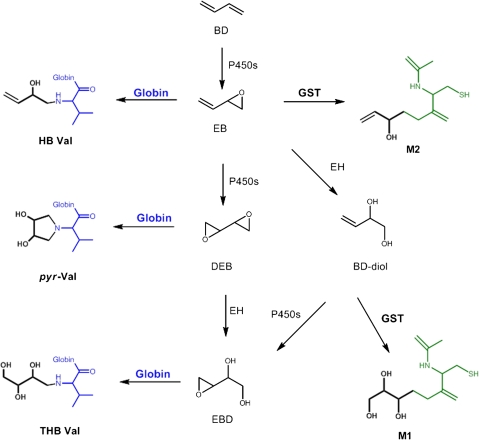
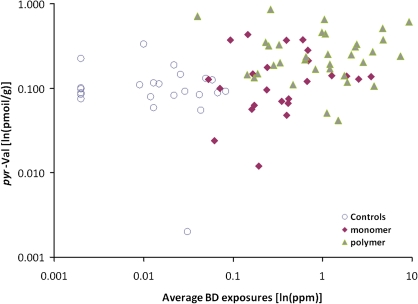
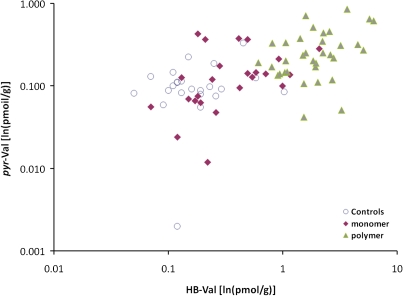
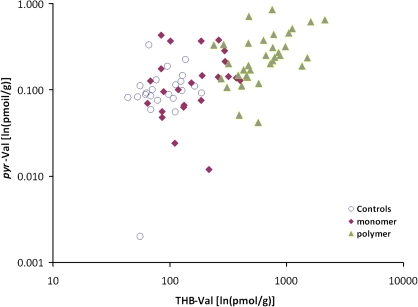
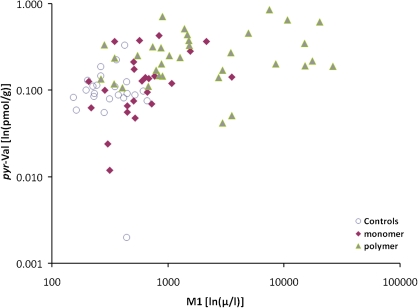
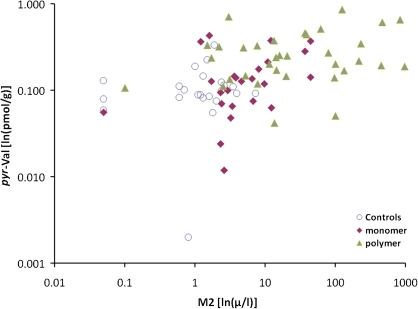
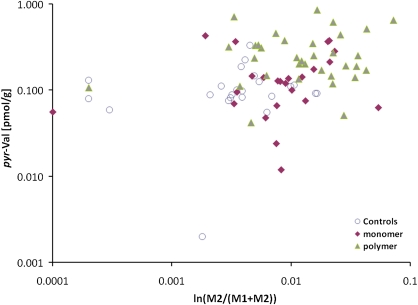
1,3-Butadiene (BD) is an important industrial chemical that is classified as a human carcinogen. BD carcinogenicity has been attributed to its metabolism to several reactive epoxide metabolites and formation of the highly mutagenic 1,2:3,4-diepoxybutane (DEB) has been hypothesized to drive mutagenesis and carcinogenesis at exposures experienced in humans. We report herein the formation of DEB-specific N,N-(2,3-dihydroxy-1,4-butadiyl)valine (pyr-Val) in BD-exposed workers as a biomarker of DEB formation. pyr-Val was determined in BD monomer and polymer plant workers that had been previously analyzed for several other biomarkers of exposure and effect. pyr-Val was detected in 68 of 81 (84%) samples ranging from 0.08 to 0.86 pmol/g globin. Surprisingly, pyr-Val was observed in 19 of 23 administrative control subjects not known to be exposed to BD, suggesting exposure from environmental sources of BD. The mean ± SD amounts of pyr-Val were 0.11 ± 0.07, 0.16 ± 0.12, and 0.29 ± 0.20 pmol/g globin in the controls, monomer, and polymer workers, respectively, clearly demonstrating formation of DEB in humans. The amounts of pyr-Val found in this study suggest that humans are much less efficient in the formation of DEB than mice or rats at similar exposures. Formation of pyr-Val was more than 50-fold lower than has been associated with increased mutagenesis in rodents. The results further suggest that formation of DEB relative to other epoxides is significantly different in the highest exposed polymer workers compared with controls and BD monomer workers. Whether this is due to saturation of metabolic formation or increased GST-mediated detoxification could not be determined.
Figures
References
-
- Albertini RJ, Carson ML, Kirman CR, Gargas ML. 1,3-butadiene: II. Genotoxicity profile. Crit. Rev. Toxicol. 2010;40(Suppl. 1):12–73. - PubMed
-
- Albertini RJ, Šram RJ, Vacek PM, Lynch J, Nicklas JA, van Sittert NJ, Boogaard PJ, Henderson RF, Swenberg JA, Tates AD, et al. Biomarkers in Czech Workers Exposed to 1,3-Butadiene: A Transitional Epidemiologic Study. 2003. pp. 1–141. Health Effects Institute, Cambridge, MA, Report (116), 1–141. - PubMed
-
- Albertini RJ, Šram RJ, Vacek PM, Lynch J, Rossner P, Nicklas JA, McDonald JD, Boysen G, Georgieva N, Swenberg JA. Molecular epidemiological studies in 1,3-butadiene exposed Czech workers: Female-male comparisons. Chem. Biol. Interact. 2007;166:63–77. - PubMed
-
- Agency for Toxic Substances and Disease Registry (ATSDR) Toxicological Profile for 1,3-Butadiene. Benzene. Agency for Toxic Substances and Disease Registry, U.S. Department of Health and Human Services, Public Health Service, Atlanta, GA; 1992.
-
- Booth ED, Kilgour JD, Watson WP. Dose responses for the formation of hemoglobin adducts and urinary metabolites in rats and mice exposed by inhalation to low concentrations of 1,3-[2,3-14C]-butadiene. Chem. Biol. Interact. 2004;147:213–232. - PubMed
Publication types
MeSH terms
Substances
Grants and funding
LinkOut - more resources
Full Text Sources
Medical
Research Materials
