


Social support and socioeconomic status interact to predict Epstein-Barr virus latency in women awaiting diagnosis or newly diagnosed with breast cancer
- PMID: 22004465
- PMCID: PMC3254856
- DOI: 10.1037/a0025599
Social support and socioeconomic status interact to predict Epstein-Barr virus latency in women awaiting diagnosis or newly diagnosed with breast cancer
Abstract
Objective: Both higher socioeconomic status (SES) and supportive personal relationships confer health benefits, including better immune function. This study assessed the joint impact of SES and social support on the expression of a latent herpesvirus, Epstein-Barr virus (EBV), in a group of highly stressed women.
Methods: Two-hundred and twenty four women either awaiting further evaluation following an abnormal mammogram or newly diagnosed with breast cancer completed questionnaires and provided blood samples to assess EBV viral capsid antigen (VCA) IgG antibody titers.
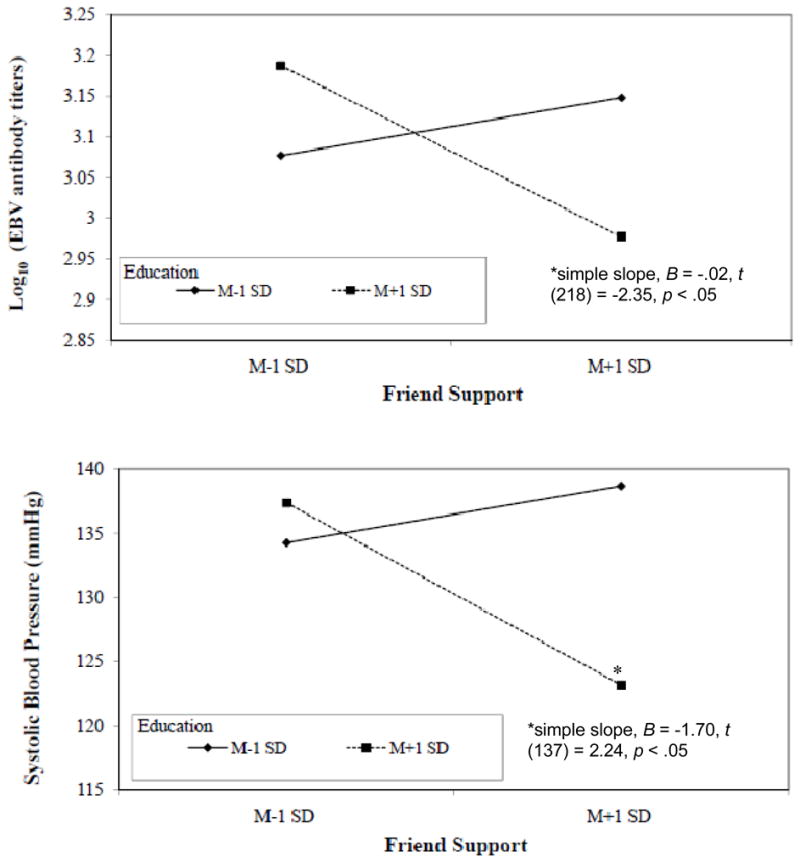
Results: More highly educated women with more support from friends had lower EBV VCA antibody titers, reflecting a stronger cellular immune response to the latent virus; however, among less educated women, friend support was not associated with EBV antibody titers. As revealed in an ancillary analysis, more highly educated women with more friend support had lower systolic blood pressure (SBP); however, friend support was not associated with SBP among less educated women. Neither depression nor perceived stress mediated these associations. Neither cancer status nor cancer stage among those diagnosed with cancer was significantly related to these outcomes.
Conclusion: Lower SES women may not reap the same immunological benefits from friend support when experiencing a stressful life event as their higher SES counterparts.
Figures
References
-
- Adler N, Boyce T, Chesney M, Cohen S, Folkman S, Kahn R, et al. Socioeconomic status and health. American Psychologist. 1994;49:15–24. - PubMed
-
- Adler N, Rehkopf D. Us disparities in health: Descriptions, causes, and mechanisms. Public Health. 2008;29(1):235. - PubMed
-
- Arora N, Finney Rutten L, Gustafson D, Moser R, Hawkins R. Perceived helpfulness and impact of social support provided by family, friends, and health care providers to women newly diagnosed with breast cancer. Psycho Oncology. 2007;16(5):474–486. - PubMed
-
- Basco MR, Krebaum SR, Rush AJ. Outcome measures of depression. In: Strupp HH, Horowitz LM, Lambert MJ, editors. Measuring patient changes in mood, anxiety, and personality disorders. Washington D. C: American Psychological Association; 1997. pp. 207–245.
-
- Bastien CH, Vallieres A, Morin CM. Validation of the insomnia severity index as an outcome measure for insomnia research. Sleep Medicine Reviews. 2001;2(4):297–307. - PubMed
Publication types
MeSH terms
Substances
Grants and funding
LinkOut - more resources
Full Text Sources
Medical
Research Materials
