


Review
doi: 10.1111/j.1399-3046.2010.01436.x.
Epub 2011 Mar 29.
Donor specific antibodies after transplantation
Affiliations
- PMID: 22004543
- PMCID: PMC3196851
- DOI: 10.1111/j.1399-3046.2010.01436.x
Item in Clipboard
Review
Donor specific antibodies after transplantation
Pediatr Transplant.
2011 Nov.
Abstract
The detection of donor-specific antibodies after organ transplantation might provide an incisive way to monitor allo-specific immunity and predict graft outcome. Still, the availability of new assays for these antibodies prompts us to pose some questions about results that might be observed. These questions include whether the antibodies detected in the blood are a sensitive measure of alloimmunity, whether the detected antibodies are truly specific for the donor and whether they are noxious for the graft. Here, we explain why answers to these questions might interest the basic scientist and clinician.
© 2011 John Wiley & Sons A/S.
Figures

Absorption of total xenoreactive (A) and anti-Galα1-3Gal antibodies (B) from baboon blood during perfusion of xenogeneic organs. Squirrel monkey kidneys were connected through ex vivo circuits with the circulation of baboons, and blood was sampled before and after passage through the kidneys. Total xenoreactive and anti-Galα1-3Gal antibodies were measured by ELISA on the basis of binding to cultured porcine endothelial cells. Adapted from Figure 3, Collins et al. (28), copyright 1995, The American Association of Immunologists, Inc.
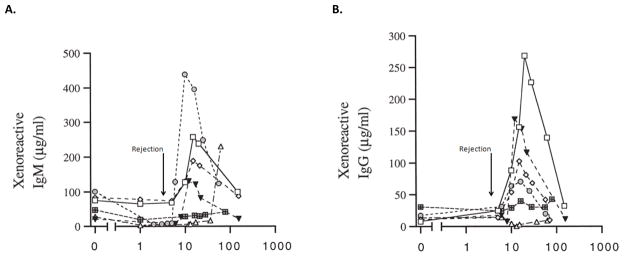
Xenoreactive IgG was measured by ELISA after transplantation of swine hearts into baboons. In each of six baboons xenoreactive IgG levels remained at baseline until day 10–15 when the xenografts were removed. Impaired contractility and severe antibody mediated rejection were observed by day 7 (arrow). Adapted from Figure 3, McCurry et al. (29), copyright 1997, with permission from Elsevier.
References
-
- Kissmeyer-Nielsen F, Olsen S, Petersen VP, Fjeldborg O. Hyperacute rejection of kidney allografts, associated with pre-existing humoral antibodies against donor cells. Lancet. 1966;2:662–665. - PubMed
-
- Vlad G, Ho EK, Vasilescu ER, et al. Relevance of different antibody detection methods for the prediction of antibody-mediated rejection and deceased-donor kidney allograft survival. Hum Immunol. 2009;70:589–594. - PubMed
-
- Cascalho M, Platt JL. Basic mechanisms of humoral rejection. Pediatric Transplantation. 2005;9:9–16. - PubMed
-
- Cascalho M, Platt JL. The immunological barrier to xenotransplantation. Immunity. 2001;14:437–446. - PubMed
-
- Gorer P. The genetic and antigentic basis of tumor transplantation. Journal of Pathology and Bacteriology. 1937;44:691–697.
