. 2012 Jan;40(1):111-9.
doi: 10.1124/dmd.111.040832. Epub 2011 Oct 17.

Frequency of undetected CYP2D6 hybrid genes in clinical samples: impact on phenotype prediction

Affiliations

Frequency of undetected CYP2D6 hybrid genes in clinical samples: impact on phenotype prediction

John Logan Black 3rd et al. Drug Metab Dispos. 2012 Jan.

Erratum in

  • Drug Metab Dispos. 2012 Jun;40(6):1238

Abstract

Cytochrome P450 2D6 (CYP2D6) is highly polymorphic. CYP2D6-2D7 hybrid genes can be present in samples containing CYP2D6*4 and CYP2D6*10 alleles. CYP2D7-2D6 hybrid genes can be present in samples with duplication signals and in samples with homozygous genotyping results. The frequency of hybrid genes in clinical samples is unknown. We evaluated 1390 samples for undetected hybrid genes by polymerase chain reaction (PCR) amplification, PCR fragment analysis, TaqMan copy number assays, DNA sequencing, and allele-specific primer extension assay. Of 508 CYP2D6*4-containing samples, 109 (21.5%) harbored CYP2D6*68 + *4-like, whereas 9 (1.8%) harbored CYP2D6*4N + *4-like. Of 209 CYP2D6*10-containing samples, 44 (21.1%) were found to have CYP2D6*36 + *10. Of 332 homozygous samples, 4 (1.2%) harbored a single CYP2D7-2D6 hybrid, and of 341 samples with duplication signals, 25 (7.3%) harbored an undetected CYP2D7-2D6 hybrid. Phenotype before and after accurate genotyping was predicted using a method in clinical use. The presence of hybrid genes had no effect on the phenotype prediction of CYP2D6*4- and CYP2D6*10-containing samples. Four of four (100%) homozygous samples containing a CYP2D7-2D6 gene had a change in predicted phenotype, and 23 of 25 (92%) samples with a duplication signal and a CYP2D7-2D6 gene had a change in predicted phenotype. Four novel genes were identified (CYP2D6*13A1 variants 1 and 2, CYP2D6*13G1, and CYP2D6*13G2), and two novel hybrid tandem structures consisting of CYP2D6*13B + *68×2 + *4-like and CYP2D6*13A1 variant 2 + *1×N were observed.


Figures
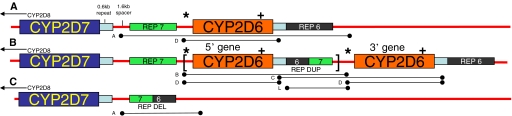
Fig. 1.
Fig. 1.
CYP2D locus structures for single, typical duplicated and deleted arrangements. A, single CYP2D6 arrangement. CYP2D8 (not shown) and CYP2D7 pseudogenes are located 5′ to the CYP2D6 gene. Similar 0.6-kb repeats follow the CYP2D7 and CYP2D6 sequences as do rep 7 and rep 6, respectively, which differ by just a few nucleotides in the 5′ and 3′ regions of 5 rep. Note that the 1.6-kb spacer is located 3′ to the CYP2D7 pseudogene, which is absent downstream of the CYP2D6 gene. B, typical CYP2D6 duplication arrangement. The first CYP2D6 gene is followed by rep dup, a hybrid containing a 5′ rep 6 sequence and a 3′ rep 7 sequence. Multiplications of the sequence shown between the brackets are known to exist. C, CYP2D6 deletion arrangement (CYP2D6*5), in which CYP2D7 is followed by a rep del that is a hybrid containing a 5′ rep 7 sequence and a 3′ rep 6 sequence. PCR fragments used in this investigation are depicted as lettered lines under the structures (Table 1). Probe locations for TaqMan copy number assays are designated as * and + for the 5′ flanking CYP2D6 assay and the CYP2D6 intron 6 assay, respectively.
Fig. 2.
Fig. 2.
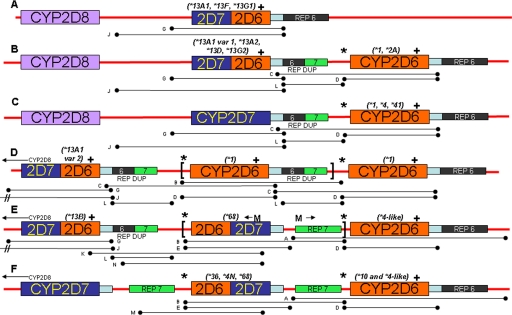
CYP2D locus structures for single and hybrid tandems of CYP2D7-2D6 and CYP2D6-2D7. A, single CYP2D7-2D6 arrangement (e.g., CYP2D6*13A1, CYP2D6*13F, and CYP2D6*13G1). B, CYP2D7-2D6 + CYP2D6 arrangement (e.g., CYP2D6*13A1, CYP2D6*13A2, CYP2D6*13D, and CYP2D6*13G2 with a tandem CYP2D6*1, CYP2D6*2A). Notice that the hybrid gene is followed by rep dup. C, CYP2D7 gene in a duplication arrangement that is followed by rep dup upstream of the tandem CYP2D6 gene (e.g., CYP2D6*1, CYP2D6*4, and CYP2D6*41). D, novel CYP2D7-2D6 + CYP2D6×N hybrid tandem multiplication arrangement. In this case, the CYP2D7-2D6 hybrid is a CYP2D6*13A1 variant 2 and the CYP2D6 alleles are CYP2D6*1. The absolute number of CYP2D6*1 alleles in tandem could not be determined. E, novel CYP2D7-2D6 hybrid (CYP2D6*13B) followed by rep dup, CYP2D6-2D7 hybrids (CYP2D6* 68×2) and a CYP2D6 gene (CYP2D6*4-like). The ←M and M→ designations show the relative locations of fragment M primers in this arrangement, which generates a product because the CYP2D6-2D7 hybrid is found in tandem in this arrangement. F, CYP2D6-2D7 + CYP2D6 arrangement (e.g., CYP2D6*36, CYP2D6*4N, CYP2D6*68 with a tandem, CYP2D6*10, and CYP2D6*4-like). Note that the CYP2D6-2D7 gene is followed by rep 7 rather than rep dup. Multiduplications have multiples of the sequence shown between the brackets and were observed in D and E. PCR fragments used in this analysis are depicted as lettered lines under the structures (Table 1). Probe locations for TaqMan copy number assays are designated as * and + for the 5′ flanking CYP2D6 assay and the CYP2D6 intron 6 assay, respectively. Note that CYP2D8 is thought to be present in all of the structures but is only shown in structures A to C for simplicity.
Fig. 3.
Fig. 3.
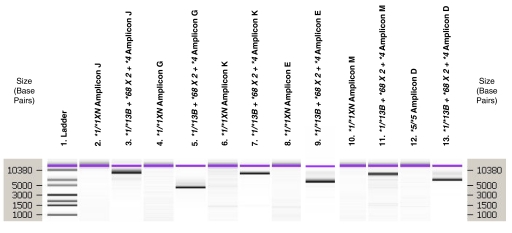
Amplicon analysis of novel CYP2D6*13B + *68×2 + *4. PCR fragment analysis for case 19 (Fig. 2E). PCR primers and expected fragment sizes for products D, E, G, J, K, and M are listed in Table 1. Fragment analysis was performed using the Agilent Technologies DNA 12000 kit. The ladder in lane 1 shows the size in base pairs of the molecular weight marker. For each amplicon, a negative control is shown first followed by amplicons generated for case number 19. Amplicon J (lanes 2 and 3) primed from the trailing sequence of CYP2D8 to the beginning of rep 6 or rep dup. When the CYP2D7 pseudogene was present, no amplicon was generated because of the lengthy span of DNA. In this case (lane 3), a fragment was generated indicating that CYP2D7 was absent. Amplicon G (lanes 4 and 5) uniquely amplified the CYP2D7-2D6 gene (CYP2D6*13B) and was used in sequencing. Amplicon K (lanes 6 and 7) primed from the CYP2D6 exon 9 sequence in CYP2D6*13B to the CYP2D7 exon 9 sequence in CYP2D6*68. This amplicon was sequenced using multiple amplicons to ensure continuity between the CYP2D6*13B and CYP2D6*68 alleles. Amplicon M (lanes 8 and 9) primes from a unique forward region in rep 7 to the exon 9 sequence in CYP2D7 found in CYP2D6*68. Amplification would only occur with a complete rep 7 (not rep dup) upstream of CYP2D6*68. Amplicon E (lanes 10 and 11) uniquely amplified CYP2D6-2D7 genes (CYP2D6*68) and was used to generate an amplicon that was genotyped using the CYP2D6 ASPE v2 kit, thus verifying the CYP2D6*68 allele. Amplicon D (lanes 12 and 13) amplified CYP2D6 gene in any normal arrangement (e.g., Fig. 1A), any CYP2D6 gene 3′ allele in a duplication arrangement (Fig. 1B), and any CYP2D6 gene in a tandem (Fig. 2, B–F). This amplicon generated the genotype of heterozygous CYP2D6*4 from the tandem gene in Fig. 2E and the CYP2D6*1 allele on the other chromosome using the CYP2D6 v2 kit.

References

    1. Abduljalil K, Frank D, Gaedigk A, Klaassen T, Tomalik-Scharte D, Jetter A, Jaehde U, Kirchheiner J, Fuhr U. (2010) Assessment of activity levels for CYP2D6*1, CYP2D6*2, and CYP2D6*41 genes by population pharmacokinetics of dextromethorphan. Clin Pharmacol Ther 88:643–651 - PubMed
    1. Bapiro TE, Hasler JA, Ridderström M, Masimirembwa CM. (2002) The molecular and enzyme kinetic basis for the diminished activity of the cytochrome P450 2D6.17 (CYP2D6.17) variant. Potential implications for CYP2D6 phenotyping studies and the clinical use of CYP2D6 substrate drugs in some African populations. Biochem Pharmacol 64:1387–1398 - PubMed
    1. Black JL, 3rd, O'Kane DJ, Mrazek DA. (2007) The impact of CYP allelic variation on antidepressant metabolism: a review. Expert Opin Drug Metab Toxicol 3:21–31 - PubMed
    1. Chida M, Ariyoshi N, Yokoi T, Nemoto N, Inaba M, Kinoshita M, Kamataki T. (2002) New allelic arrangement CYP2D6*36×2 found in a Japanese poor metabolizer of debrisoquine. Pharmacogenetics 12:659–662 - PubMed
    1. Gaedigk A, Bradford LD, Alander SW, Leeder JS. (2006) CYP2D6*36 gene arrangements within the CYP2D6 locus: association of CYP2D6*36 with poor metabolizer status. Drug Metab Dispos 34:563–569 - PubMed

Publication types

Substances

LinkOut - more resources