


Assessing the impact of non-differential genotyping errors on rare variant tests of association
- PMID: 22004945
- PMCID: PMC3214826
- DOI: 10.1159/000332222
Assessing the impact of non-differential genotyping errors on rare variant tests of association
Abstract
Background/aims: We aim to quantify the effect of non-differential genotyping errors on the power of rare variant tests and identify those situations when genotyping errors are most harmful.
Methods: We simulated genotype and phenotype data for a range of sample sizes, minor allele frequencies, disease relative risks and numbers of rare variants. Genotype errors were then simulated using five different error models covering a wide range of error rates.
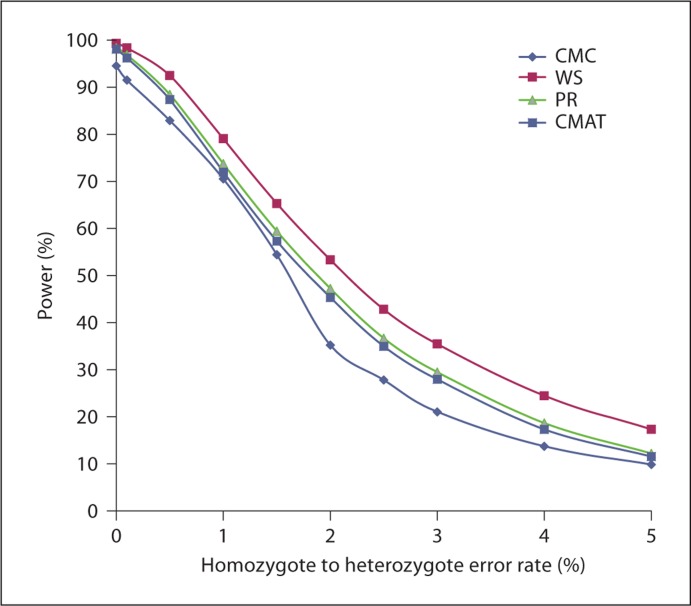
Results: Even at very low error rates, misclassifying a common homozygote as a heterozygote translates into a substantial loss of power, a result that is exacerbated even further as the minor allele frequency decreases. While the power loss from heterozygote to common homozygote errors tends to be smaller for a given error rate, in practice heterozygote to homozygote errors are more frequent and, thus, will have measurable impact on power.
Conclusion: Error rates from genotype-calling technology for next-generation sequencing data suggest that substantial power loss may be seen when applying current rare variant tests of association to called genotypes.
Copyright © 2011 S. Karger AG, Basel.
Figures
References
-
- Mardis ER. The impact of next-generation sequencing technology on genetics. Trends Genet. 2008;24:133–141. - PubMed
Publication types
MeSH terms
Grants and funding
LinkOut - more resources
Full Text Sources
