Review
. 2012;6(1-3):46-60.
doi: 10.1159/000332740. Epub 2011 Oct 14.

Gonadal and sex differentiation abnormalities of dogs and cats

Affiliations
Review

Gonadal and sex differentiation abnormalities of dogs and cats

V N Meyers-Wallen. Sex Dev. 2012.

Abstract

The molecular steps in normal sexual development were largely discovered by studying patients and animal models with disorders of sexual development (DSD). Although several types of DSD have been reported in the cat and dog, which are often strikingly similar to human DSD, these have been infrequently utilized to contribute to our knowledge of mammalian sexual development. Canine and feline cases of DSD with sufficient evidence to be considered as potential models are summarized in this report. The consensus DSD terminology, and reference to previous terminology, is used to foster adoption of a common nomenclature that will facilitate communication and collaboration between veterinarians, physicians, and researchers. To efficiently utilize these unique resources as molecular tools continue to improve, it will be helpful to deposit samples from valuable cases into repositories where they are available to contribute to our understanding of sexual development, and thus improve human and animal health.


Figures

Fig. 1
Fig. 1
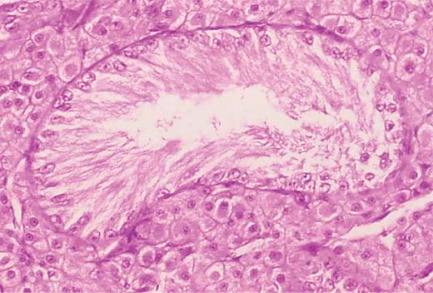
Sex chromosome DSD. Testis histology from a 39,XXY cat. Only Sertoli cells are present in seminiferous tubules. Leydig cells are present in the interstitium.
Fig. 2
Fig. 2
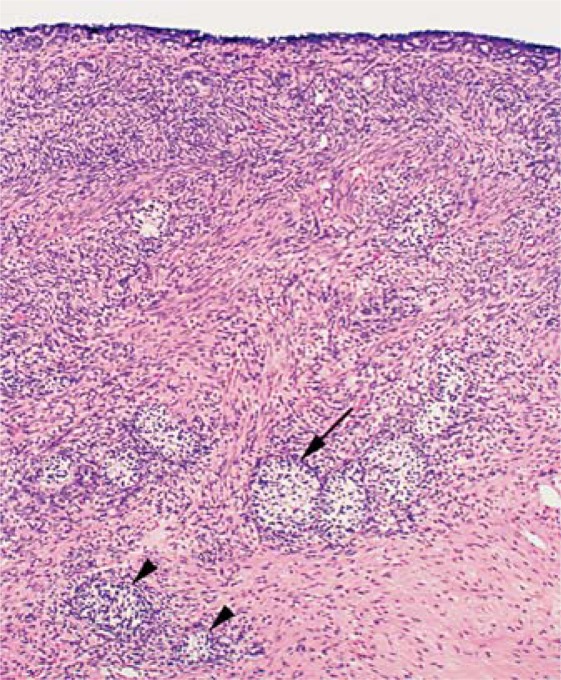
Sex chromosome DSD. Histology of a hypoplastic ovary from a 79,XXX dog. There are subepithelial structures and cross sections of immature sex cords, varying from poorly differentiated follicles without oocytes (large arrow) to smaller ones resembling seminiferous tubules (arrowheads; reprinted from O'Connor et al. [2011], with permission from Elsevier).
Fig. 3
Fig. 3
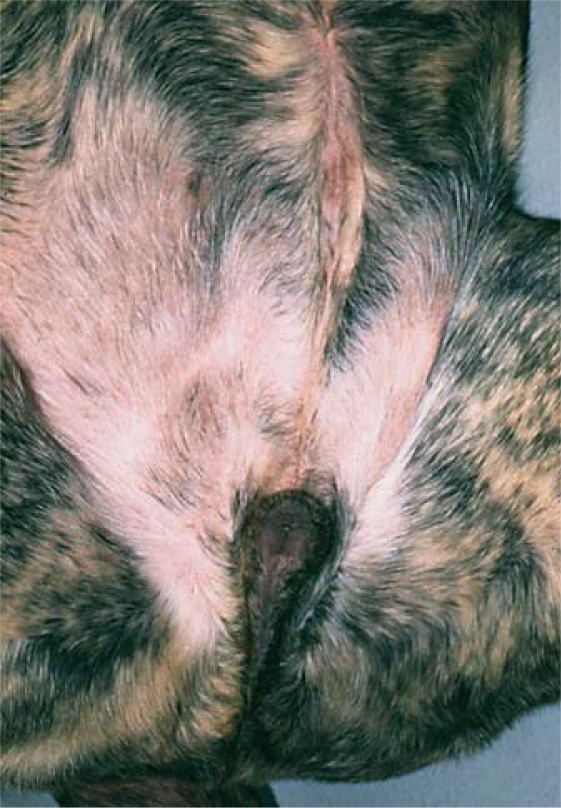
Sex chromosome DSD. Ambiguous external genitalia of a 78,XX/78,XY Fila Brasileiro dog. The prepuce is caudally displaced, being located closer to the anus and farther from the umbilicus (top of photograph) than in a normal male (reprinted with permission from International Veterinary Information Service, Ithaca, New York: Meyers-Wallen 2001]).
Fig. 4
Fig. 4
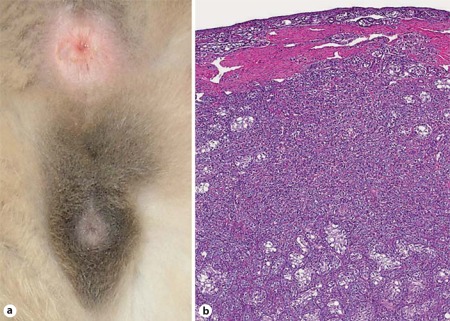
XY DSD, ovotesticular. a External genitalia of a cat affected with ovotesticular DSD. The cat is in standing position, such that the nonpigmented anus is dorsal, the penis is ventral, and the scrotum, which does not contain testes, is between the anus and penis. Hair surrounding the scrotum and prepuce is pigmented. b Bilateral ovotestes were present. A band of connective tissue separated the smaller cortical rim of ovarian tissue from the larger medullary testis. Rare primordial follicles and oocytes were observed. The central medullary region contained Leydig cells, small irregular sex cords and hypoplastic seminiferous tubules lined by Sertoli cells (reprinted with permission from Veterinary Pathology: Schlafer et al. [2011]).
Fig. 5
Fig. 5
XY DSD, disorder of androgen action. Testis histology from a 6-month-old cat lacking functional androgen receptors (complete androgen insensitivity syndrome, Meyers-Wallen et al. [1989a]). The overall architecture is disorganized. Germ cells and Sertoli cells are present within irregular seminiferous tubules lacking spermatogenesis. Leydig cells are present in the interstitium.
Fig. 6
Fig. 6
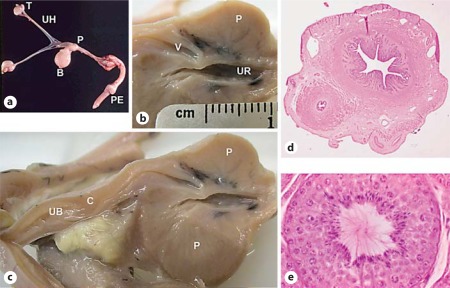
XY DSD, PMDS. Gross features of the reproductive tract in an affected miniature schnauzer. a Complete reproductive tract. b, c Portions of a longitudinally bisected formalin-fixed reproductive tract. b The cranial vagina enters the dorsal prostate gland. c Müllerian duct derivatives cranial to the prostate gland include the cervix and the uterine body. d Cross section of uterine horn and adjacent deferent duct, coursing in parallel. e Seminiferous tubule in a scrotal testis from a 6-year-old PMDS dog, showing normal stages of spermatogenesis. T = Testis; UH = uterine horn; P = prostate gland; B = urinary bladder; PE = penis; V = cranial vagina; UR = urethra; UB = uterine body; C = cervix (reprinted with permission from Journal of Andrology: Wu et al. [2009]).
Fig. 7
Fig. 7
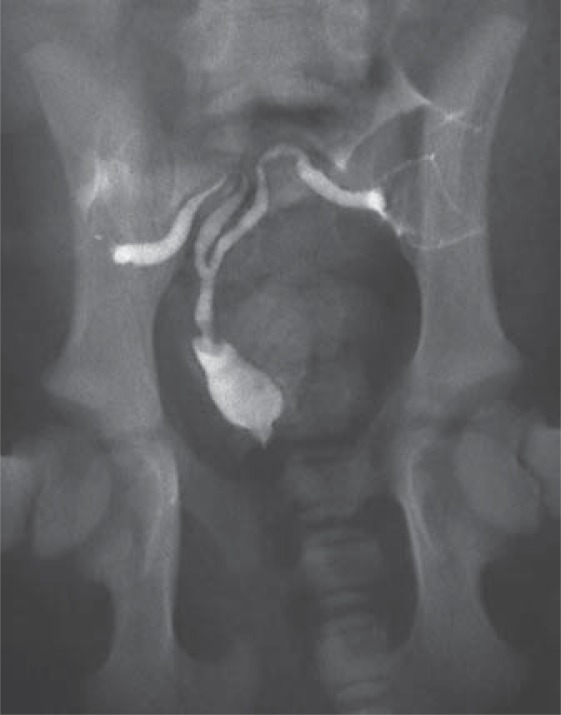
XY DSD, PMDS. Ventrodorsal radiograph of a 6-week-old PMDS dog. Contrast dye was injected retrograde via a balloon catheter into the prostatic urethra. Contrast fills the dilated prostatic urethra, the cranial vagina, the uterine body and both uterine horns, confirming a patent connection between the cranial vagina and the prostatic urethra. The prostate parenchyma, which does not contain contrast, surrounds the cranial vagina (radiograph courtesy of Don Schlafer).
Fig. 8
Fig. 8
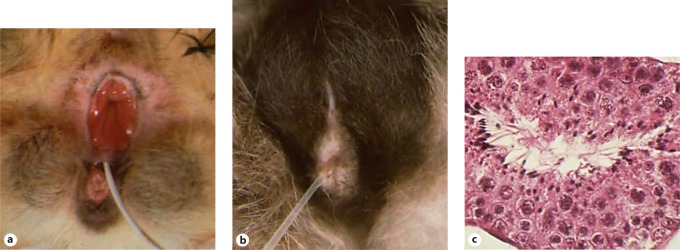
XY DSD, perineal hypospadias. External genitalia of a an affected and b a normal male cat, each in standing position with a catheter placed in the urethra. a The scrotum is bisected due to failure of closure of the prepuce and penile urethra, causing severe hypospadias. The urethra is open along the entire dorsal aspect, and the urethral orifice is directly ventral to the anus (photo courtesy of Peter Jezyk). b The normal cat scrotum is fused along the midline and lies dorsal to the penis and ventral to the anus. Hair surrounding the scrotum and prepuce is darkly pigmented in this cat. c Affected cat, representative testis histology in which all stages of spermatogenesis were identified.
Fig. 9
Fig. 9
XY DSD, perineal hypospadias. The external genitalia of a mixed breed terrier dog, shown from the ventral aspect. The urethra and prepuce are open along the entire ventral aspect. The scrotum is bisected and the urinary orifice is located directly ventral to the anus. The penile shaft is diverted caudally (reprinted with permission from Journal of the American Animal Hospital Association: Ader and Hobson [1978]).
Fig. 10
Fig. 10
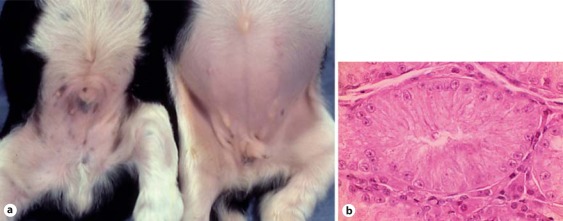
XX DSD, testicular. a Normal XY male littermate (left) to an XX male (right) from the canine ACS research model pedigree. The affected pup is bilaterally cryptorchid and the penis and prepuce are caudally displaced. Mild hypospadias is also present (not shown). b Histology of the testis from an XX male showing Leydig cells in the interstitium and seminiferous tubules containing Sertoli cells. Germ cells are absent.
Fig. 11
Fig. 11
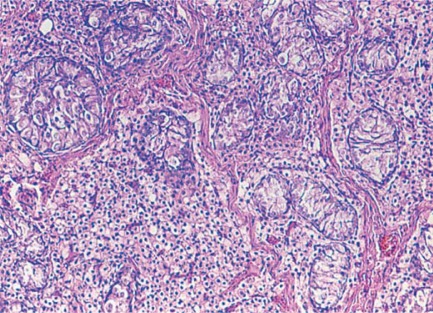
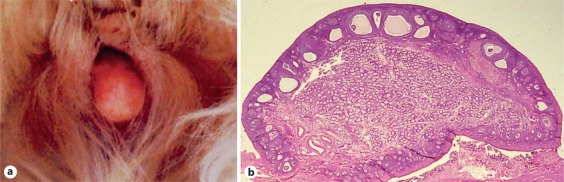
XX DSD, ovotesticular. ACS with bilateral ovotestes. a A prepuce-like vulva is present and the enlarged clitoris, which contains a bone, protrudes from the vulva. b Ovotestis. The cortex has several stages of ovarian follicles containing oocytes and regressing corpora lutea. The medulla contains Leydig cells in the interstitium and seminiferous tubules containing Sertoli cells only, as in XX males (see fig. 10b) (reprinted with permission from Cold Spring Harbor Laboratory Press: Meyers-Wallen [2006]).

References

    1. Adelsberger ME, Smeak DD. Repair of extensive perineal hypospadias in a Boston terrier using tubularized incised plate urethroplasty. Can Vet J. 2009;50:937–942. - PMC - PubMed
    1. Ader PL, Hobson HP. Hypospadias: a report of three cases. J Am Anim Hosp Assoc. 1978;14:721–727.
    1. Aronson LR, Cooper ML. Penile spines of the domestic cat: their endocrine-behavior relations. Anat Rec. 1967;157:71–78. - PubMed
    1. Arrighi S, Bosi G, Groppetti D, Aralla M, Cremonesi F. An insight into testis and gubernaculum dynamics of INSL3-RXFP2 signalling during testicular descent in the dog. Reprod Fertil Dev. 2010;22:751–760. - PubMed
    1. Biggers JD, McFeeley RA. Intersexuality in domestic animals. In: McLaren A, editor. Advances in Reproductive Physiology. London: Logos Press; 1966. pp. 30–58.

Publication types

MeSH terms

Supplementary concepts