


Dorsal hippocampal N-methyl-D-aspartate glutamatergic and δ-opioidergic systems modulate anxiety behaviors in rats in a noninteractive manner
- PMID: 22005157
- PMCID: PMC11916614
- DOI: 10.1016/j.kjms.2011.06.011
Dorsal hippocampal N-methyl-D-aspartate glutamatergic and δ-opioidergic systems modulate anxiety behaviors in rats in a noninteractive manner
Abstract
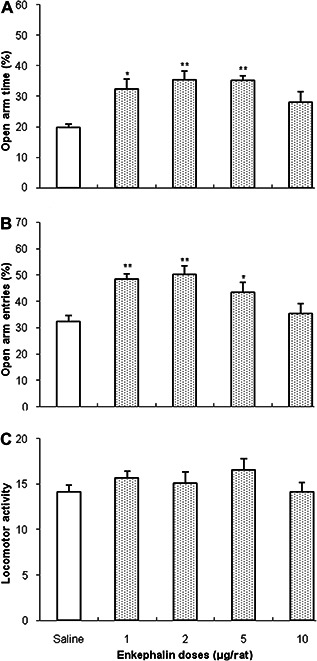
The present study aimed to investigate the effects of N-methyl-d-aspartate (NMDA)-type glutamate receptor agonist, NMDA, on anxiety-like behavior induced by δ-opioid receptor agents in rats, using the elevated plus maze instrument. The dorsal hippocampus (CA1) is known to play an important role in anxiety formation and modulation. Bilateral administration of different doses of δ-opioid receptor agonist, [d-pen2,5] enkephalin acetate hydrate (1 μg/rat, 2 μg/rat, 5 μg/rat, and 10 μg/rat; 1 μL/rat; 0.5 μL/rat in each side), into CA1 area induced an anxiolytic-like effect, demonstrated by substantial increases in the percent of open arm time (OAT%) and percent of open arm entries (OAE%). Intra-CA1 injection of different doses of δ-opioid receptor antagonist, naltrindole hydrochloride (0.25 μg/rat, 0.5 μg/rat, 1 μg/rat, and 2 μg/rat), produced significant anxiogenic-like behavior. Furthermore, intra-CA1 administration of NMDA glutamate receptor agonist, NMDA (0.125 μg/rat, 0.25 μg/rat, 0.5 μg/rat, and 0.75 μg/rat), increased the OAT% and OAE%, indicating anxiolytic-like behavior. However, administration of different doses of NMDA glutamatergic antagonist, MK801 (0.125 μg/rat, 0.25 μg/rat, 0.5 μg/rat, and 1μg/rat), showed no significant effect on the OAT% but decreased the OAE% significantly. The ineffective dose of NMDA (0.125 μg/rat), when coadministered with enkephalin (1 μg/rat, 2 μg/rat, 5 μg/rat, and 10 μg/rat), did not decrease the anxiety behavior significantly. An effective dose of NMDA (0.5 μg/rat), in combination with different doses of naltrindole hydrochloride (0.25 μg/rat, 0.5 μg/rat, 1 μg/rat, and 2 μg/rat), demonstrated no significant interaction with the OAT%, OAE%, and locomotor activity. These results suggest that CA1 δ-opioid and NMDA glutamatergic systems modulate anxiety behaviors in a noninteractive manner.
Copyright © 2011. Published by Elsevier B.V.
Figures




References
-
- File S., Kenny P., Cheeta S.. The role of the dorsal hippocampal serotonergic and cholinergic systems in the modulation of anxiety. Pharmacol Biochem Behav. 2000; 66: 65–72. - PubMed
-
- Ozawa S., Kamiya H., Tsuzuki K.. Glutamate receptors in the mammalian central nervous system. Prog Neurobiol. 1998; 54: 581–618. - PubMed
-
- Guimarães F., Carobrez A., Aguiar J., Graeff F.. Anxiolytic effect in the elevated plus‐maze of the NMDA receptor antagonist AP7 microinjected into the dorsal periaqueductal grey. Psychopharmacology. 1991; 103: 91–94. - PubMed
-
- Zarrindast M., Babapoor‐Farrokhran S., Rezayof A.. Involvement of opioidergic system of the ventral hippocampus, the nucleus accumbens or the central amygdala in anxiety‐related behavior. Life Sci. 2008; 6: 23–24. - PubMed
MeSH terms
Substances
LinkOut - more resources
Full Text Sources
Medical
Miscellaneous
