Review
. 2011 Dec;21(6):753-8.
doi: 10.1016/j.gde.2011.09.010. Epub 2011 Oct 15.

We are all individuals: causes and consequences of non-genetic heterogeneity in mammalian cells

Affiliations
Review

We are all individuals: causes and consequences of non-genetic heterogeneity in mammalian cells

Alexander Loewer et al. Curr Opin Genet Dev. 2011 Dec.

Abstract

The human body is formed by trillions of individual cells. These cells work together with remarkable precision, first forming an adult organism out of a single fertilized egg, and then keeping the organism alive and functional for decades. To achieve this precision, one would assume that each individual cell reacts in a reliable, reproducible way to a given input, faithfully executing the required task. However, a growing number of studies investigating cellular processes on the level of single cells revealed large heterogeneity even among genetically identical cells of the same cell type. Here we discuss the sources of heterogeneity in mammalian systems; how cells ensure reliable processing of information despite fluctuations in their molecular components; and what could be the benefit of cell-to-cell variability for mammalian cells.


Figures

Figure 1
Figure 1
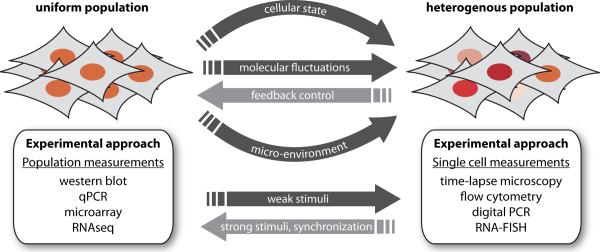
Multiple internal and external factors increase heterogeneity between individual genetically identical cells of the same type. Experimental techniques that average the behavior of many cells together do not allow observing these variations and can result in misleading assumptions about cellular responses.
Figure 2
Figure 2
Single Cell observations: Population studies suggested that p53 levels are low in basal conditions and show damped oscillations in response to DNA damage [10]]. Single live-cell analysis using fluorescent reporter for p53 revealed that individual cells show a series of undamped p53 pulses in response to DNA damage [11] and similar, but less frequent pulses in basal conditions [6]. Averaging across a population of cells masked these behaviors of p53 as the timing of pulses varies between cells in basal conditions and different cells show different number of pulses in response to DNA damage. Insights: Prior to the single cell studies, the general view was that the delayed negative feedback loop between p53 and Mdm2 is sufficient for triggering p53's damped oscillations [10,51]. However, this simple mechanism was insufficient in explaining the undamped pulses seen in single cells. Therefore, a new model was developed, in which the p53 pulses are driven by pulses in the upstream signaling molecules ATM-P and Chk2-P through a negative feedback loop from p53 to ATM [36]. In this model, p53 pulses are the result of repeated initiation from recurring examination of damaged DNA by ATM. The spontaneous bursts that were found in basal conditions taught us that activation of p53 is excitable; transient DNA damage during normal growth triggers similar pulses as high sustained damage. However, transient damage is not sufficient for changing p53 modifications from an inactive to an active state. Therefore, p53 pulses in basal conditions do not induce a cellular response such as cell cycle arrest [6].

References

    1. Barkai N, Shilo BZ. Variability and robustness in biomolecular systems. Mol Cell. 2007;28:755–760. - PubMed
    1. Raj A, van Oudenaarden A. Nature, nurture, or chance: stochastic gene expression and its consequences. Cell. 2008;135:216–226. - PMC - PubMed
    1. Huh D, Paulsson J. Non-genetic heterogeneity from stochastic partitioning at cell division. Nat Genet. 2011;43:95–100. - PMC - PubMed
    1. Spencer SL, Gaudet S, Albeck JG, Burke JM, Sorger PK. Non-genetic origins of cell-to-cell variability in TRAIL-induced apoptosis. Nature. 2009;459:428–432. ++ Through measurements and modeling, Spencer et al. elegantly show that variability in the levels of regulatory proteins can determine cellular decisions. - PMC - PubMed
    1. Chang HH, Hemberg M, Barahona M, Ingber DE, Huang S. Transcriptome-wide noise controls lineage choice in mammalian progenitor cells. Nature. 2008;453:544–547. - PMC - PubMed

Publication types