Review
. 2012 Jan;347(1):245-56.
doi: 10.1007/s00441-011-1246-y. Epub 2011 Oct 19.

TGF-β in progression of liver disease

Affiliations
Review

TGF-β in progression of liver disease

Steven Dooley et al. Cell Tissue Res. 2012 Jan.

Abstract

Transforming growth factor-β (TGF-β) is a central regulator in chronic liver disease contributing to all stages of disease progression from initial liver injury through inflammation and fibrosis to cirrhosis and hepatocellular carcinoma. Liver-damage-induced levels of active TGF-β enhance hepatocyte destruction and mediate hepatic stellate cell and fibroblast activation resulting in a wound-healing response, including myofibroblast generation and extracellular matrix deposition. Being recognised as a major profibrogenic cytokine, the targeting of the TGF-β signalling pathway has been explored with respect to the inhibition of liver disease progression. Whereas interference with TGF-β signalling in various short-term animal models has provided promising results, liver disease progression in humans is a process of decades with different phases in which TGF-β or its targeting might have both beneficial and adverse outcomes. Based on recent literature, we summarise the cell-type-directed double-edged role of TGF-β in various liver disease stages. We emphasise that, in order to achieve therapeutic effects, we need to target TGF-β signalling in the right cell type at the right time.


Figures
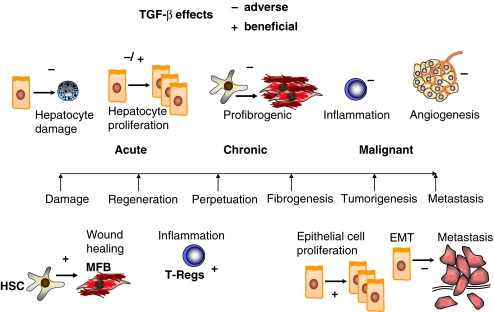
Fig. 1
Fig. 1
Pros and cons of transforming growth factor-β (TGF-β) signalling during the progression of chronic liver diseases. Upon liver damage caused by many different aetiologies, active TGF-β ligands show up in the liver and induce downstream signalling in all cell types investigated. TGF-β is recognised as a major profibrogenic cytokine and, thus, TGF-β-directed therapies are being investigated for their capacity to interfere with fibrogenesis and combat disease progression. Although many of these approaches have shown promising results in animal disease models for more than a decade, there is currently still no effective treatment for human disease on the market. This scheme attempts to explain the difficulties one faces when dealing with chronic liver diseases in human patients. In animal models, severe damage from fibrosis and inflammation can be achieved within weeks, whereas the establishment of end-stage liver disease in humans usually takes several decades to establish. During that life span, the liver undergoes many different phases, as shown along the central time line. Strongly depending on the disease stage, TGF-β and thus its targeting might have a good (+) or bad (−) outcome in the organ. TGF-β enhances damage to epithelial cells by inducing apoptosis and oxidative stress, triggers myofibroblast (MFB) activation and a wound-healing response, controls or inhibits liver regeneration by hepatocyte apoptosis and inhibition of proliferation, activates regulatory T cells (T Reg) and Th17 differentiation to calm down inflammatory responses, causes fibrogenesis and liver scarring in chronic disease, inhibits the proliferation of premalignant cells, activates stroma fibroblasts in the neighbourhood of tumour cells, inhibits tumour-directed inflammatory responses, facilitates tumour angiogenesis and induces epithelial-mesenchymal transition (EMT) of tumour cells. This multiplicity of outcomes in one organ during the different stages of one disease clearly reveals the difficulties that we have to face while directing therapeutic approaches towards TGF-β. One must select the accurate therapeutic window, target the right cell type and interfere with the adverse downstream branches of the signalling pathway. To achieve this, a great deal of basic research is still required
Fig. 2
Fig. 2
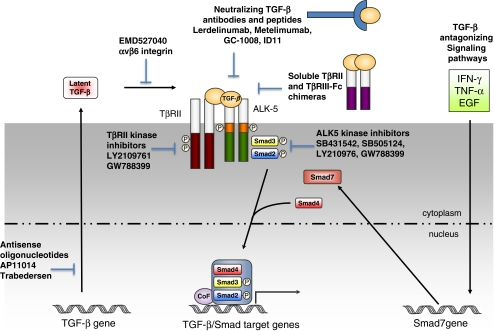
TGF-β signal transduction pathway and targets for therapeutic intervention. TGF-β signals via heteromeric transmembrane complexes of type I and type II receptors (TβR) that are endowed with intrinsic serine/threonine kinase activity (ALK activin receptor-like kinase). Upon type-II-mediated phosphorylation of the type I receptor, the activated type I receptor initiates intracellular signalling by phosphorylating receptor regulated (R)-Smad2 and Smad3. Activated R-Smads form heteromeric complexes with Smad4 and these complexes accumulate in the nucleus where they mediate transcriptional responses. Inhibitory Smad7 antagonises TGF-β/Smad signalling by competing with R-Smads for receptor interaction and by recruiting E3 ubiquitin ligases to the activated receptor complex and mediating its degradation. This pathway has been targeted by anti-sense molecules that inhibit TGF-β mRNA expression, by neutralising antibodies against TGF-β or TGF-β receptors that interfere with ligand-receptor interactions, by antibodies that interfere with the activation of latent TGF-β and by soluble extracellular domains of the type II receptor that sequester ligand binding to endogenous receptors and small ATP mimetics of TGF-β receptor kinases. Antagonising pathways, such as interferon-γ (IFN-γ), tumour necrosis factor-α (TNF-α) and epidermal growth factor (EGF), can inhibit TGF-β/Smad-induced responses by stimulating Smad7 expression

References

    1. Bataller R, Brenner DA. Liver fibrosis. J Clin Invest. 2005;115:209–218. - PMC - PubMed
    1. Becker C, Fantini MC, Neurath MF. TGF-β as a T cell regulator in colitis and colon cancer. Cytokine Growth Factor Rev. 2006;17:97–106. - PubMed
    1. Biname F, Lassus P, Hibner U. Transforming growth factor β controls the directional migration of hepatocyte cohorts by modulating their adhesion to fibronectin. Mol Biol Cell. 2008;19:945–956. - PMC - PubMed
    1. Bohm F, Kohler UA, Speicher T, Werner S. Regulation of liver regeneration by growth factors and cytokines. EMBO Mol Med. 2010;2:294–305. - PMC - PubMed
    1. Braun L, Gruppuso P, Mikumo R, Fausto N. Transforming growth factor β1 in liver carcinogenesis: messenger RNA expression and growth effects. Cell Growth Differ. 1990;1:103–111. - PubMed

MeSH terms

Substances