


Impacts of logging on density-dependent predation of dipterocarp seeds in a South East Asian rainforest
- PMID: 22006965
- PMCID: PMC3179629
- DOI: 10.1098/rstb.2011.0034
Impacts of logging on density-dependent predation of dipterocarp seeds in a South East Asian rainforest
Abstract
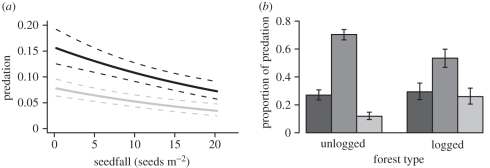
Much of the forest remaining in South East Asia has been selectively logged. The processes promoting species coexistence may be the key to the recovery and maintenance of diversity in these forests. One such process is the Janzen-Connell mechanism, where specialized natural enemies such as seed predators maintain diversity by inhibiting regeneration near conspecifics. In Neotropical forests, anthropogenic disturbance can disrupt the Janzen-Connell mechanism, but similar data are unavailable for South East Asia. We investigated the effects of conspecific density (two spatial scales) and distance from fruiting trees on seed and seedling survival of the canopy tree Parashorea malaanonan in unlogged and logged forests in Sabah, Malaysia. The production of mature seeds was higher in unlogged forest, perhaps because high adult densities facilitate pollination or satiate pre-dispersal predators. In both forest types, post-dispersal survival was reduced by small-scale (1 m(2)) conspecific density, but not by proximity to the nearest fruiting tree. Large-scale conspecific density (seeds per fruiting tree) reduced predation, probably by satiating predators. Higher seed production in unlogged forest, in combination with slightly higher survival, meant that recruitment was almost entirely limited to unlogged forest. Thus, while logging might not affect the Janzen-Connell mechanism at this site, it may influence the recruitment of particular species.
Figures
References
-
- Curran L. M., Trigg S. N., McDonald A. K., Astiani D., Hardiono Y. M., Siregar P., Caniago I., Kasischke E. 2004. Lowland forest loss in protected areas of Indonesian Borneo. Science 303, 1000–1003 10.1126/science.1091714 (doi:10.1126/science.1091714) - DOI - PubMed
-
- Achard F., Eva H. D., Stibig H. J., Mayaux P., Gallego J., Richards T., Malingreau J.-P. 2002. Determination of deforestation rates of the world's humid tropical forests. Science 297, 999–1002 10.1126/science.1070656 (doi:10.1126/science.1070656) - DOI - PubMed
-
- Sodhi N. S., Koh L. P., Brook B. W., Ng P. K. L. 2004. Southeast Asian biodiversity: an impending disaster. Trends Ecol. Evol. 19, 654–660 10.1016/j.tree.2004.09.006 (doi:10.1016/j.tree.2004.09.006) - DOI - PubMed
-
- McMorrow J., Talip M. A. 2001. Decline of forest area in Sabah, Malaysia: relationship to state policies, land code and land capability. Global Environ. Chang. 11, 217–230 10.1016/S0959-3780(00)00059-5 (doi:10.1016/S0959-3780(00)00059-5) - DOI
-
- Marsh C. W., Greer A. G. 1992. Forest-land use in Sabah, Malaysia: an introduction to Danum Valley. Phil. Trans. R. Soc. Lond. B 335, 331–339 10.1098/rstb.1992.0025 (doi:10.1098/rstb.1992.0025) - DOI
Publication types
MeSH terms
LinkOut - more resources
Full Text Sources
