


Variations in Amazon forest productivity correlated with foliar nutrients and modelled rates of photosynthetic carbon supply
- PMID: 22006971
- PMCID: PMC3179632
- DOI: 10.1098/rstb.2011.0045
Variations in Amazon forest productivity correlated with foliar nutrients and modelled rates of photosynthetic carbon supply
Abstract
The rate of above-ground woody biomass production, W(P), in some western Amazon forests exceeds those in the east by a factor of 2 or more. Underlying causes may include climate, soil nutrient limitations and species composition. In this modelling paper, we explore the implications of allowing key nutrients such as N and P to constrain the photosynthesis of Amazon forests, and also we examine the relationship between modelled rates of photosynthesis and the observed gradients in W(P). We use a model with current understanding of the underpinning biochemical processes as affected by nutrient availability to assess: (i) the degree to which observed spatial variations in foliar [N] and [P] across Amazonia affect stand-level photosynthesis; and (ii) how these variations in forest photosynthetic carbon acquisition relate to the observed geographical patterns of stem growth across the Amazon Basin. We find nutrient availability to exert a strong effect on photosynthetic carbon gain across the Basin and to be a likely important contributor to the observed gradient in W(P). Phosphorus emerges as more important than nitrogen in accounting for the observed variations in productivity. Implications of these findings are discussed in the context of future tropical forests under a changing climate.
Figures
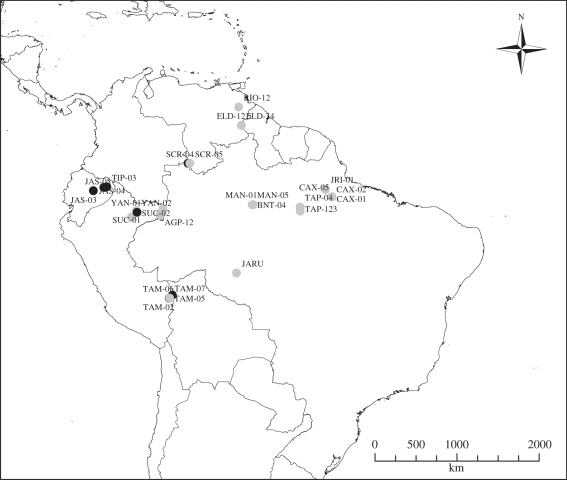
 and
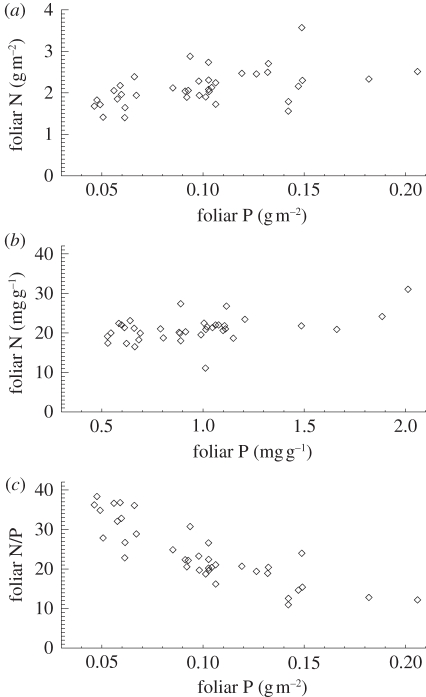
and  on (a) area basis, (b) dry-weight basis and (c) their N : P ratio. Data taken from Fyllas et al. [7].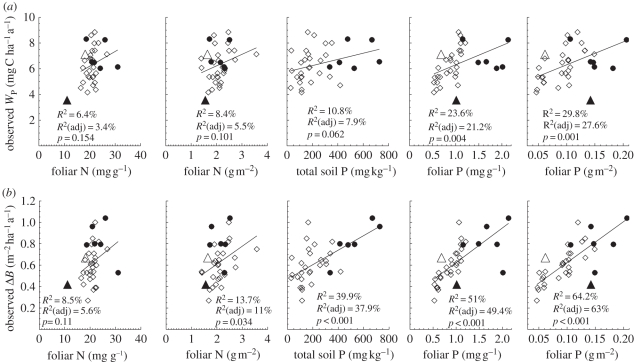
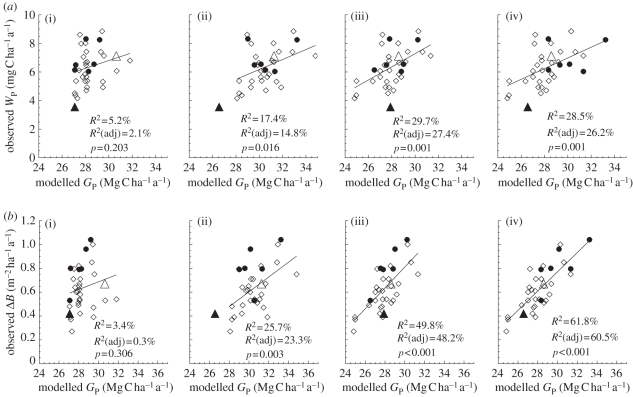
 (using the ‘min{N : P}’ relationship under four model configurations) against (a) observed stem growth (WP), and (b) basal area growth (ΔB) [6] at 33 sites. Each of the four model configurations correspond to a column: (i) with invariant
  and
and  , assuming (ii) N limitation, (iii) P limitation and (iv) both N and P limitation across all studied sites. Filled and open symbols correspond to N and P limited sites, respectively, according to equation (2.2). The triangle symbols correspond to sites with no available soil phosphorous data.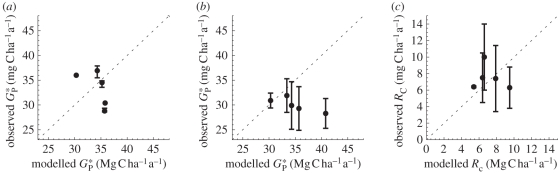
 ), and leaf respiration (RC) using available observations derived from (a) eddy correlation and (b,c) bottom-up. Error bars for eddy correlation measurements correspond to uncertainty [35] and correspond to standard error for bottom-up estimates. Data sources for each site are described in the methods.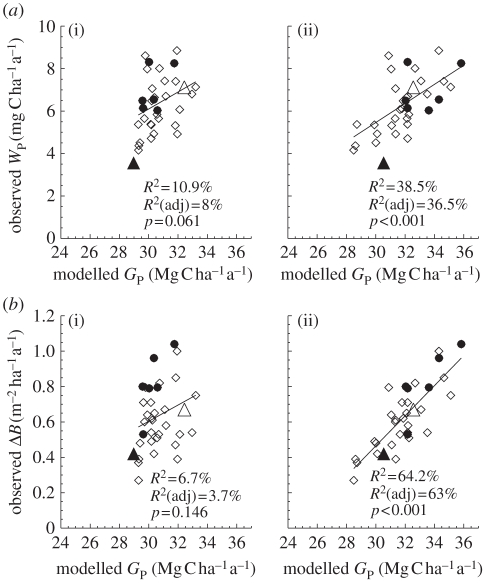
 against (a) observed stem growth (WP) and (b) basal area growth (ΔB) [6] at 33 sites. Model configurations correspond to assumption of (i) N limitation (using [N]A only) and (ii) P limitation (using [P]A only) across all studied sites. Filled and open symbols correspond to N- and P-limited sites, respectively, according to equation (2.2). The triangle symbols correspond to sites with no available soil phosphorous data.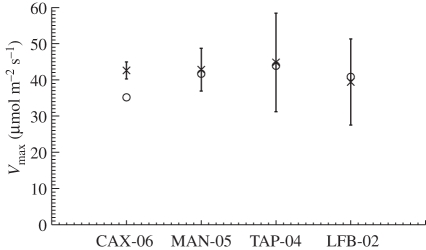
References
-
- Malhi Y., et al. 2004. The above-ground coarse wood productivity of 104 Neotropical forest plots. Glob. Change Biol. 10, 563–591 10.1111/j.1529-8817.2003.00778.x (doi:10.1111/j.1529-8817.2003.00778.x) - DOI
-
- Phillips O. L., et al. 2004. Pattern and process in Amazon tree turnover, 1976–2001. Phil. Trans. R. Soc. Lond. B 359, 381–407 10.1098/rstb.2003.1438 (doi:10.1098/rstb.2003.1438) - DOI - PMC - PubMed
-
- Baker T. R., et al. 2004. Variation in wood density determines spatial patterns in Amazonian forest biomass. Glob. Change Biol. 10, 545–562 10.1111/j.1529-8817.2003.00751.x (doi:10.1111/j.1529-8817.2003.00751.x) - DOI
-
- Quesada C. A., Lloyd J., Anderson L. O., Fyllas N. M., Schwarz M., Czimczik C. I. 2009. Soils of Amazonia with particular reference to the rainforest sites. Biogeosciences 8, 1415–1440 10.5194/bg-8-1415-2011 (doi:10.5194/bg-8-1415-2011) - DOI
-
- Quesada C. A., et al. 2010. Variations in chemical and physical properties of Amazon forest soils in relation to their genesis. Biogeosciences 7, 1515–1541 10.5194/bg-7-1515-2010 (doi:10.5194/bg-7-1515-2010) - DOI
Publication types
MeSH terms
Substances
LinkOut - more resources
Full Text Sources
