


Use of an Internet portal to improve community-based pediatric ADHD care: a cluster randomized trial
- PMID: 22007005
- PMCID: PMC3208964
- DOI: 10.1542/peds.2011-0872
Use of an Internet portal to improve community-based pediatric ADHD care: a cluster randomized trial
Abstract
Objective: To determine the effectiveness of a quality improvement program to improve pediatricians' adherence to existing, evidence-based, attention-deficit/hyperactivity disorder (ADHD) practice guidelines.
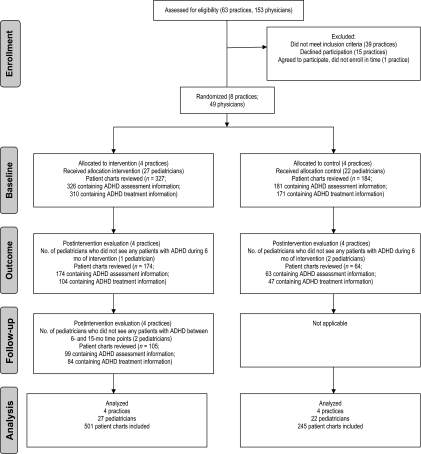
Methods: Forty-nine community-based pediatricians at 8 practices participated in a cluster-randomized trial. Practices were matched according to the numbers of pediatricians and the proportions of patients receiving Medicaid. The medical charts for a random sample of patients with ADHD for each of the participating pediatricians were examined at baseline and 6 months. All practices participated in 4 sessions of training, including didactic lectures and office flow modification workshops. Practices were then given access to an ADHD Internet portal that allowed parents, teachers, and pediatricians to input information (eg, rating scales) about patients, after which information was scored, interpreted, and formatted in a report style that was helpful for assessment and treatment of patients with ADHD. Physicians evaluated their practice behaviors quarterly and addressed underperforming areas.
Results: Pediatricians in the intervention group, compared with those in the control group, demonstrated significantly higher rates of many American Academy of Pediatrics-recommended ADHD care practices, including collection of parent (Cohen's d = 0.69) and teacher (d = 0.68) rating scales for assessment of children with ADHD, use of Diagnostic and Statistical Manual of Mental Disorders, Fourth Edition, criteria (d = 0.85), and use of teacher rating scales to monitor treatment responses (d = 1.01).
Conclusion: A quality improvement intervention that can be widely disseminated by using Internet-based information technology significantly improved the quality of ADHD care in community-based pediatric settings.
Trial registration: ClinicalTrials.gov NCT01056016.
References
-
- American Academy of Pediatrics, Committee on Quality Improvement, Subcommittee on Attention-Deficit/Hyperactivity Disorder Clinical practice guideline: diagnosis and evaluation of the child with attention deficit/hyperactivity disorder. Pediatrics. 2000;105(5):1158–1170 - PubMed
-
- American Academy of Pediatrics, Subcommittee on Attention-Deficit/Hyperactivity Disorder and Committee on Quality Improvement Clinical practice guideline: treatment of the school-aged child with attention deficit/hyperactivity disorder. Pediatrics. 2001;108(4):1033–1044 - PubMed
-
- Chan E, Hopkins MR, Perrin JM, Herrerias C, Homer CJ. Diagnostic practices for attention deficit hyperactivity disorder: a national survey of primary care physicians. Ambul Pediatr. 2005;5(4):201–208 - PubMed
-
- Rushton JL, Fant KE, Clark SJ. Use of practice guidelines in the primary care of children with attention-deficit/hyperactivity disorder. Pediatrics. 2004;114(1). Available at: www.pediatrics.org/cgi/content/full/114/1/e23 - PubMed
-
- Epstein JN, Langberg JM, Lichtenstein PK, Mainwaring BA, Luzader CP, Stark LJ. A community-wide intervention to improve the ADHD assessment and treatment practices of community physicians. Pediatrics. 2008;122(1):19–27 - PubMed
Publication types
MeSH terms
Associated data
Grants and funding
LinkOut - more resources
Full Text Sources
Medical
