


doi: 10.1155/2011/872065.
Epub 2011 Oct 9.
Efficient protein transduction method using cationic peptides and lipids
Affiliations
- PMID: 22007148
- PMCID: PMC3189636
- DOI: 10.1155/2011/872065
Item in Clipboard
Efficient protein transduction method using cationic peptides and lipids
J Biomed Biotechnol.
2011.
Abstract
Cationic peptides termed protein transduction domains (PTDs) have been shown to cross biological membranes efficiently. However, proteins transduced by PTDs become entrapped within the endosomal vesicles and are not delivered into organelles. We have developed a novel protein delivery system to enhance the proton sponge effect, which results in rupture of the endosomes, by using a mixture of Wr-T transporter peptide and a commercially available cationic lipid reagent. This peptide and cationic lipid reagent mixture efficiently delivers a variety of cargo proteins into living cells by releasing them from the endosomes.
Figures
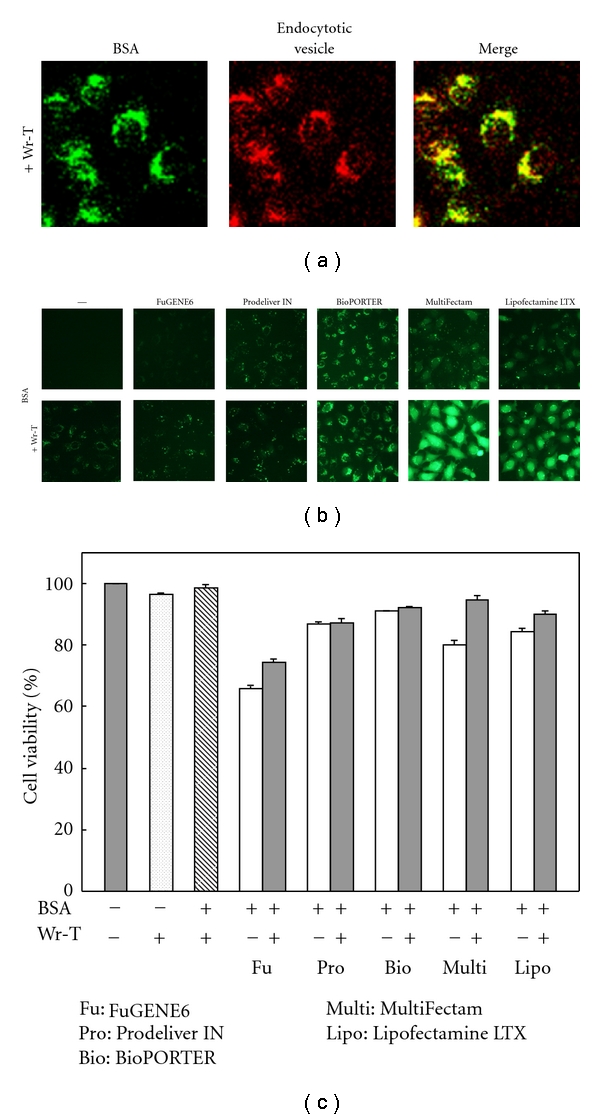
Wr-T/cationic lipid reagent mixture-mediated delivery of BSA proteins into living cells. (a) Cellular localization of Wr-T/BSA complexes. The internalization of Alexa-488-labeled BSA protein and marker dyes for endocytotic vesicles into HeLa cells was analyzed by confocal laser scanning microscopy. (b) Functional properties of Wr-T/cationic lipid reagents mixture pertaining to protein transduction. HeLa cells were cotreated by BSA with Wt-T and cationic lipid reagents in serum-free medium. After incubation for 3 h, the cells were placed in fresh medium and assessed at the same exposure time by fluorescence microscopy. (c) Cytotoxicity of Wr-T/cationic lipid reagent/cargo protein mixture. HeLa cell viability was quantified by the amount of ATP derived from metabolically active cells. Data were consistent in two repeat experiments.
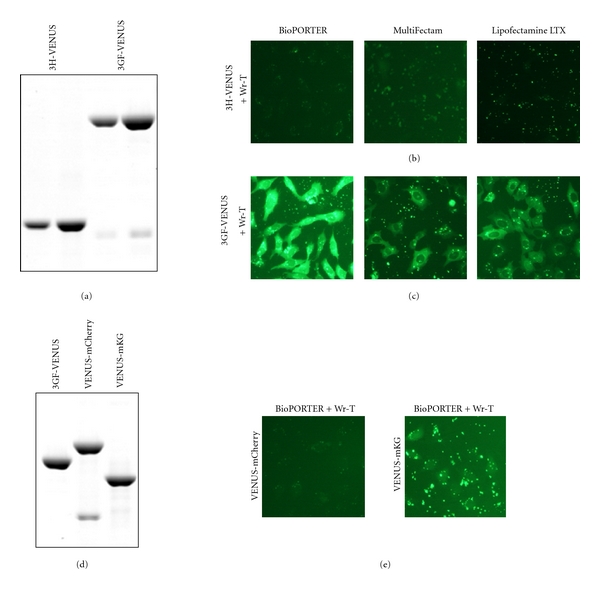
Wr-T/cationic lipid reagents mixture-mediated delivery of VENUS proteins into living cells. (a, c) Following protein purification, 3′ His tag-VENUS, 3′GST and FLAG tag-VENUS, 3′mCherry and His tag-VENUS, and 3′mKG and His tag-VENUS were analyzed by SDS-PAGE. VENUS proteins were complexed with Wr-T and cationic lipid reagents and then overlaid onto HeLa cells in a serum-free medium. Cellular localization was monitored at the same exposure time by fluorescence microscopy. (b) 3′His tag-VENUS; (c) 3′GST and FLAG tag-VENUS; (e) 3′mCherry tag-VENUS and 3′mKG tag-VENUS.
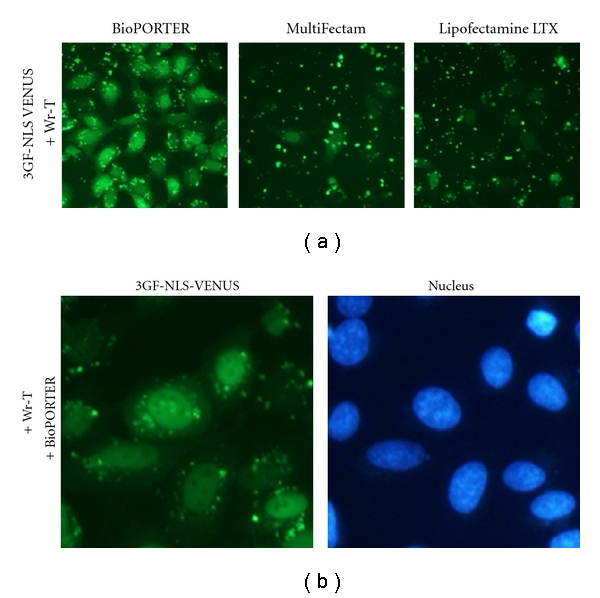
Wr-T/cationic lipid reagents mixture-mediated selective delivery of proteins into living cells. (a) 3′GST and FLAG tag-NLS VENUS proteins were incubated with Wr-T and cationic lipid reagents and then overlaid onto HeLa cells in serum-free medium for 3 h. The cells were then washed and observed at the same exposure time by fluorescence microscopy. (b) The cells treated with Wr-T/BioPORTER mixture were counterstained with Hoescht 33342.
References
-
- Nagahara H, Vocero-Akbani AM, Snyder EL, et al. Transduction of full-length TAT fusion proteins into mammalian cells: TAT-p27(Kip1) induces cell migration. Nature Medicine. 1998;4(12):1449–1452. - PubMed
-
- Derossi D, Joliot AH, Chassaing G, Prochiantz A. The third helix of the Antennapedia homeodomain translocates through biological membranes. Journal of Biological Chemistry. 1994;269(14):10444–10450. - PubMed
-
- Fretz M, Jin J, Conibere R, et al. Effects of Na+/H+ exchanger inhibitors on subcellular localisation of endocytic organelles and intracellular dynamics of protein transduction domains HIV-TAT peptide and octaarginine. Journal of Controlled Release. 2006;116(2):247–254. - PubMed
-
- Wadia JS, Stan RV, Dowdy SF. Transducible TAT-HA fusogenic peptide enhances escape of TAT-fusion proteins after lipid raft macropinocytosis. Nature Medicine. 2004;10(3):310–315. - PubMed
MeSH terms
Substances
LinkOut - more resources
Full Text Sources
