


Generation of Induced Pluripotent Stem (iPS) Cells by Nuclear Reprogramming
- PMID: 22007240
- PMCID: PMC3189620
- DOI: 10.4061/2011/619583
Generation of Induced Pluripotent Stem (iPS) Cells by Nuclear Reprogramming
Abstract
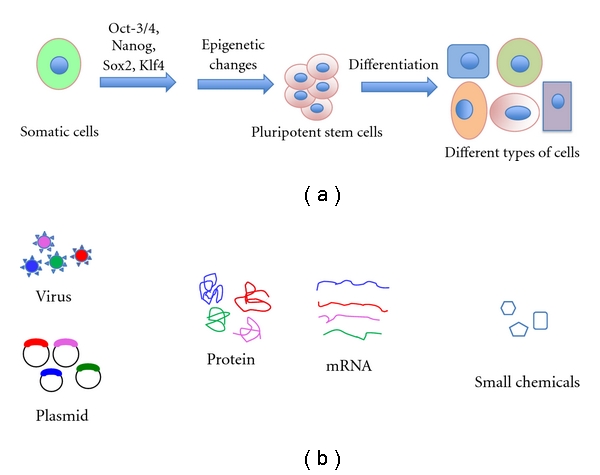
During embryonic development pluripotency is progressively lost irreversibly by cell division, differentiation, migration and organ formation. Terminally differentiated cells do not generate other kinds of cells. Pluripotent stem cells are a great source of varying cell types that are used for tissue regeneration or repair of damaged tissue. The pluripotent stem cells can be derived from inner cell mass of blastocyte but its application is limited due to ethical concerns. The recent discovery of iPS with defined reprogramming factors has initiated a flurry of works on stem cell in various laboratories. The pluripotent cells can be derived from various differentiated adult cells as well as from adult stem cells by nuclear reprogramming, somatic cell nuclear transfer etc. In this review article, different aspects of nuclear reprogramming are discussed.
Figures
References
-
- Nottebohm F. From bird song to neurogenesis. Scientific American. 1989;260(2):74–79. - PubMed
-
- Gurdon JB. The developmental capacity of nuclei taken from intestinal epithelium cells of feeding tadpoles. Journal of Embryology and Experimental Morphology. 1962;10:622–640. - PubMed
-
- Wilmut I, Schnieke AE, McWhir J, Kind AJ, Campbell KH. Viable offspring derived from fetal and adult mammalian cells. Nature. 1997;385(6619):810–813. - PubMed
-
- Reynolds BA, Weiss S. Generation of neurons and astrocytes from isolated cells of the adult mammalian central nervous system. Science. 1992;255(5052):1707–1710. - PubMed
LinkOut - more resources
Full Text Sources
Other Literature Sources
