


doi: 10.1155/2011/398476.
Epub 2011 Oct 11.
Optimal control of the lost to follow up in a tuberculosis model
Affiliations
- PMID: 22007263
- PMCID: PMC3191742
- DOI: 10.1155/2011/398476
Item in Clipboard
Optimal control of the lost to follow up in a tuberculosis model
Comput Math Methods Med.
2011.
Abstract
This paper deals with the problem of optimal control for the transmission dynamics of tuberculosis (TB). A TB model that considers the existence of a new class (mainly in the African context) is considered: the lost to follow up individuals. Based on the model formulated and studied in the work of Plaire Tchinda Mouofo, (2009), the TB control is formulated and solved as an optimal control theory problem using the Pontryagin's maximum principle (Pontryagin et al., 1992). This control strategy indicates how the control of the lost to follow up class can considerably influence the basic reproduction ratio so as to reduce the number of lost to follow up. Numerical results show the performance of the optimization strategy.
Figures
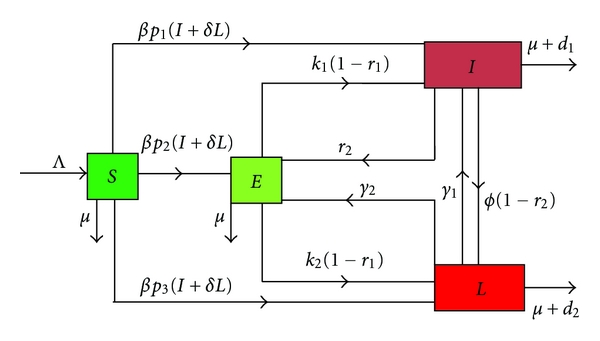
Flow diagram of the model without control.
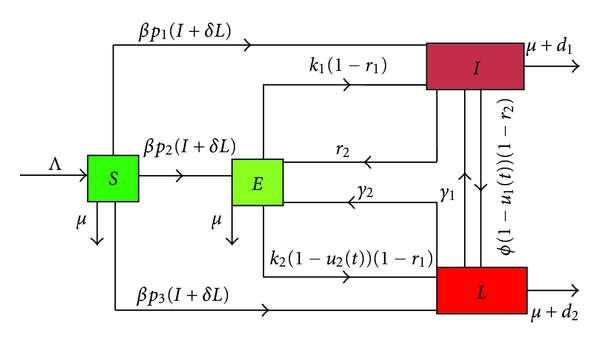
Flow diagram of the model with control.
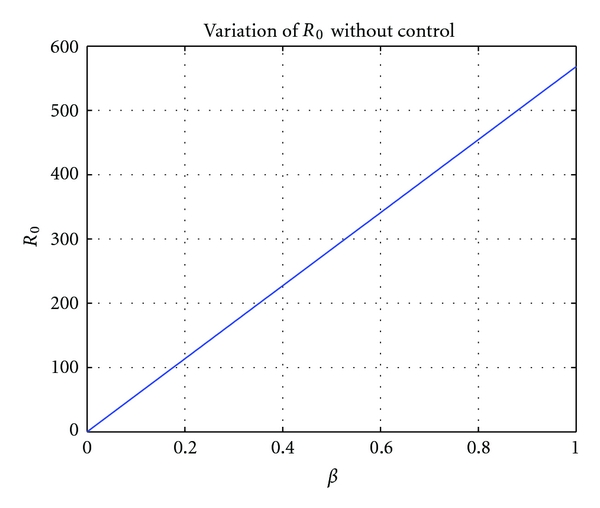
Variation of the basic reproduction ratio without control as a function of β, with ϕ = 0.0022 and k
2 = 0.0006.
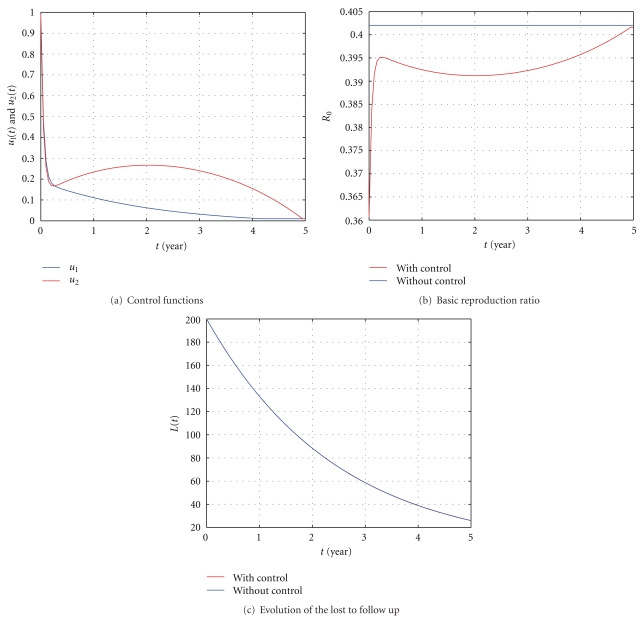
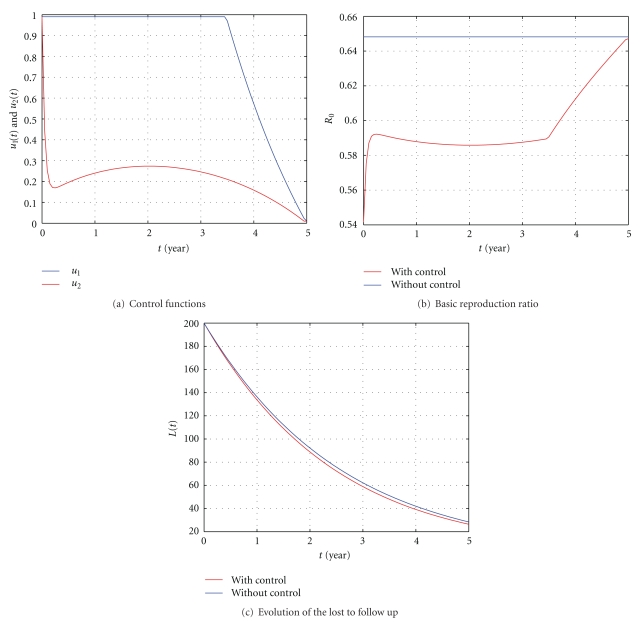
The influence of the control with S(0) = 50, E(0) = 100, I(0) = 150, L(0) = 200, β = 0.002, ϕ = 0.0022, and k
2 = 0.0006. All the other parameter values are as in Table 1.
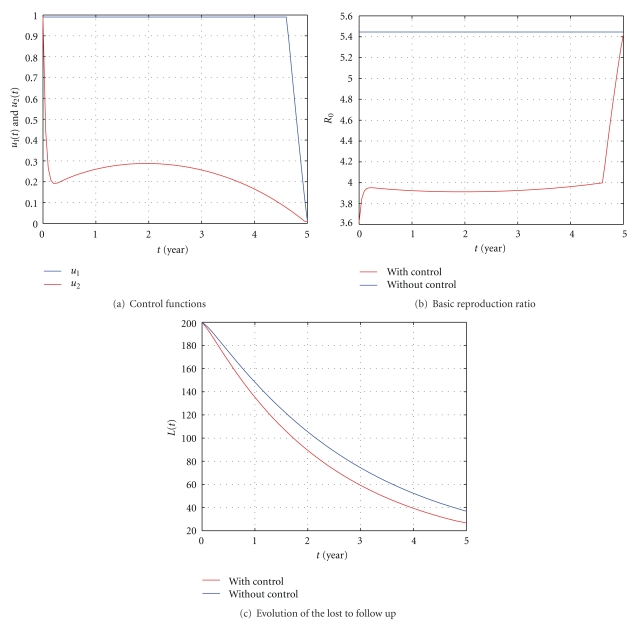
The influence of the control with S(0) = 50, E(0) = 100, I(0) = 150, L(0) = 200, β = 0.003, ϕ = 0.1, and k
2 = 0.0006. All the other parameter values are as in Table 1.
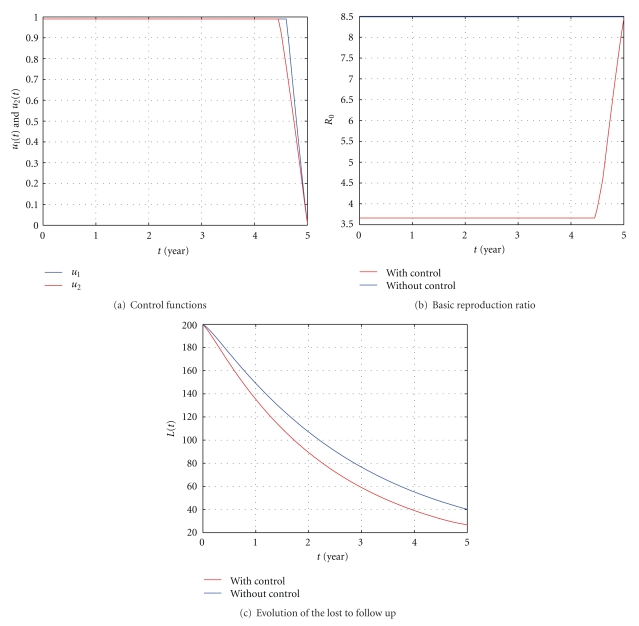
The influence of the control with S(0) = 50, E(0) = 100, I(0) = 150, L(0) = 200, β = 0.02, ϕ = 0.5, and k
2 = 0.0006. All the other parameter values are as in Table 1.
The influence of the control with S(0) = 50, E(0) = 100, I(0) = 150, L(0) = 200, β = 0.02, ϕ = 0.5, and k
2 = 0.006. All the other parameter values are as in Table 1.
References
-
- Bercion R, Kuaban C. Resistance of Mycobacterium tuberculosis complex to the main antituberculosis drugs in Yaounde-Cameroon. Bulletin de la Societe de Pathologie Exotique. 1998;91(3):199–202. - PubMed
-
- Global Tuberculosis Control: Surveillance, Planning, Financing. Geneva, Switzerland: World Health Organization; 2005.
-
- Feng Z, Castillo-Chavez C. Mathematical Models for the Disease Dynamics of Tubeculosis. River Edge, NJ, USA: World Scientific Publishing; 1998.
-
- Blower SM, Small PM, Hopewell PC. Control strategies for tuberculosis epidemics: New models for old problems. Science. 1996;273(5274):497–500. - PubMed
-
- Bowong S, Emvudu Y, Moualeu DP, Tewa JJ. Mathematical properies of a tuberculosis model with two differential infectivity and N latent classes. Journal of Nonlinear Systems and Applications. 2010:13–26.
MeSH terms
LinkOut - more resources
Full Text Sources
Medical
