Mental health and psychosocial support in humanitarian settings: linking practice and research
- PMID: 22008428
- PMCID: PMC3985411
- DOI: 10.1016/S0140-6736(11)61094-5
Mental health and psychosocial support in humanitarian settings: linking practice and research
Abstract
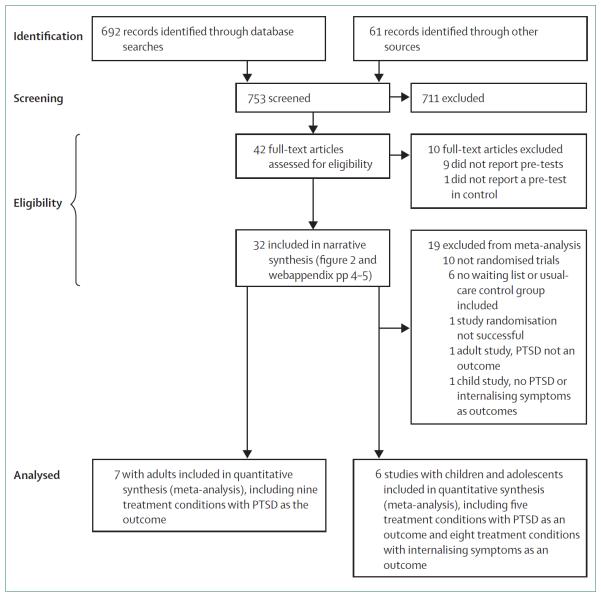
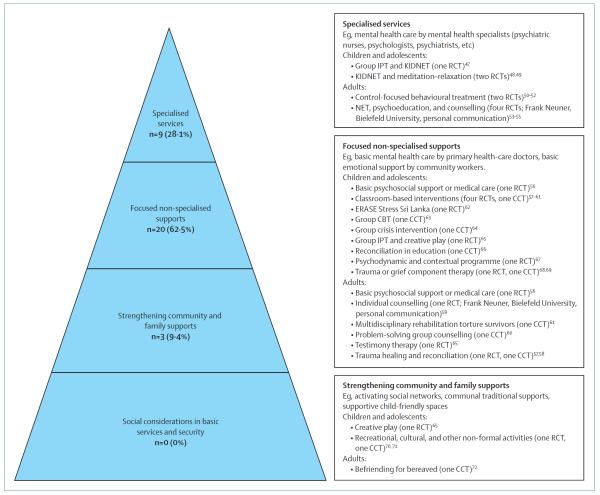
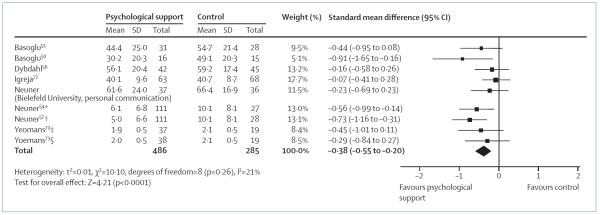
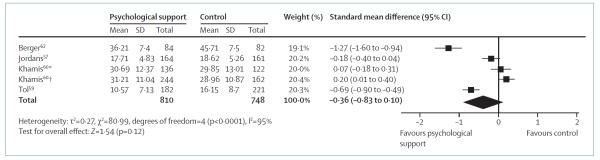
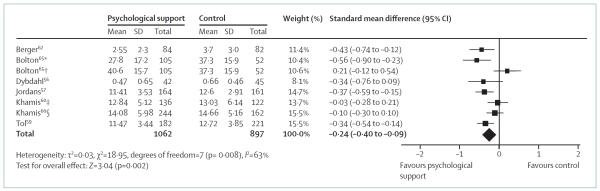
This review links practice, funding, and evidence for interventions for mental health and psychosocial wellbeing in humanitarian settings. We studied practice by reviewing reports of mental health and psychosocial support activities (2007-10); funding by analysis of the financial tracking service and the creditor reporting system (2007-09); and interventions by systematic review and meta-analysis. In 160 reports, the five most commonly reported activities were basic counselling for individuals (39%); facilitation of community support of vulnerable individuals (23%); provision of child-friendly spaces (21%); support of community-initiated social support (21%); and basic counselling for groups and families (20%). Most interventions took place and were funded outside national mental health and protection systems. 32 controlled studies of interventions were identified, 13 of which were randomised controlled trials (RCTs) that met the criteria for meta-analysis. Two studies showed promising effects for strengthening community and family supports. Psychosocial wellbeing was not included as an outcome in the meta-analysis, because its definition varied across studies. In adults with symptoms of post-traumatic stress disorder (PTSD), meta-analysis of seven RCTs showed beneficial effects for several interventions (psychotherapy and psychosocial supports) compared with usual care or waiting list (standardised mean difference [SMD] -0·38, 95% CI -0·55 to -0·20). In children, meta-analysis of four RCTs failed to show an effect for symptoms of PTSD (-0·36, -0·83 to 0·10), but showed a beneficial effect of interventions (group psychotherapy, school-based support, and other psychosocial support) for internalising symptoms (six RCTs; SMD -0·24, -0·40 to -0·09). Overall, research and evidence focuses on interventions that are infrequently implemented, whereas the most commonly used interventions have had little rigorous scrutiny.
Copyright © 2011 Elsevier Ltd. All rights reserved.
Figures
References
-
- Steel Z, Chey T, Silove D, Marnane C, Bryant RA, van Ommeren M. Association of torture and other potentially traumatic events with mental health outcomes among populations exposed to mass conflict and displacement. JAMA. 2009;302:537–49. - PubMed
-
- de Jong JTVM, Komproe IH, van Ommeren M. Common mental disorders in postconflict settings. Lancet. 2003;361:2128–30. - PubMed
-
- Norris FH, Friedman MJ, Watson PJ, Byrne CM, Diaz E, Kaniasty K. 60,000 disaster victims speak: part I. An empirical review of the empirical literature, 1981–2001. Psychiatry. 2002;65:207–39. - PubMed
-
- Silove D, Bateman CR, Brooks RT, et al. Estimating clinically relevant mental disorders in a rural and an urban setting in postconflict Timor Leste. Arch Gen Psychiatry. 2008;65:1205–12. - PubMed
Publication types
MeSH terms
Grants and funding
LinkOut - more resources
Full Text Sources
Medical
Miscellaneous