


Migratory flyway and geographical distance are barriers to the gene flow of influenza virus among North American birds
- PMID: 22008513
- PMCID: PMC3228906
- DOI: 10.1111/j.1461-0248.2011.01703.x
Migratory flyway and geographical distance are barriers to the gene flow of influenza virus among North American birds
Abstract
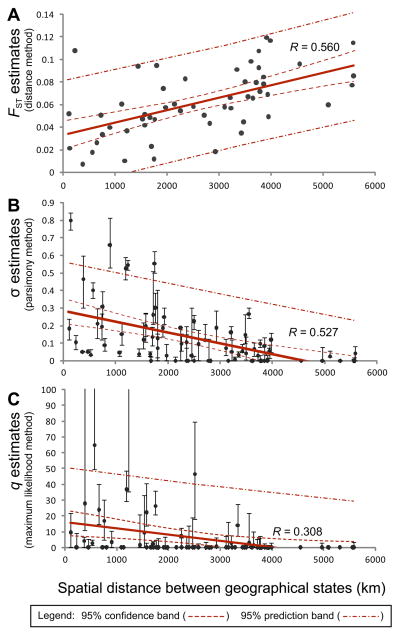
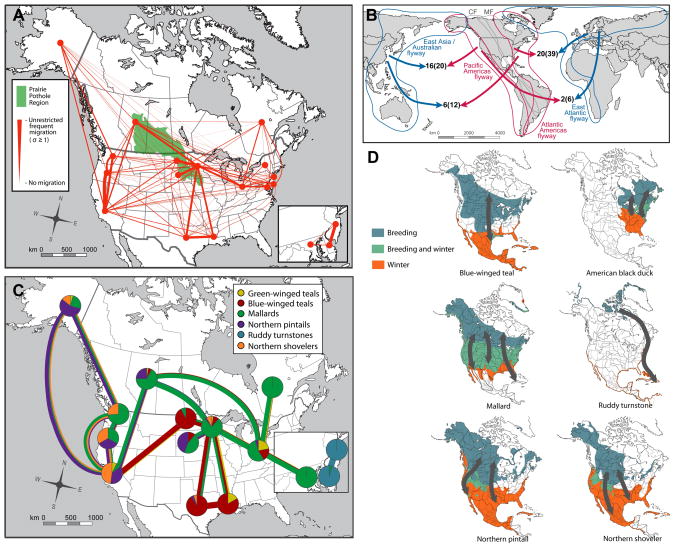
Despite the importance of migratory birds in the ecology and evolution of avian influenza virus (AIV), there is a lack of information on the patterns of AIV spread at the intra-continental scale. We applied a variety of statistical phylogeographic techniques to a plethora of viral genome sequence data to determine the strength, pattern and determinants of gene flow in AIV sampled from wild birds in North America. These analyses revealed a clear isolation-by-distance of AIV among sampling localities. In addition, we show that phylogeographic models incorporating information on the avian flyway of sampling proved a better fit to the observed sequence data than those specifying homogeneous or random rates of gene flow among localities. In sum, these data strongly suggest that the intra-continental spread of AIV by migratory birds is subject to major ecological barriers, including spatial distance and avian flyway.
© 2011 Blackwell Publishing Ltd/CNRS.
Figures


References
-
- Chen H, Smith GJ, Zhang SY, Qin K, Wang J, Li KS, Webster RG, Peiris JS, Guan Y. Avian flu: H5N1 virus outbreak in migratory waterfowl. Nature. 2005;436:191–2. - PubMed
-
- Davidson NC, Rothwell PI, Pienkowski MW. Towards a flyway conservation strategy for waders. Wader Study Group Bull. 1995:70–81.
-
- Deibel R, Emord DE, Dukelow W, Hinshaw VS, Wood JM. Influenza viruses and paramyxoviruses in ducks in the Atlantic flyway, 1977–1983, including an H5N2 isolate related to the virulent chicken virus. Avian Dis. 1985;29:970–85. - PubMed
Publication types
MeSH terms
Grants and funding
LinkOut - more resources
Full Text Sources
Medical
