


Fatty acid synthase and liver triglyceride metabolism: housekeeper or messenger?
- PMID: 22009142
- PMCID: PMC3288544
- DOI: 10.1016/j.bbalip.2011.09.017
Fatty acid synthase and liver triglyceride metabolism: housekeeper or messenger?
Abstract
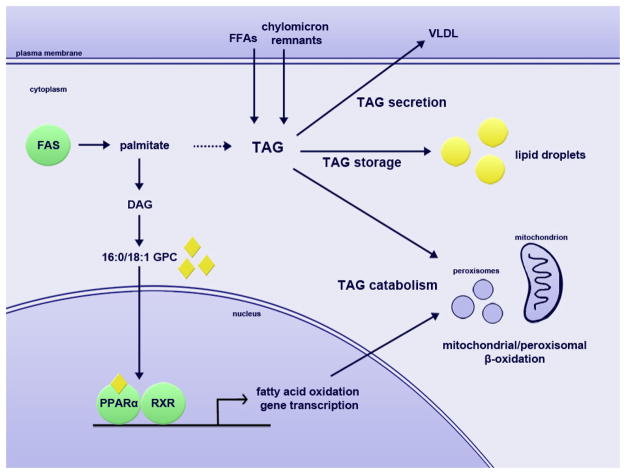
Fatty acid synthase (FAS) catalyzes the de novo synthesis of fatty acids. In the liver, FAS has long been categorized as a housekeeping protein, producing fat for storage of energy when nutrients are present in excess. Most previous studies of FAS regulation have focused on the control of gene expression. However, recent findings suggest that hepatic FAS may also be involved in signaling processes that include activation of peroxisome proliferator-activated receptor α (PPARα). Moreover, reports of rapid alterations in FAS activity as well as findings of post-translational modifications of the FAS protein support the notion that dynamic events in addition to transcription impact FAS regulation. These results indicate that FAS enzyme activity can impact liver physiology through signaling as well as energy storage and that its regulation may be complex. This article is part of a Special Issue entitled Triglyceride Metabolism and Disease.
Copyright © 2011 Elsevier B.V. All rights reserved.
Figures

References
-
- Wu M, Singh SB, Wang J, Chung CC, Salituro G, Karanam BV, Lee SH, Powles M, Ellsworth KP, Lassman ME, Miller C, Myers RW, Tota MR, Zhang BB, Li C. Antidiabetic and antisteatotic effects of the selective fatty acid synthase (FAS) inhibitor platensimycin in mouse models of diabetes. Proc Natl Acad Sci U S A. 2011;108:5378–5383. - PMC - PubMed
-
- Grundy SM, Brewer HB, Jr, Cleeman JI, Smith SC, Jr, Lenfant C. Definition of metabolic syndrome: Report of the National Heart, Lung, and Blood Institute/American Heart Association conference on scientific issues related to definition. Circulation. 2004;109:433–438. - PubMed
-
- Marchesini G, Brizi M, Bianchi G, Tomassetti S, Bugianesi E, Lenzi M, McCullough AJ, Natale S, Forlani G, Melchionda N. Nonalcoholic fatty liver disease: a feature of the metabolic syndrome. Diabetes. 2001;50:1844–1850. - PubMed
-
- Ford ES, Giles WH, Dietz WH. Prevalence of the metabolic syndrome among US adults: findings from the third National Health and Nutrition Examination Survey. JAMA. 2002;287:356–359. - PubMed
-
- Austin MA, Hokanson JE, Edwards KL. Hypertriglyceridemia as a cardiovascular risk factor. Am J Cardiol. 1998;81:7B–12B. - PubMed
Publication types
MeSH terms
Substances
Grants and funding
LinkOut - more resources
Full Text Sources
Other Literature Sources
Research Materials
Miscellaneous
