


Molecular basis of differential target regulation by miR-96 and miR-182: the Glypican-3 as a model
- PMID: 22009679
- PMCID: PMC3273822
- DOI: 10.1093/nar/gkr843
Molecular basis of differential target regulation by miR-96 and miR-182: the Glypican-3 as a model
Abstract
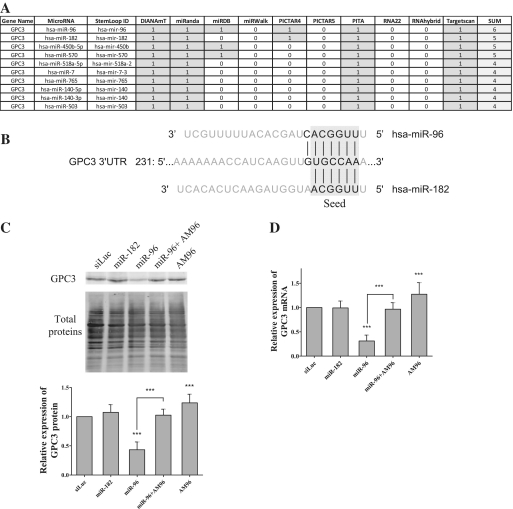
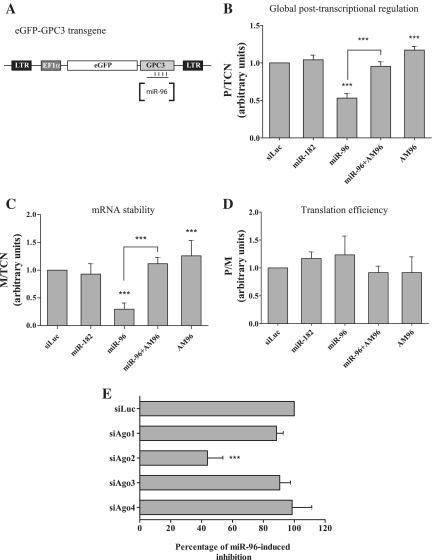
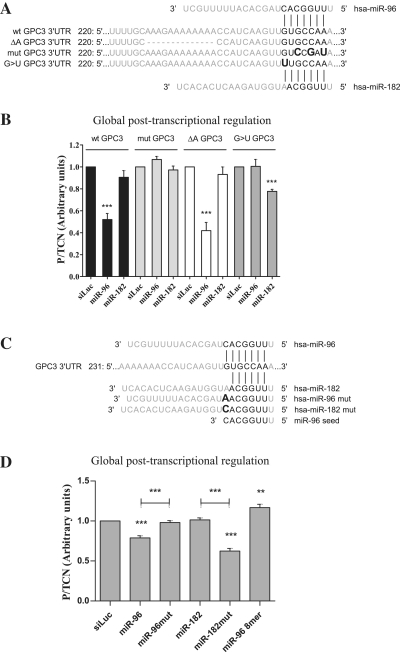
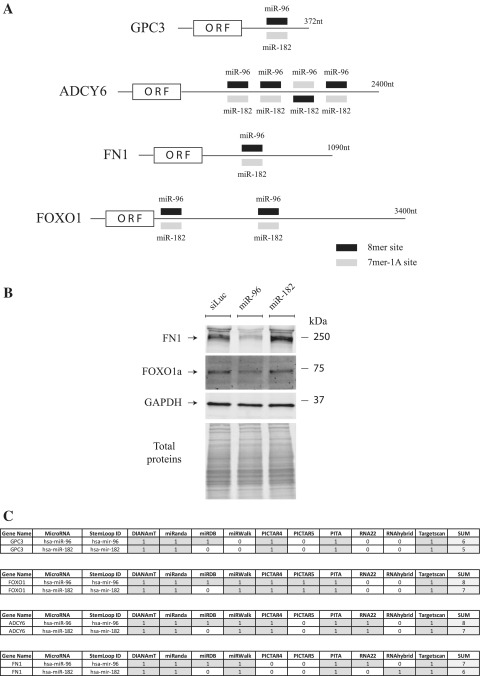
Besides the fact that miR-96 and miR-182 belong to the miR-182/183 cluster, their seed region (UUGGCA, nucleotides 2-7) is identical suggesting potential common properties in mRNA target recognition and cellular functions. Here, we used the mRNA encoding Glypican-3, a heparan-sulfate proteoglycan, as a model target as its short 3' untranslated region is predicted to contain one miR-96/182 site, and assessed whether it is post-transcriptionally regulated by these two microRNAs. We found that miR-96 downregulated GPC3 expression by targeting its mRNA 3'-untranslated region and interacting with the predicted site. This downregulatory effect was due to an increased mRNA degradation and depended on Argonaute-2. Despite its seed similarity with miR-96, miR-182 was unable to regulate GPC3. This differential regulation was confirmed on two other targets, FOXO1 and FN1. By site-directed mutagenesis, we demonstrated that the miRNA nucleotide 8, immediately downstream the UUGGCA seed, plays a critical role in target recognition by miR-96 and miR-182. Our data suggest that because of a base difference at miRNA position 8, these two microRNAs control a completely different set of genes and therefore are functionally independent.
Figures
References
-
- Garneau NL, Wilusz J, Wilusz CJ. The highways and byways of mRNA decay. Nat. Rev. Mol. Cell Biol. 2007;8:113–126. - PubMed
-
- Grosset C, Chen CY, Xu N, Sonenberg N, Jacquemin-Sablon H, Shyu AB. A mechanism for translationally coupled mRNA turnover: interaction between the poly(A) tail and a c-fos RNA coding determinant via a protein complex. Cell. 2000;103:29–40. - PubMed
-
- Grosset C, Boniface R, Duchez P, Solanilla A, Cosson B, Ripoche J. In vivo studies of translational repression mediated by the granulocyte-macrophage colony-stimulating factor AU-rich element. J. Biol. Chem. 2004;279:13354–13362. - PubMed
Publication types
MeSH terms
Substances
LinkOut - more resources
Full Text Sources
Other Literature Sources
Research Materials
Miscellaneous
