


Association between adolescent idiopathic scoliosis with double curve and polymorphisms of calmodulin1 gene/estrogen receptor-α gene
- PMID: 22009847
- PMCID: PMC6583290
- DOI: 10.1111/j.1757-7861.2009.00038.x
Association between adolescent idiopathic scoliosis with double curve and polymorphisms of calmodulin1 gene/estrogen receptor-α gene
Abstract
Objective: To investigate whether single nucleotide polymorphisms (SNP) of the calmodulin1 (CALM1) and estrogen receptor-α genes correlate with double curve in adolescent idiopathic scoliosis (AIS).
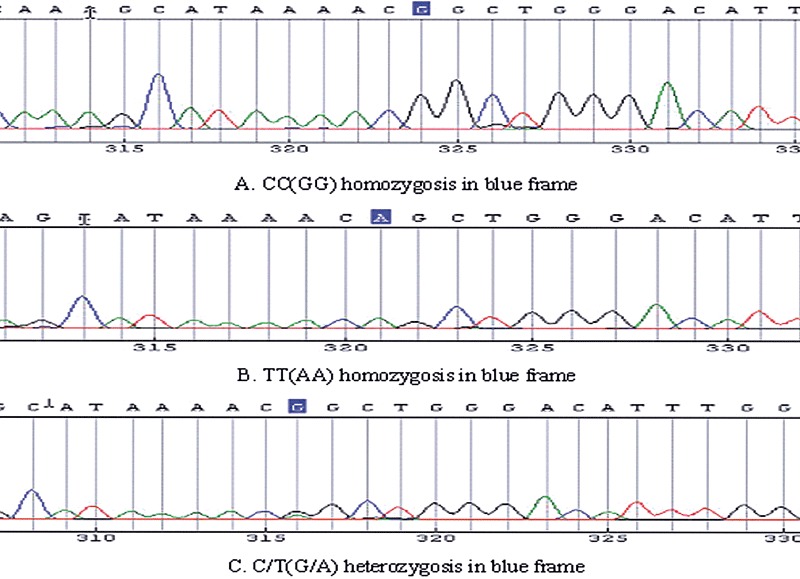
Methods: A total of 67 Chinese patients with AIS with double curve and 100 healthy controls were recruited. Curve pattern and Cobb angle of each patient were recorded. The Cobb angle is at least 30°. There were 60 patients with Cobb angle ≥ 40°. According to the apical location of the major curve, there were 40 thoracic curve patients. Four polymorphic loci, including rs12885713 (-16C > T) and rs5871 in the CALM1 gene and rs2234693 (Pvu II) and rs9340799 (Xba I) in the estrogen receptor 1 (ER1) gene were analyzed by the ABI3730 genetic analyzer.
Results: The current study indicates that: (i) there are statistical differences between patients with double curve, with Cobb angle ≥ 40° and with thoracic curve and healthy controls in the polymorphic distribution of the rs2234693 site of the ER1 gene, (P= 0.014, 0.0128, 0.0184 respectively); (ii) there is a difference between patients with double curve and controls in the polymorphic distribution of the rs12885713 site in the CALM1 gene (P= 0.034); and (iii) there is a difference between thoracic curve patients and controls in the polymorphic distribution of the rs5871 site in the CALM1 gene (P= 0.0102).
Conclusions: Different subtypes of AIS might be related to different SNP. A combination of CALM1 and ER1 gene polymorphisms might be related to double curve in patients with AIS. Further study is necessary to confirm these hypotheses.
© 2009 Tianjin Hospital and Blackwell Publishing Asia Pty Ltd.
Figures



References
-
- Barrack RL, Whitecloud TS 3rd, Burke SW, et al. Proprioception in idiopathic scoliosis. Spine, 1984, 9: 681–685. - PubMed
-
- Dickson RA. The aetiology of spinal deformities. Lancet, 1988, 1: 1151–1155. - PubMed
-
- Miller NH. Genetics of familial idiopathic scoliosis. Clin Orthop Relat Res, 2002, 401: 60–64. - PubMed
-
- Burwell RG. Aetiology of idiopathic scoliosis: current concepts. Pediatr Rehabil, 2003, 6: 137–170. - PubMed
-
- Lowe TG, Edgar M, Margulies JY, et al. Etiology of idiopathic scoliosis: current trends in research. J Bone Joint Surg Am, 2000, 82: 1157–1168. - PubMed
Publication types
MeSH terms
Substances
LinkOut - more resources
Full Text Sources
Medical
Miscellaneous
