


Characteristics of triple-negative breast cancer in patients with a BRCA1 mutation: results from a population-based study of young women
- PMID: 22010008
- PMCID: PMC3221522
- DOI: 10.1200/JCO.2010.33.6446
Characteristics of triple-negative breast cancer in patients with a BRCA1 mutation: results from a population-based study of young women
Abstract
Purpose: Triple-negative breast cancers (TNBCs) are tumors with low or no expression of estrogen receptor, progesterone receptor, or human epidermal growth factor receptor 2. These tumors have a poor prognosis, remain a clinical challenge, and are more common among women with BRCA1 mutations. We tested whether there are distinguishing features of TNBC after BRCA1 mutation status has been taken into account.
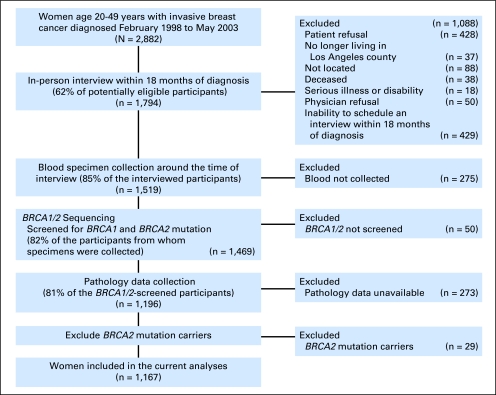
Patients and methods: We sequenced BRCA1 and BRCA2 genes in a population-based sample of 1,469 patients with incident breast cancer age 20 to 49 years from Los Angeles County (California). Information on tumor receptor status was available for 1,167 women. Clinical, pathologic, and hormone-related lifestyle characteristics were compared across patient subgroups defined by BRCA1 mutation status and triple-negative receptor status.
Results: Forty-eight percent of BRCA1 mutation carriers had TNBC compared with only 12% of noncarriers. Within BRCA1 mutation carriers, as well as within noncarriers, triple-negative receptor status was associated with younger age at diagnosis and higher tumor grade. Among women without a BRCA1 mutation, we observed that women with TNBC had higher premenopausal body mass index and earlier age at first full-term pregnancy than those with non-TNBC. Age at menarche and other reproductive factors were not associated with triple-negative status regardless of BRCA1 mutation status. Within BRCA1 mutation carriers, Ashkenazi Jewish women were about five times more likely to have TNBC than non-Ashkenazi Jewish women.
Conclusion: Our results suggest that among BRCA1 mutation carriers, as among noncarriers, there are unique characteristics associated with the triple-negative subtype. The findings in Ashkenazi Jewish BRCA1 mutation carriers should be confirmed.
Conflict of interest statement
Authors' disclosures of potential conflicts of interest and author contributions are found at the end of this article.
Figures
Comment in
-
Frequency of triple-negative breast cancer in BRCA1 mutation carriers: comparison between common Ashkenazi Jewish and other mutations.J Clin Oncol. 2012 Dec 10;30(35):4447-8. doi: 10.1200/JCO.2012.44.5635. Epub 2012 Oct 22. J Clin Oncol. 2012. PMID: 23091104 No abstract available.
References
-
- Hudis CA. Trastuzumab: Mechanism of action and use in clinical practice. N Engl J Med. 2007;357:39–51. - PubMed
-
- Riggs BL, Hartmann LC. Selective estrogen-receptor modulators: Mechanisms of action and application to clinical practice. N Engl J Med. 2003;348:618–629. - PubMed
-
- Reis-Filho JS, Tutt AN. Triple negative tumours: A critical review. Histopathology. 2008;52:108–118. - PubMed
-
- Bauer KR, Brown M, Cress RD, et al. Descriptive analysis of estrogen receptor (ER)-negative, progesterone receptor (PR)-negative, and HER2-negative invasive breast cancer, the so-called triple-negative phenotype: A population-based study from the California Cancer Registry. Cancer. 2007;109:1721–1728. - PubMed
-
- Carey LA, Dees EC, Sawyer L, et al. The triple negative paradox: Primary tumor chemosensitivity of breast cancer subtypes. Clin Cancer Res. 2007;13:2329–2334. - PubMed
Publication types
MeSH terms
Substances
Grants and funding
LinkOut - more resources
Full Text Sources
Medical
Research Materials
Miscellaneous
