


Gas-foaming calcium phosphate cement scaffold encapsulating human umbilical cord stem cells
- PMID: 22011243
- PMCID: PMC3313611
- DOI: 10.1089/ten.TEA.2011.0267
Gas-foaming calcium phosphate cement scaffold encapsulating human umbilical cord stem cells
Abstract
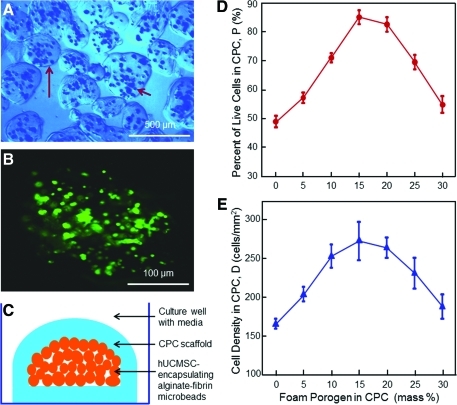
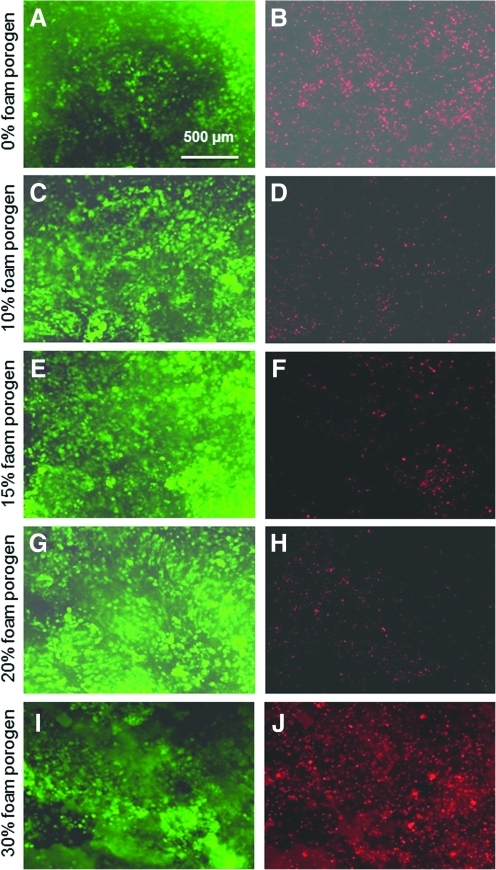
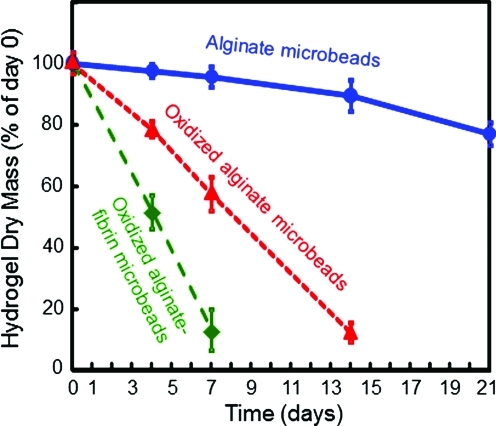
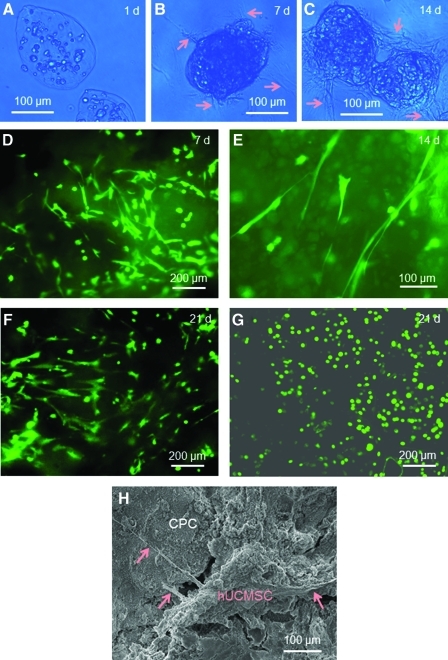
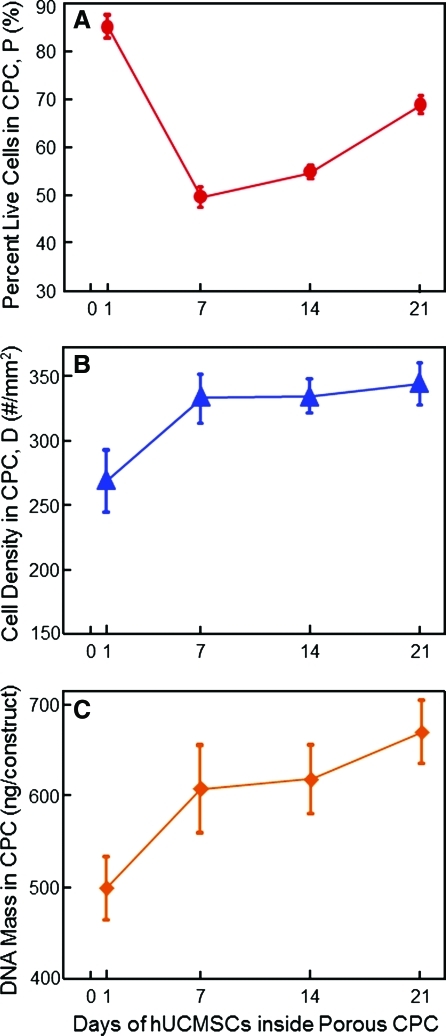
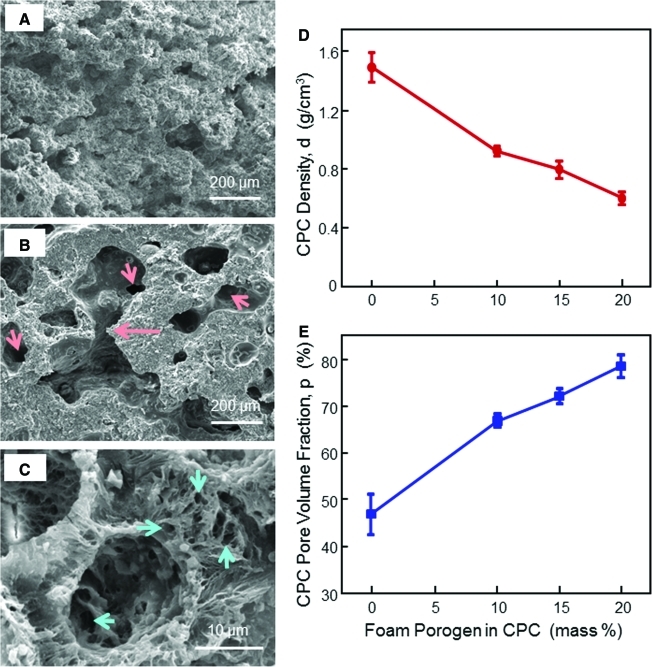
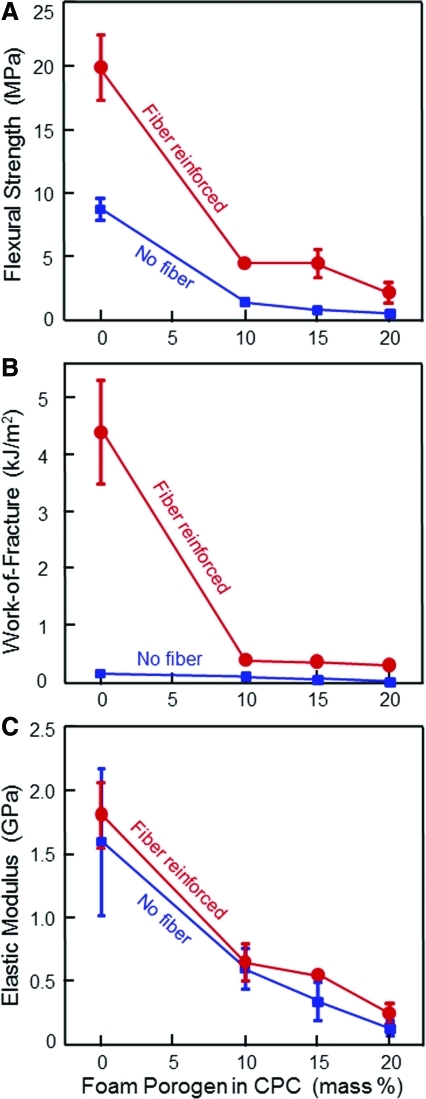
Tissue engineering approaches are promising to meet the increasing need for bone regeneration. Calcium phosphate cement (CPC) can be injected and self-set to form a scaffold with excellent osteoconductivity. The objectives of this study were to develop a macroporous CPC-chitosan-fiber construct containing alginate-fibrin microbeads encapsulating human umbilical cord mesenchymal stem cells (hUCMSCs) and to investigate hUCMSC release from the degrading microbeads and proliferation inside the porous CPC construct. The hUCMSC-encapsulated microbeads were completely wrapped inside the CPC paste, with the gas-foaming porogen creating macropores in CPC to provide for access to culture media. Increasing the porogen content in CPC significantly increased the cell viability, from 49% of live cells in CPC with 0% porogen to 86% of live cells in CPC with 15% porogen. The alginate-fibrin microbeads started to degrade and release the cells inside CPC at 7 days. The released cells started to proliferate inside the macroporous CPC construct. The live cell number inside CPC increased from 270 cells/mm(2) at 1 day to 350 cells/mm(2) at 21 days. The pore volume fraction of CPC increased from 46.8% to 78.4% using the gas-foaming method, with macropore sizes of approximately 100 to 400 μm. The strength of the CPC-chitosan-fiber scaffold at 15% porogen was 3.8 MPa, which approximated the reported 3.5 MPa for cancellous bone. In conclusion, a novel gas-foaming macroporous CPC construct containing degradable alginate-fibrin microbeads was developed that encapsulated hUCMSCs. The cells had good viability while wrapped inside the porous CPC construct. The degradable microbeads in CPC quickly released the cells, which proliferated over time inside the porous CPC. Self-setting, strong CPC with alginate-fibrin microbeads for stem cell delivery is promising for bone tissue engineering applications.
Figures
References
-
- Mao J.J. Vunjak-Novakovic G. Mikos A.G. Atala A. Regenerative Medicine: Translational Approaches and Tissue Engineering. Boston, MA: Artech House; 2007.
-
- Russias J. Saiz E. Deville S. Gryn K. Liu G. Tomsia A.P. Fabrication and in vitro characterization of three-dimensional organic/inorganic scaffolds by robocasting. J Biomed Mater Res A. 2007;83:434. - PubMed
-
- Bodde E.W. Boerman O.C. Russel F.G. Mikos A.G. Spauwen P.H. Jansen J.A. The kinetic and biological activity of different loaded rhBMP-2 calcium phosphate cement implants in rats. J Biomed Mater Res A. 2008;87:780. - PubMed
-
- Atala A. Engineering organs. Curr Opin Biotechnol. 2009;20:575. - PubMed
-
- Bohner M. Design of ceramic-based cements and putties for bone graft substitution. Eur Cell Mater. 2010;20:1. - PubMed
Publication types
MeSH terms
Substances
Grants and funding
LinkOut - more resources
Full Text Sources
Medical
