


Serum uric acid and 1-h postload glucose in essential hypertension
- PMID: 22011411
- PMCID: PMC3241313
- DOI: 10.2337/dc11-1727
Serum uric acid and 1-h postload glucose in essential hypertension
Abstract
Objective: Subjects who are normal glucose tolerant (NGT) are considered at low risk, even if a plasma glucose value ≥155 mg/dL for the 1-h postload plasma glucose during an oral glucose tolerance test (OGTT) is able to identify NGT subjects at high risk for type 2 diabetes and subclinical organ damage. Hyperuricemia is associated with several risk factors for cardiovascular diseases such as hypertension, insulin resistance, and diabetes. However, it is unknown whether uric acid (UA) is able to affect 1-h postload plasma glucose in hypertensive NGT subjects.
Research design and methods: From a cohort of ∼1,200 uncomplicated hypertensive outpatients who underwent OGTT, we selected 955 subjects (548 men and 407 women) aged 45.6 ± 10.1 years. Laboratory evaluations were performed, and estimated glomerular filtration rate was assessed by using the new equation proposed by investigators in the Chronic Kidney Disease Epidemiology Collaboration.
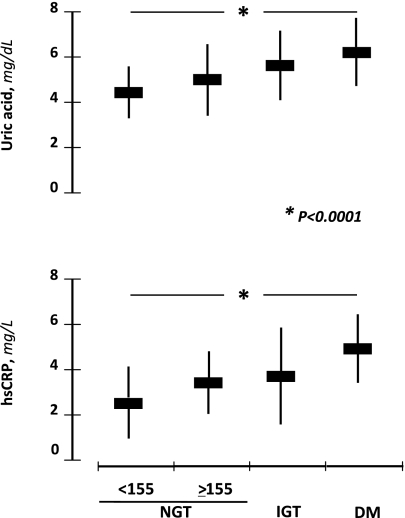
Results: Considering different stepwise multivariate linear regression models, UA was the major predictor of 1-h postload glucose in the entire population, with NGT ≥155 subjects, impaired glucose tolerant, and type 2 diabetic patients accounting for 26.0% (P < 0.0001), 25.3% (P < 0.0001), 13.5% (P < 0.0001), and 13.5% (P = 0.003) of its variation in the respective models.
Conclusions: We documented that in hypertensive NGT ≥155 subjects, UA is strongly associated with 1-h postload glucose, similarly to what is observed in impaired glucose tolerant and diabetic patients.
Figures
References
-
- Reaven GM. Role of insulin resistance in human disease (syndrome X): an expanded definition. Annu Rev Med 1993;44:121–131 - PubMed
-
- Facchini F, Chen YD, Hollenbeck CB, Reaven GM. Relationship between resistance to insulin-mediated glucose uptake, urinary uric acid clearance, and plasma uric acid concentration. JAMA 1991;266:3008–3011 - PubMed
-
- Takahashi S, Yamamoto T, Tsutsumi Z, Moriwaki Y, Yamakita J, Higashino K. Close correlation between visceral fat accumulation and uric acid metabolism in healthy men. Metabolism 1997;46:1162–1165 - PubMed
-
- Rathmann W, Funkhouser E, Dyer AR, Roseman JM. Relations of hyperuricemia with the various components of the insulin resistance syndrome in young black and white adults: the CARDIA study. Coronary Artery Risk Development in Young Adults. Ann Epidemiol 1998;8:250–261 - PubMed
MeSH terms
Substances
LinkOut - more resources
Full Text Sources
Medical
