. 2011 Dec 7;11(23):3990-8.
doi: 10.1039/c1lc20615j. Epub 2011 Oct 20.

High-speed, clinical-scale microfluidic generation of stable phase-change droplets for gas embolotherapy

Affiliations

High-speed, clinical-scale microfluidic generation of stable phase-change droplets for gas embolotherapy

David Bardin et al. Lab Chip. .

Abstract

In this study we report on a microfluidic device and droplet formation regime capable of generating clinical-scale quantities of droplet emulsions suitable in size and functionality for in vivo therapeutics. By increasing the capillary number-based on the flow rate of the continuous outer phase-in our flow-focusing device, we examine three modes of droplet breakup: geometry-controlled, dripping, and jetting. Operation of our device in the dripping regime results in the generation of highly monodisperse liquid perfluoropentane droplets in the appropriate 3-6 μm range at rates exceeding 10(5) droplets per second. Based on experimental results relating droplet diameter and the ratio of the continuous and dispersed phase flow rates, we derive a power series equation, valid in the dripping regime, to predict droplet size, D(d) approximately equal 27(Q(C)/Q(D))(-5/12). The volatile droplets in this study are stable for weeks at room temperature yet undergo rapid liquid-to-gas phase transition, and volume expansion, above a uniform thermal activation threshold. The opportunity exists to potentiate locoregional cancer therapies such as thermal ablation and percutaneous ethanol injection using thermal or acoustic vaporization of these monodisperse phase-change droplets to intentionally occlude the vessels of a cancer.


Figures
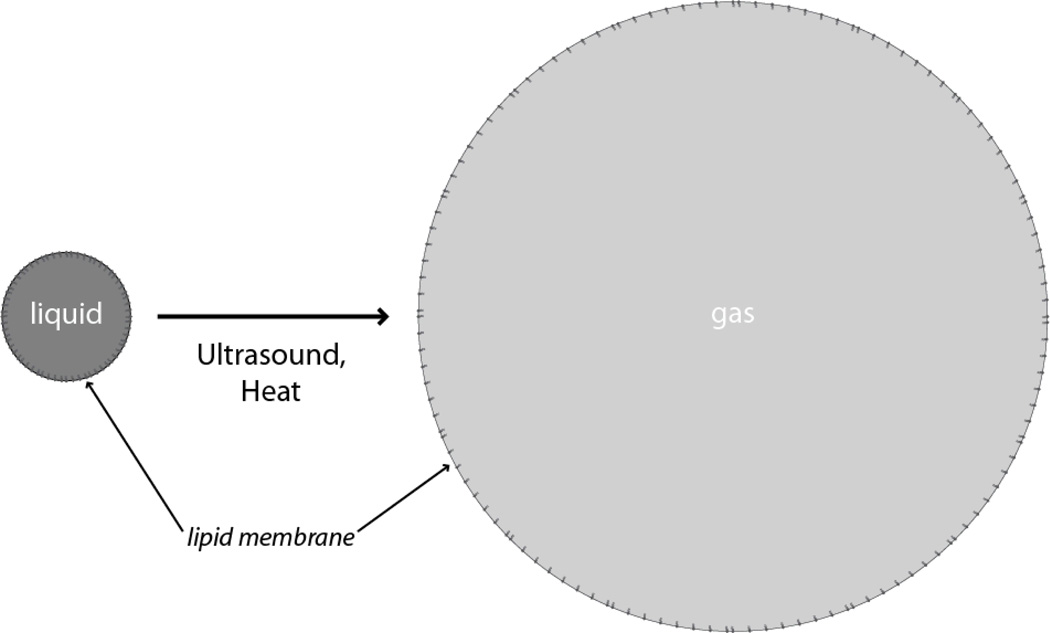
Fig. 1
Fig. 1
Schematic of the liquid-to-gas phase transition of a phase-change droplet. When presented with acoustic or thermal stimuli of a threshold amount, the volatile liquid core of the droplet rapidly vaporizes within the lipid shell. Expansion to a gas bubble enables the intentional occlusion of a target vessel in vivo. Other possible stimuli include light and mechanical pressure.
Fig. 2
Fig. 2
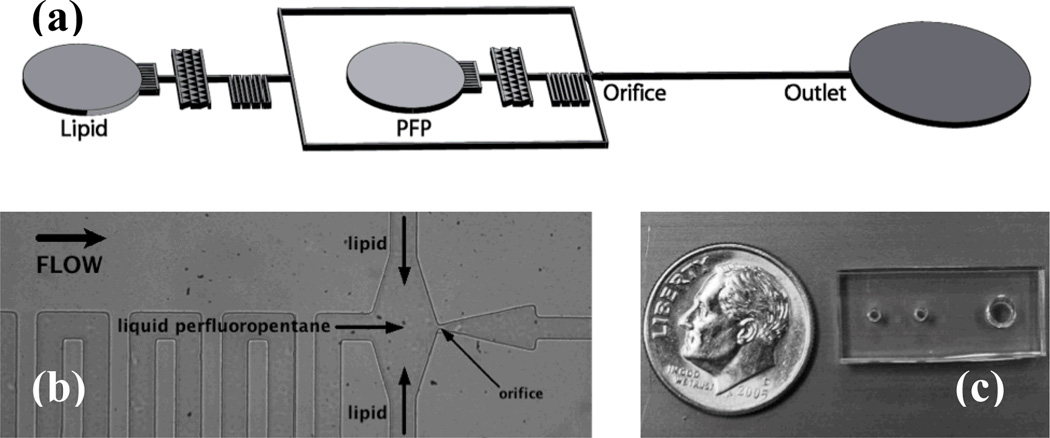
Geometry of the device for the generation of liquid perfluoropentane phase-change droplets. (a) Schematic view of the microfluidic flow-focusing device. All channels are rectangular with a height of 25 µm. (b) Image of the flow-focusing region. Lipid solution and liquid perfluoropentane distribution channels measure 38 µm in width and direct flows to a 7 µm orifice. Expanding nozzle geometry precedes a post-orifice channel 30 µm in width. (c) Overhead view of assembled PDMS device relative to a dime.
Fig. 3
Fig. 3
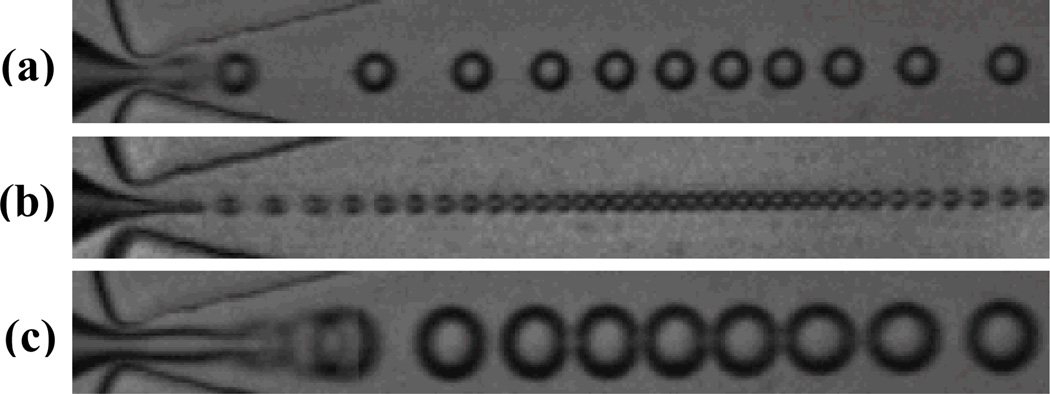
Representative images of three distinct droplet formation regimes. (a) Geometry-controlled. A series of overlaid images, successive in time, demonstrate the protrude-and-retract mechanism of the dispersed phase finger. (b) Dripping. Droplets break off from the tip of the dispersed phase finger at high rates due to “steady” Rayleigh capillary instability. (c) Jetting. A series of overlaid images, successive in time, demonstrate the break off of droplets due to “dynamic” Rayleigh capillary instability. Image height is 25 µm.
Fig. 4
Fig. 4
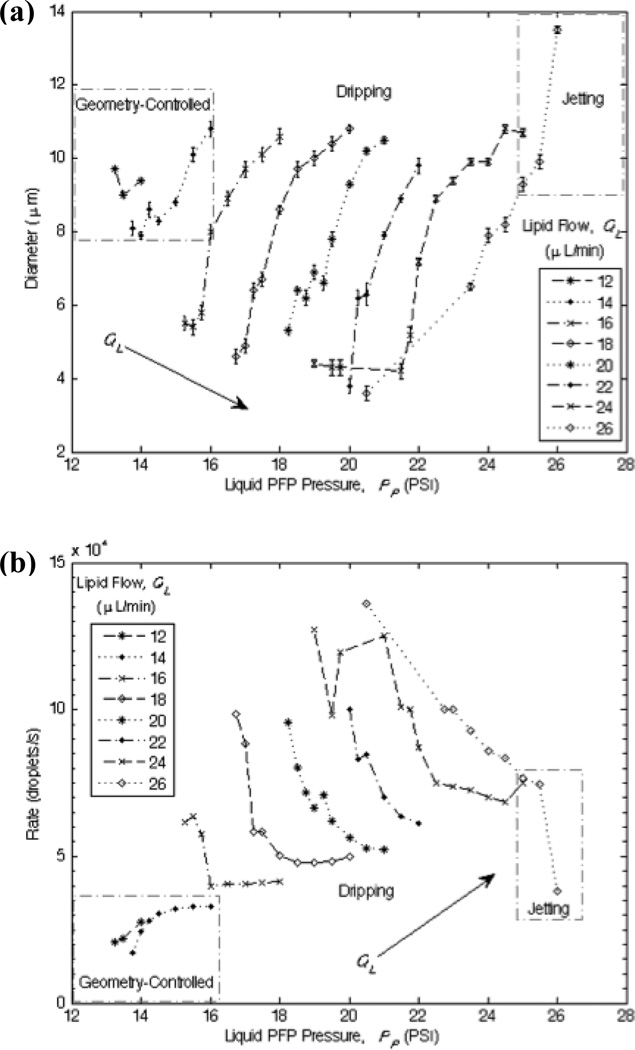
Diagrams of the production characteristics as determined by the flow parameters. Boxes distinguish geometry-controlled and jetting modes of droplet formation from dripping. (a) Droplet diameter D as a function of the lipid flow QL and the liquid perfluoropentane pressure PP. (b) Generation frequency fd as a function of QL and PP.
Fig. 5
Fig. 5
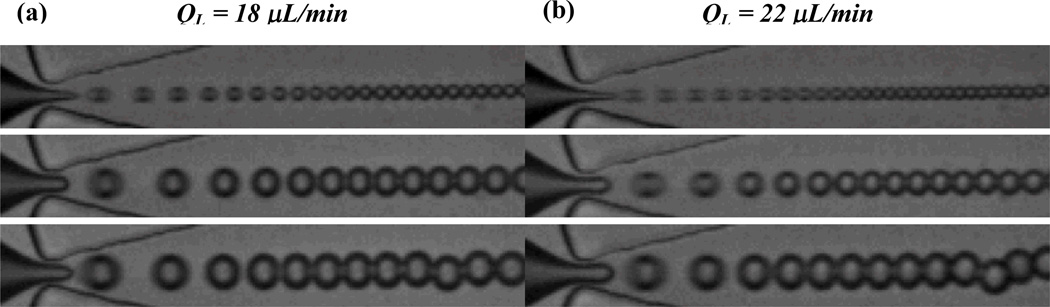
Sequence of images showing the effect of liquid perfluoropentane pressure for two lipid flows in the dripping regime. Droplet diameter decreases and generation frequency quickens as the dimensionless flow rate ratio φ = QL/QP increases. (a) QL = 18 µL/min. Top to bottom: PP = 17 PSI, φ = 55, D = 4.9 ± .2 µm, fd = 8.82 × 10⁴ Hz; PP = 18 PSI, φ = 18, D = 8.6 ± .1 µm, fd = 5.04 × 10⁴ Hz; PP = 19 PSI, φ = 9, D = 10.0 ± .2 µm, fd = 4.80 × 10⁴ Hz. (b) QL = 22 µL/min. Top to bottom: PP = 20 PSI, φ = 128, D = 3.8 ± .2 µm, fd = 1.00 × 10⁵ Hz; PP = 21 PSI, φ = 20, D = 7.9 ± .1 µm, fd = 7.00 × 10⁴ Hz; PP = 22 PSI, φ = 12, D = 9.8 ± .2 µm, fd = 6.12 × 10⁴ Hz. Image height is 25 µm.
Fig. 6
Fig. 6
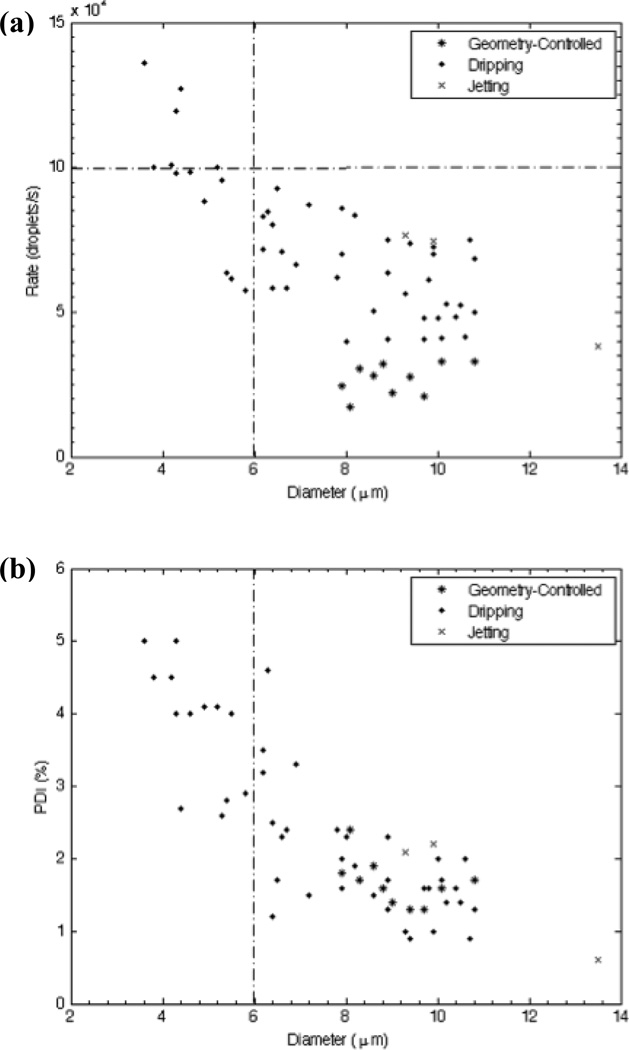
Plots relating generation frequency and polydispersity index to droplet size. The dripping regime enables droplet formation in the appropriate 3–6 µm range at high frequency and monodispersity. (a) Generation frequency fd as a function of droplet diameter D. (b) Polydispersity index (PDI) as a function of D. All flow conditions generated droplets with PDI < 5%.
Fig. 7
Fig. 7
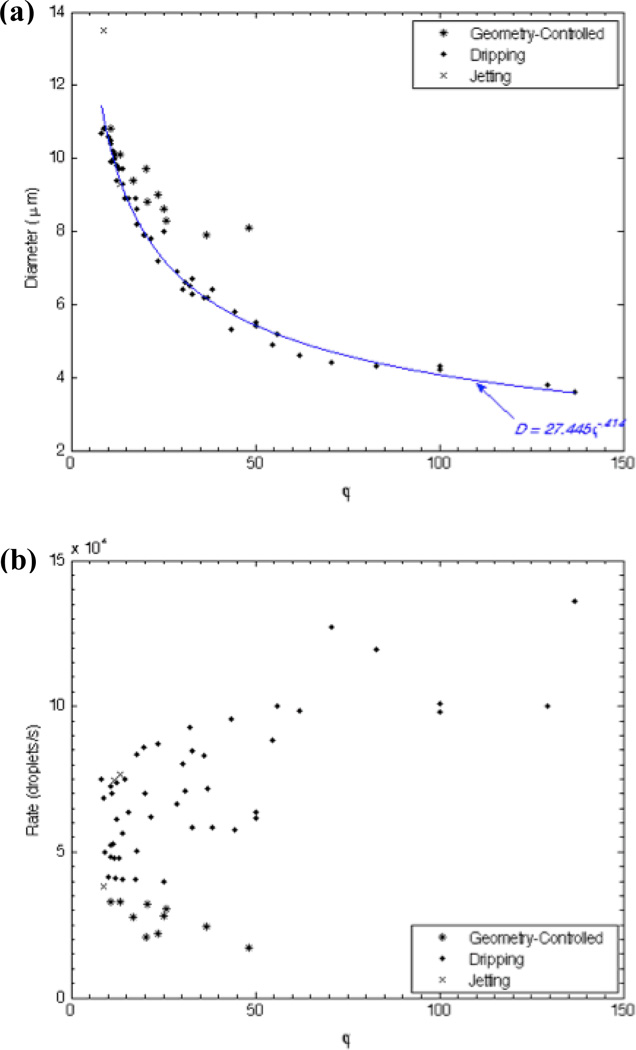
Diagrams of the production characteristics as determined by the ratio of the continuous lipid flow to the dispersed liquid perfluoropentane flow, φ = QL/QP. (a) Droplet diameter D as a function φ. For a given φ, droplet formation in geometry-controlled mode generates droplets of a larger size than in dripping. A power-series equation, valid in the dripping regime, emerges to predict droplet size based on the dimensionless flow rate ratio as D = 27.445φ−.414 (r2 = .99). (b) Generation frequency fd as a function of φ. Increasing φ tends to slow fd in geometry-controlled mode and quicken fd in dripping.
Fig. 8
Fig. 8
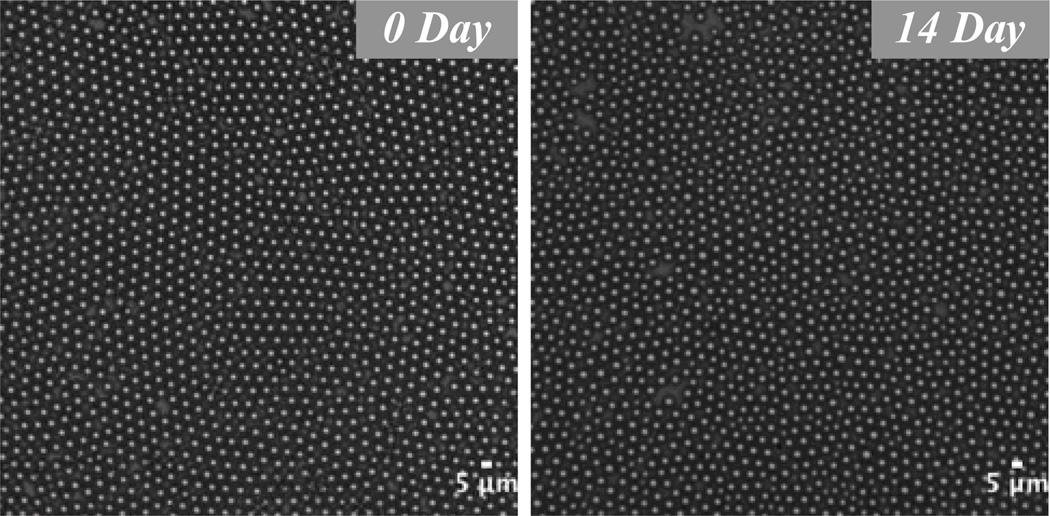
Images showing stability of a droplet population over a two-week time period. Droplets 4.5 µm in diameter drifted less than 4% in size over 14 days in a sealed glass vial at room temperature. Thus our phase-change droplets exhibited high stability in a true on-the-shelf setting. Scale bar represents 5 µm.
Fig. 9
Fig. 9
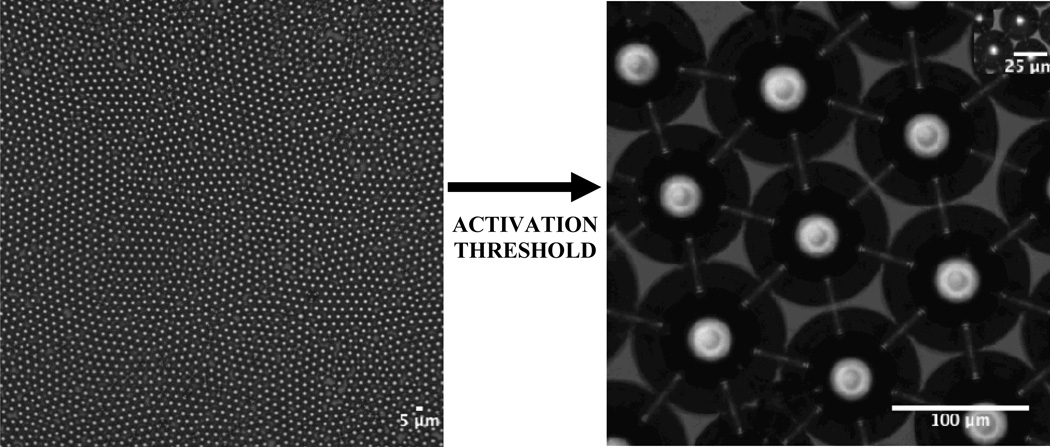
Thermal vaporization of a population of liquid perfluoropentane droplets after heating in a stirred water bath. Rapid droplet activation was observed at a water bath temperature of 88°C. Upon vaporization, 4.5 µm droplets initially transitioned into gas bubbles 106.7 µm in diameter. (inset) Occlusive bubbles with a resting diameter of 27.4 µm resulted following dissolution of extra gases.

References

    1. Goode JA, Matson MB. Embolisation of cancer: What is the evidence? Cancer Imaging. 2004;4:133–141. - PMC - PubMed
    1. Kalman D, Varenhorst E. The role of arterial embolization in renal cell carcinoma. Scandinavian Journal of Urology and Nephrology. 1999;33(3):162–170. - PubMed
    1. Kripfgans OD, Fowlkes JB, Miller DL, Eldevik OP, Carson PL. Acoustic droplet vaporization for therapeutic and diagnostic applications. Ultrasound Med. Biol. 2000;26(7):1177–1189. - PubMed
    1. Apfel RE. Activatable infusible dispersions containing drops of a superheated liquid for methods of therapy and diagnosis. United States: Apfel Enterprises, Inc.; 1998. Kripfgans 2002, In vivo droplet vaporization for occlusion therapy and phase aberration correction.
    1. Kripfgans OD, Fowlkes JB, Woydt M, Eldevik OP, Carson PL. In vivo droplet vaporization for occlusion therapy and phase aberration correction. IEEE Transactions on Ultrasonics, Ferroelectrics, and Frequency Control. 2002;49(6):726–738. - PubMed

Publication types

MeSH terms