. 2011 Oct 19;479(7373):365-71.
doi: 10.1038/nature10572.

Transgenerational epigenetic inheritance of longevity in Caenorhabditis elegans

Affiliations

Transgenerational epigenetic inheritance of longevity in Caenorhabditis elegans

Eric L Greer et al. Nature. .

Abstract

Chromatin modifiers regulate lifespan in several organisms, raising the question of whether changes in chromatin states in the parental generation could be incompletely reprogrammed in the next generation and thereby affect the lifespan of descendants. The histone H3 lysine 4 trimethylation (H3K4me3) complex, composed of ASH-2, WDR-5 and the histone methyltransferase SET-2, regulates Caenorhabditis elegans lifespan. Here we show that deficiencies in the H3K4me3 chromatin modifiers ASH-2, WDR-5 or SET-2 in the parental generation extend the lifespan of descendants up until the third generation. The transgenerational inheritance of lifespan extension by members of the ASH-2 complex is dependent on the H3K4me3 demethylase RBR-2, and requires the presence of a functioning germline in the descendants. Transgenerational inheritance of lifespan is specific for the H3K4me3 methylation complex and is associated with epigenetic changes in gene expression. Thus, manipulation of specific chromatin modifiers only in parents can induce an epigenetic memory of longevity in descendants.


Figures

Fig. 1
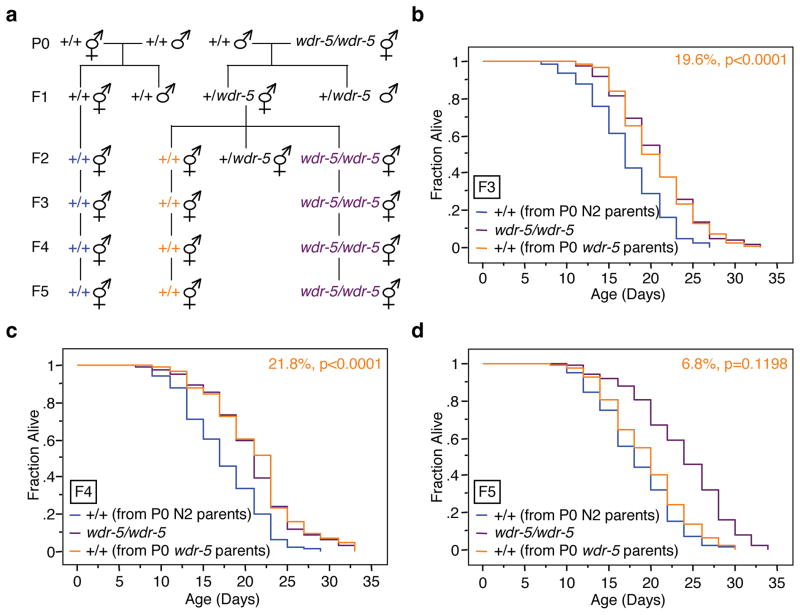
Fig. 1. Genetically wildtype descendents from wdr-5 mutant parents have extended lifespan for several generations
a, Scheme for generating wildtype descendents from wdr-5(ok1417) mutant worms. b–d, Lifespan of genetically wildtype F3 (b), F4 (c), F5 (d) descendents of wdr-5(ok1417) mutant worms (+/+ from P0 wdr-5 parents) compared to descendents of wildtype (N2) worms (+/+ from P0 N2 parents). Mean lifespan and statistics are presented in Supplementary Table 1.
Fig. 2
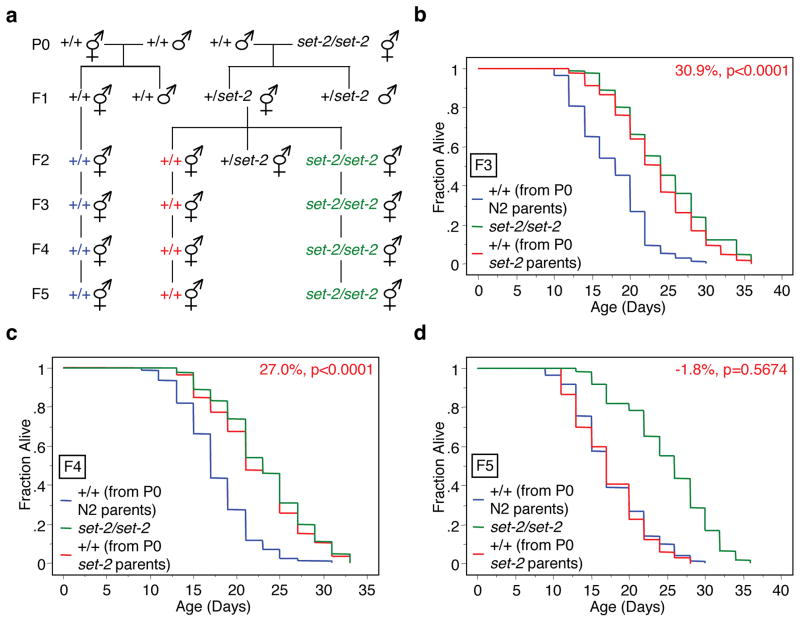
Fig. 2. Genetically wildtype descendents from set-2 mutant parents have extended lifespan for several generations
a, Scheme for generating wildtype descendents from set-2(ok952) mutant worms. b–d, Lifespan of genetically wildtype F3 (b), F4 (c), and F5 (d) descendents from set-2(ok952) mutant worms (+/+ from P0 set-2 parents) compared to descendents of wildtype (N2) worms (+/+ from P0 N2 parents). Mean lifespan and statistics are presented in Supplementary Table 1.
Fig. 3
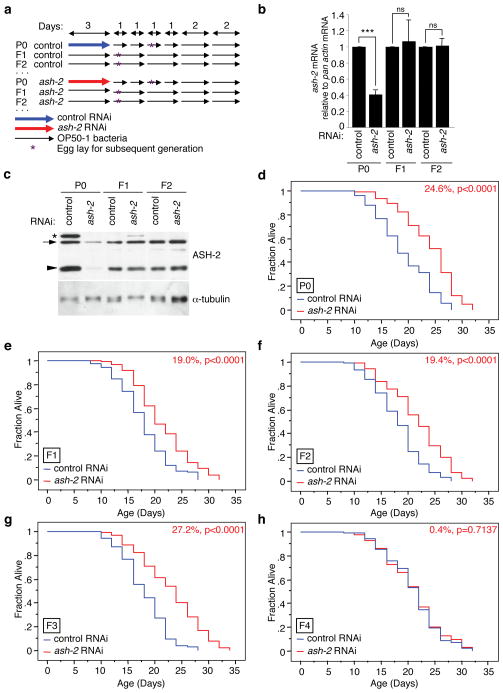
Fig. 3. Knock-down of ash-2 only in the parental generation extends lifespan for several generations
a, Scheme for generating wildtype descendents from RNAi treated parents. b, ash-2 mRNA levels at day 7 in different generations of worms treated with ash-2 RNAi or empty vector (control) only in the P0 generation. Mean ± s.e.m. of 3 independent experiments. ***p=0.0002 with paired t-test. c, ASH-2 protein levels at L3 stage in different generations of worms treated with ash-2 RNAi or empty vector (control) only in the P0 generation. Representative of 2 independent experiments. *: non-specific band; Arrow: ASH-2; Arrowhead: protein related to ASH-2, possibly a degradation product. d–h, Lifespan of P0 (d), F1 (e), F2 (f), F3 (g), and F4 (h) generations of worms with RNAi knock-down of ash-2 in parents only. Control RNAi: empty vector. Mean lifespan and statistics are presented in Supplementary Table 2.
Fig. 4
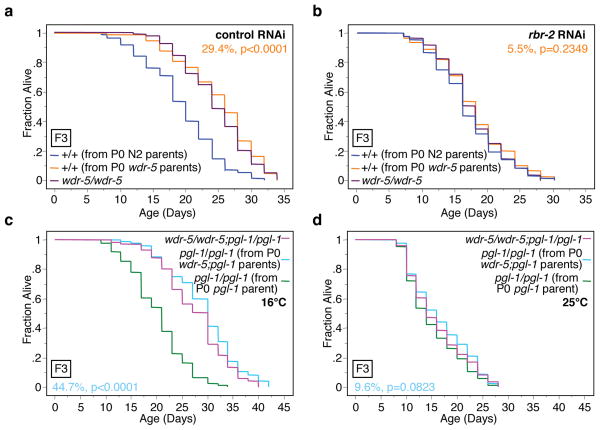
Fig. 4. The transgenerational inheritance of longevity by deficiencies in ASH-2 complex members is dependent on the presence of the H3K4me3 demethylase RBR-2 and of an intact germline
a–b, Lifespan of genetically wildtype F3 descendents from wdr-5(ok1417) mutant worms (+/+ from P0 wdr-5 parents) in the presence of empty vector (control RNAi) (a) or rbr-2 RNAi (b). c–d, Lifespan of pgl-1 F3 descendents from a wdr-5(ok1417);pgl-1(bn101) mutant worms (pgl-1/pgl-1 from P0 wdr-5;pgl-1 parents) compared to descendents from pgl-1(bn101) worms at the permissive temperature (16°C) (c) and at the restrictive temperature (25°C) (d). Mean lifespan and statistics are presented in Supplementary Tables 3 and 4.
Fig. 5
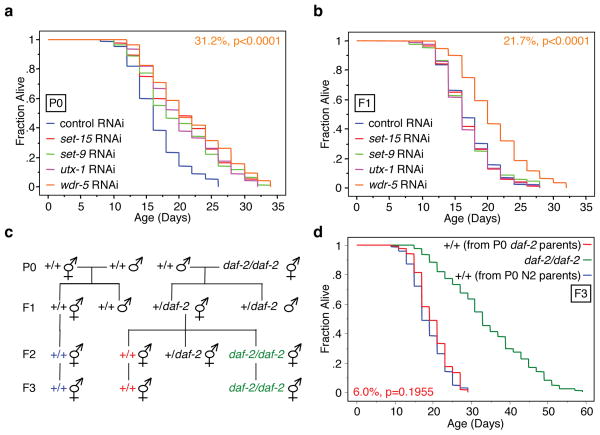
Fig. 5. Other longevity regulators do not have a transgenerational effect on lifespan
a–b, Lifespan of P0 (a) and F1 (b) generation descendents from worms treated with set-9, set-15, utx-1, and wdr-5 RNAi only in the P0 generation. Control RNAi: empty vector. c, Scheme for generating wildtype progeny from daf-2(e1370) mutant worms. d, Lifespan of genetically wildtype F3 descendents from daf-2(e1370) mutant worms (+/+ from P0 daf-2 parents). Mean lifespan and statistics are presented in Supplementary Tables 2 and 4.
Fig. 6
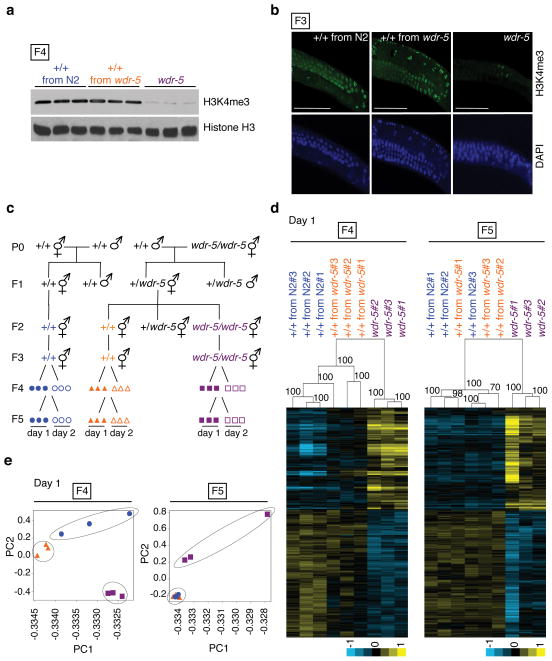
Fig. 6. Genetically wildtype descendents from wdr-5 mutant parents exhibit differences in gene expression, but not in global H3K4me3 levels, compared to descendents from wildtype parents
a–b, Global H3K4me3 levels in the F4 generation by western blot (a) or in the F3 generation by immunocytochemistry (b) of L3 worms from genetically wildtype descendents from wdr-5 parents (+/+ from wdr-5) or wildtype parents (+/+ from N2), and wdr-5 mutants (wdr-5). Scale bars: 50 μm. c, Scheme for generating wildtype descendents from a cross between wdr-5(ok1417) null mutant worms and wildtype worms. Symbols represent RNA samples from L3 worms from 3 independent F2 ancestors on the first (closed symbols) or second (open symbols) day of egg-laying. d, Unbiased hierarchical clustering of WDR-5 regulated genes from the first day of egg-laying (Supplementary Table 9). Pvclust values are displayed on each node of the dendrogram. Values superior to 95 are considered significant. e, Principal component analysis (PCA) of the entire microarray datasets from the first day of egg-laying (Supplementary Table 5). PC: Principal component. Symbols represent gene expression data from L3 worms collected on the first day of egg-laying (Fig. 6c).

Comment in

References

    1. Cubas P, Vincent C, Coen E. An epigenetic mutation responsible for natural variation in floral symmetry. Nature. 1999;401:157–61. - PubMed
    1. Brink RA. A Genetic Change Associated with the R Locus in Maize Which Is Directed and Potentially Reversible. Genetics. 1956;41:872–89. - PMC - PubMed
    1. Woodhouse MR, Freeling M, Lisch D. Initiation, establishment, and maintenance of heritable MuDR transposon silencing in maize are mediated by distinct factors. PLoS Biol. 2006;4:e339. - PMC - PubMed
    1. Katz DJ, Edwards TM, Reinke V, Kelly WG. A C. elegans LSD1 demethylase contributes to germline immortality by reprogramming epigenetic memory. Cell. 2009;137:308–20. - PMC - PubMed
    1. Cavalli G, Paro R. The Drosophila Fab-7 chromosomal element conveys epigenetic inheritance during mitosis and meiosis. Cell. 1998;93:505–18. - PubMed

Publication types

MeSH terms

Associated data