


ADORA2A Gene variation, caffeine, and emotional processing: a multi-level interaction on startle reflex
- PMID: 22012471
- PMCID: PMC3260968
- DOI: 10.1038/npp.2011.253
ADORA2A Gene variation, caffeine, and emotional processing: a multi-level interaction on startle reflex
Abstract
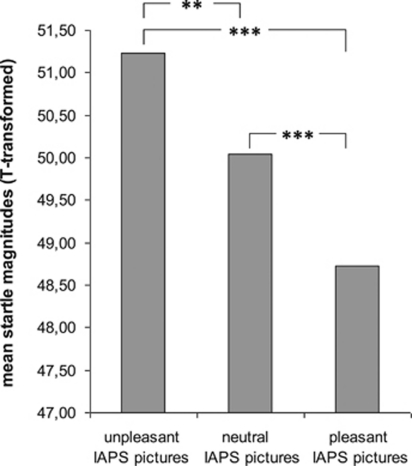
There is converging evidence for genetic, biochemical, and neuropsychological factors to increase the risk for anxiety and anxiety disorders. The pathogenesis of anxiety disorders is assumed to be influenced by a complex interaction of these individual risk factors on several levels, affecting intermediate phenotypes of anxiety such as the startle reflex. Thus, in the present double-blind, placebo-controlled study we attempted to paradigmatically investigate a multi-level pathogenetic model of anxiety by testing the effect of 300 mg caffeine citrate as an antagonist at the adenosine A2A receptor vs placebo on the emotion-potentiated (unpleasant, neutral, and pleasant International Affective Picture System pictures) startle reflex in 110 healthy individuals (male=56, female=54) stratified for the adenosine A2A receptor (ADORA2A) 1976T>C polymorphism (rs5751876). In addition to the expected main effect of picture category (highest startle amplitude for unpleasant, lowest for pleasant pictures) groups across all ADORA2A 1976T>C genotype and intervention (caffeine vs placebo) groups, an interaction effect of genotype, intervention, and picture category was discerned: In ADORA2A 1976TT risk genotype carriers, highest startle magnitudes were observed after caffeine administration in response to unpleasant pictures, with this effect arising particularly from the female subgroup. Our data point to a complex, multi-level, and potentially gender-specific pathogenetic model of anxiety, with genetic and biochemical factors interactively increasing the risk of maladaptive emotional processing and thereby possibly also anxiety disorders. The present findings may eventually aid in improving primary and secondary prevention by sharpening the risk profiles of anxiety-prone individuals.
Figures



References
-
- Albani C, Blaser G, Geyer M, Schmutzer G, Brahler E, Bailer H, et al. [The German short version of ‘Profile of Mood States' (POMS): psychometric evaluation in a representative sample] Psychother Psychosom Med Psychol. 2005;55:324–330. - PubMed
-
- Alpers GW, Pauli P. Angstsensitivitäts-Index. PsychScience: Würzburg; 2002.
-
- Alsene K, Deckert J, Sand P, de Wit H. Association between A2a receptor gene polymorphisms and caffeine-induced anxiety. Neuropsychopharmacology. 2003;28:1694–1702. - PubMed
-
- Andrews SE, Blumenthal TD, Flaten MA. Effects of caffeine and caffeine-associated stimuli on the human startle eyeblink reflex. Pharmacol Biochem Behav. 1998;59:39–44. - PubMed
-
- Armbruster D, Mueller A, Strobel A, Kirschbaum C, Lesch KP, Brocke B. Influence of functional tryptophan hydroxylase 2 gene variation and sex on the startle response in children, young adults, and older adults. Biol Psychol. 2010;83:214–221. - PubMed
Publication types
MeSH terms
Substances
LinkOut - more resources
Full Text Sources
Medical
Molecular Biology Databases
