


Comparative Study
doi: 10.1128/JVI.05474-11.
Epub 2011 Oct 19.
Length variations in the NA stalk of an H7N1 influenza virus have opposite effects on viral excretion in chickens and ducks
Affiliations
- PMID: 22013034
- PMCID: PMC3255888
- DOI: 10.1128/JVI.05474-11
Item in Clipboard
Comparative Study
Length variations in the NA stalk of an H7N1 influenza virus have opposite effects on viral excretion in chickens and ducks
J Virol.
2012 Jan.
Abstract
A deletion of ∼20 amino acids in the stalk of neuraminidase is frequently observed upon transmission of influenza A viruses from waterfowl to domestic poultry. A pair of recombinant H7N1 viruses bearing either a short- or long-stalk neuraminidase was genetically engineered. Inoculation of the long-stalk-neuraminidase virus resulted in a higher cloacal excretion in ducks and led conversely to lower-level oropharyngeal excretion in chickens, associated with a higher-level local immune response and better survival. Therefore, a short-stalk neuraminidase is a determinant of viral adaptation and virulence in chickens but is detrimental to virus replication and shedding in ducks.
Figures
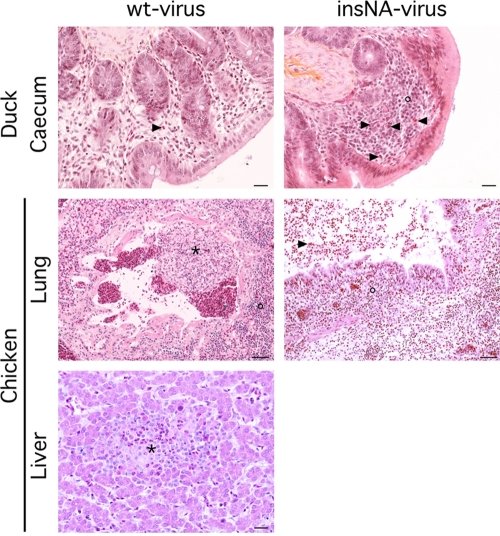
Microscopic examination of tissues sampled from chickens and ducks inoculated with the wt or insNA virus. Mild focal infiltration of mononuclear cells (open circle) and heterophils (filled arrowheads) was more pronounced in the ceca of ducks inoculated with the insNA virus than in those of ducks inoculated with the wt virus at d4 (upper panel). In the lungs of wt virus-inoculated chickens at d2, the lumen of bronchi and parabronchi was occluded by large amounts of necrotic debris of the respiratory epithelium (*) admixed with some heterophils, whereas only an exudate rich in heterophils (filled arrowheads) was present in insNA virus-inoculated animals (middle panel). Mild multifocal hepatic necrosis (*) associated with a heterophilic infiltration was detected in a chicken inoculated with the wt virus at d3 (lower panel). Hemalum-eosin-saffron staining was used. Scale bars, 20 μm (upper and lower panels) and 50 μm (middle panel).
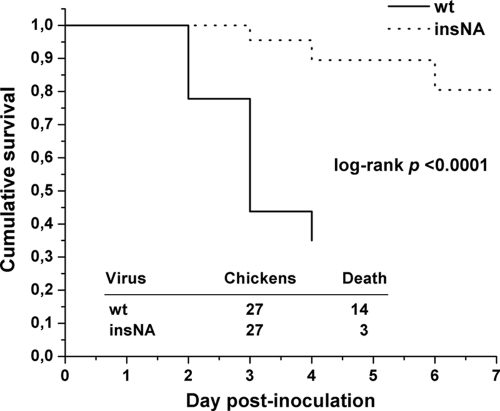
Survival of chickens inoculated with wt or insNA virus. Survival was estimated for 27 wt virus-inoculated chickens and 27 insNA virus-inoculated chickens by Kaplan-Meier life table analysis, and survival data were compared by a log rank test.
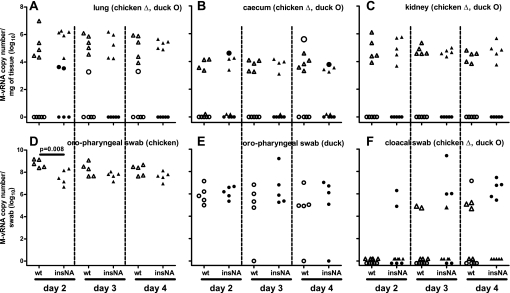
Levels of M vRNA in wt and insNA virus-inoculated birds. Levels of M vRNA were determined by qRT-PCR on viral RNA extracted from lung (A), cecum (B), and kidney (C) homogenates or from oropharyngeal and cloacal swabs (D to F). Data from both chickens and ducks are grouped in panels A to C and F. The M vRNA copy numbers per mg of tissue were calculated as previously described (16) and converted to their log10 values. Differences between the wt and insNA groups were assessed by a Mann-Whitney U test.
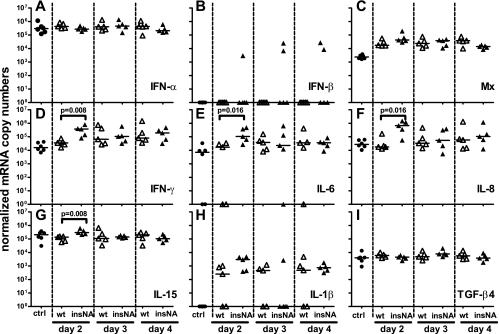
Levels of cytokine mRNAs in the lungs of wt and insNA virus-inoculated chickens. Total RNA was extracted from the lungs of 5 wt virus-inoculated chickens, 5 insNA virus-inoculated chickens, and 2 mock-inoculated chickens (ctrl) at days 2, 3, and 4 postinoculation (p.i.). The levels of the indicated cytokine mRNAs at the indicated time points were determined using quantitative RT-PCR as previously described (16). The results are expressed as mRNA copy numbers (y axis, left scale) normalized with respect to 107 copies of the geometric mean of 3 reference gene cDNA copy numbers (those corresponding to glyceraldehyde-3-phosphate dehydrogenase [GAPDH], G10, and ubiquitin), as measured in the same sample. Values from the six mock-inoculated chickens were grouped. The median value for each experimental group is indicated by a horizontal bar. Differences between the wt and insNA groups were assessed by a Mann-Whitney U test with Bonferroni's correction (corrected cutoff P for significance, 0.017).
References
-
- Baigent SJ, McCauley JW. 2001. Glycosylation of haemagglutinin and stalk-length of neuraminidase combine to regulate the growth of avian influenza viruses in tissue culture. Virus Res. 79:177–185 - PubMed
-
- Banks J, et al. 2001. Changes in the haemagglutinin and the neuraminidase genes prior to the emergence of highly pathogenic H7N1 avian influenza viruses in Italy. Arch. Virol. 146:963–973 - PubMed
-
- Campitelli L, et al. 2004. Interspecies transmission of an H7N3 influenza virus from wild birds to intensively reared domestic poultry in Italy. Virology 323:24–36 - PubMed
-
- Dundon WG, Milani A, Cattoli G, Capua I. 2006. Progressive truncation of the non-structural 1 gene of H7N1 avian influenza viruses following extensive circulation in poultry. Virus Res. 119:171–176 - PubMed
Publication types
MeSH terms
Substances
LinkOut - more resources
Full Text Sources
Other Literature Sources
Medical
