


Secretion modification region-derived peptide disrupts HIV-1 Nef's interaction with mortalin and blocks virus and Nef exosome release
- PMID: 22013042
- PMCID: PMC3255900
- DOI: 10.1128/JVI.05720-11
Secretion modification region-derived peptide disrupts HIV-1 Nef's interaction with mortalin and blocks virus and Nef exosome release
Abstract
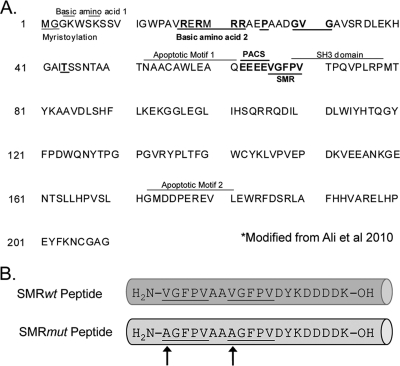
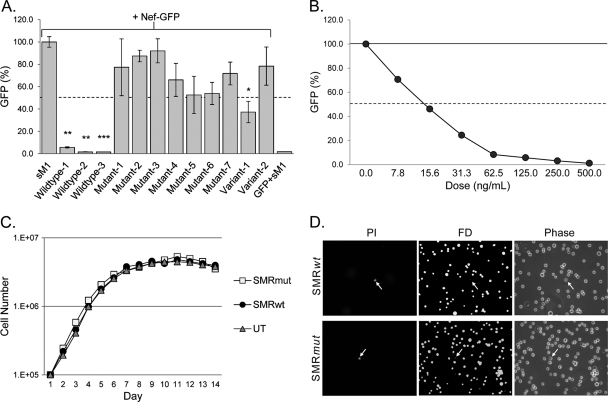
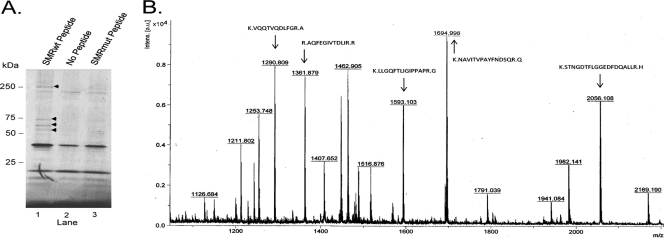
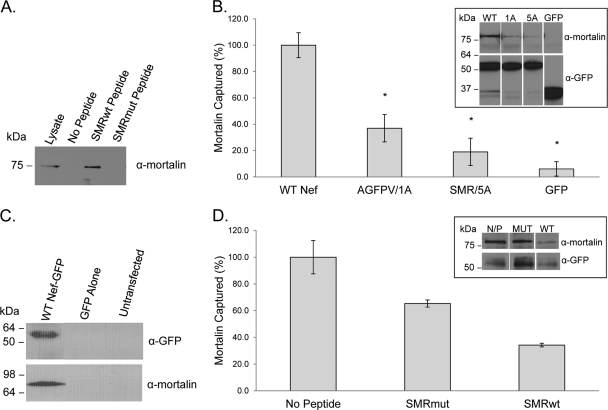
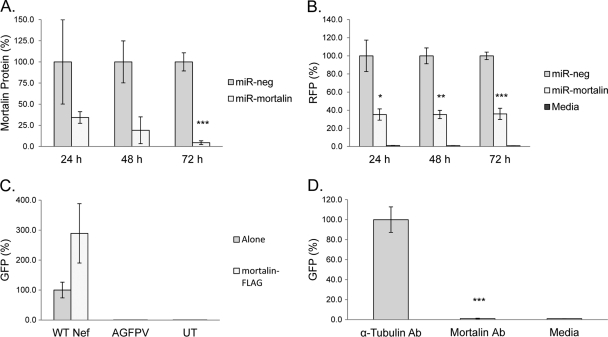
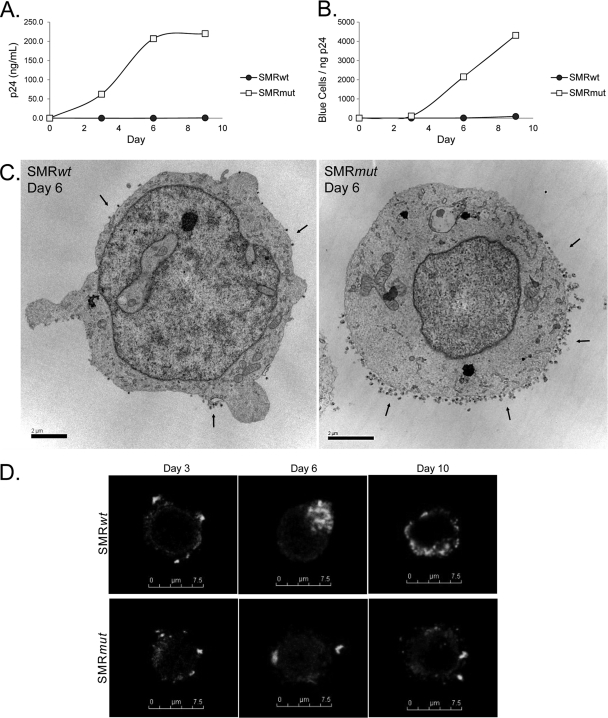
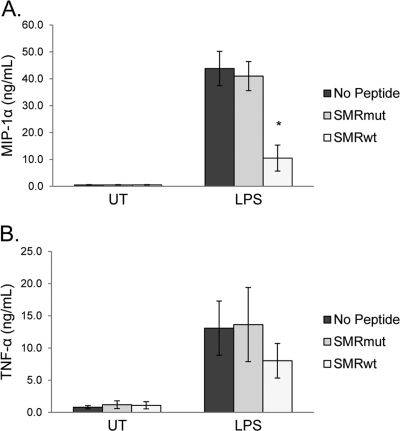
Nef is secreted from infected cells in exosomes and is found in abundance in the sera of HIV-infected individuals. Secreted exosomal Nef (exNef) induces apoptosis in uninfected CD4⁺ T cells and may be a key component of HIV pathogenesis. The exosomal pathway has been implicated in HIV-1 virus release, suggesting a possible link between these two viral processes. However, the underlying mechanisms and cellular components of exNef secretion have not been elucidated. We have previously described a Nef motif, the secretion modification region (SMR; amino acids 66 to 70), that is required for exNef secretion. In silico modeling data suggest that this motif can form a putative binding pocket. We hypothesized that the Nef SMR binds a cellular protein involved in protein trafficking and that inhibition of this interaction would abrogate exNef secretion. By using tandem mass spectrometry and coimmunoprecipitation with a novel SMR-based peptide (SMRwt) that blocks exNef secretion and HIV-1 virus release, we identified mortalin as an SMR-specific cellular protein. A second set of coimmunoprecipitation experiments with full-length Nef confirmed that mortalin interacts with Nef via Nef's SMR motif and that this interaction is disrupted by the SMRwt peptide. Overexpression and microRNA knockdown of mortalin revealed a positive correlation between exNef secretion levels and mortalin protein expression. Using antibody inhibition we demonstrated that the Nef/mortalin interaction is necessary for exNef secretion. Taken together, this work constitutes a significant step in understanding the underlying mechanism of exNef secretion, identifies a novel host-pathogen interaction, and introduces an HIV-derived peptide with antiviral properties.
Figures
References
-
- Aiken C, Konner J, Landau NR, Lenburg ME, Trono D. 1994. Nef induces CD4 endocytosis: requirement for a critical dileucine motif in the membrane-proximal CD4 cytoplasmic domain. Cell 76:853–864 - PubMed
-
- Annunziata P. 2003. Blood-brain barrier changes during invasion of the central nervous system by HIV-1. Old and new insights into the mechanism. J. Neurol. 250:901–906 - PubMed
-
- Bagasra O, Hauptman SP, Lischner HW, Sachs M, Pomerantz RJ. 1992. Detection of human immunodeficiency virus type 1 provirus in mononuclear cells by in situ polymerase chain reaction. N. Engl. J. Med. 326:1385–1391 - PubMed
Publication types
MeSH terms
Substances
Grants and funding
- P30 A1050409/PHS HHS/United States
- S06 GM08248/GM/NIGMS NIH HHS/United States
- U54 MD007588/MD/NIMHD NIH HHS/United States
- G12 RR003034/RR/NCRR NIH HHS/United States
- C06 RR018386/RR/NCRR NIH HHS/United States
- C06 RR18386/RR/NCRR NIH HHS/United States
- G12-RR03034/RR/NCRR NIH HHS/United States
- F31 AI091484/AI/NIAID NIH HHS/United States
- S21 MD000101/MD/NIMHD NIH HHS/United States
- S06 GM008248/GM/NIGMS NIH HHS/United States
- R25 GM058268/GM/NIGMS NIH HHS/United States
- F31AI091484/AI/NIAID NIH HHS/United States
- U54 RR026137/RR/NCRR NIH HHS/United States
LinkOut - more resources
Full Text Sources
Other Literature Sources
Medical
Research Materials
