


Antimicrobial efficacy of different toothpastes and mouthrinses: an in vitro study
- PMID: 22013468
- PMCID: PMC3177399
Antimicrobial efficacy of different toothpastes and mouthrinses: an in vitro study
Abstract
Background: Anti-microbial agents have been used as a chemotherapeutic agent to improve oral health. This in vitro study was carried out to determine antimicrobial efficacy of different toothpastes and mouthrinses against the oral pathogens.
Methods: A total of five toothpastes and five mouthrinses were tested for their antimicrobial activity against three oral pathogens namely, Streptococcus mutans (MTCC 890), Escherichia coli (MTCC 579) and Candida albicans (MTCC 854) by well agar diffusion assay. Statistical Analysis was performed using a statistical package, SPSS windows version 15, by applying mean values using analysis of variance (ANOVA) with post-hoc least square differences (LSD) method(α = 0.05).
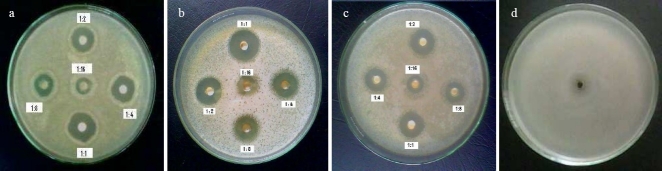
Results: Toothpaste formulation A showed maximum zones of inhibition against the test organism, Escherichia coli (P<60;0.001) compared to all other toothpastes formulations. Against Streptococcus mutans and Candida albicans, the zones of inhibition were less in comparison to E.coli but were significantly different at higher dilutions (1:8, 1:16 P<60;0.05) for toothpaste formulation A. Mouthrinses formulation H showed maximum efficacy against the test organism, Escherichia coli (P<60;0.001) compared to all other mouthrinse formulations. Against Streptococcus mutans, mouthrinses formulations F, G and J showed significant antimicrobial activity (P<60;0.05) compared to formulation H and I.
Conclusion: In the present study, it has been demonstrated that triclosan containing toothpastes formulations are more effective in control of oral microflora compared to non-triclosan containing synthetic toothpastes. Among mouthrinses formulations, chlorhexidine was found to be more effective than or as effective as triclosan against the organisms tested.
Keywords: Antimicrobial activity; Antimicrobial agents; Chlorhexidine gluconate; Mouthrinse; Toothpaste; Triclosan.
Figures
References
-
- Clarke JK. On the bacterial factor in the etiology of dental caries. Brit J Exp Pathol. 1924;5:141–7.
-
- Gamboa F, Estupinan M, Galindo A. Presence of Streptococcus mutans in saliva and its relationship with dental caries: Antimicrobial susceptibility of the isolates. Universitas Scientiarum. 2004;9(2):23–7.
-
- Oztan MD, Kiyan M, Gerceker D. Antimicrobial effect, in vitro, of gutta-percha points containing root canal medications against yeasts and Enterococcus faecalis. Oral Surg Oral Med Oral Pathol Oral Radiol Endod. 2006;102(3):410–6. - PubMed
-
- Addy M. Chemical plaque control. In: Kieser BJ, editor. Periodontics: a practical approach. London: Wright Publishing Company; 1990. pp. 527–34.
-
- Menendez A, Li F, Michalek SM, Kirk K, Makhija SK, Childers NK. Comparative analysis of the antibacterial effects of combined mouthrinses on Streptococcus mutans. Oral Microbiol Immunol. 2005;20(1):31–4. - PubMed
LinkOut - more resources
Full Text Sources
Other Literature Sources