. 2012:2012:129486.
doi: 10.1155/2012/129486. Epub 2011 Oct 15.

Th2 regulation of viral myocarditis in mice: different roles for TLR3 versus TRIF in progression to chronic disease

Affiliations

Th2 regulation of viral myocarditis in mice: different roles for TLR3 versus TRIF in progression to chronic disease

Eric D Abston et al. Clin Dev Immunol. 2012.

Abstract

Viral infections are able to induce autoimmune inflammation in the heart. Here, we investigated the role of virus-activated Toll-like receptor (TLR)3 and its adaptor TRIF on the development of autoimmune coxsackievirus B3 (CVB3) myocarditis in mice. Although TLR3- or TRIF-deficient mice developed similarly worse acute CVB3 myocarditis and viral replication compared to control mice, disease was significantly worse in TRIF compared to TLR3-deficient mice. Interestingly, TLR3-deficient mice developed an interleukin (IL)-4-dominant T helper (Th)2 response during acute CVB3 myocarditis with elevated markers of alternative activation, while TRIF-deficient mice elevated the Th2-associated cytokine IL-33. Treatment of TLR3-deficient mice with recombinant IL-33 improved heart function indicating that elevated IL-33 in the context of a classic Th2-driven response protects against autoimmune heart disease. We show for the first time that TLR3 versus TRIF deficiency results in different Th2 responses that uniquely influence the progression to chronic myocarditis.


Figures
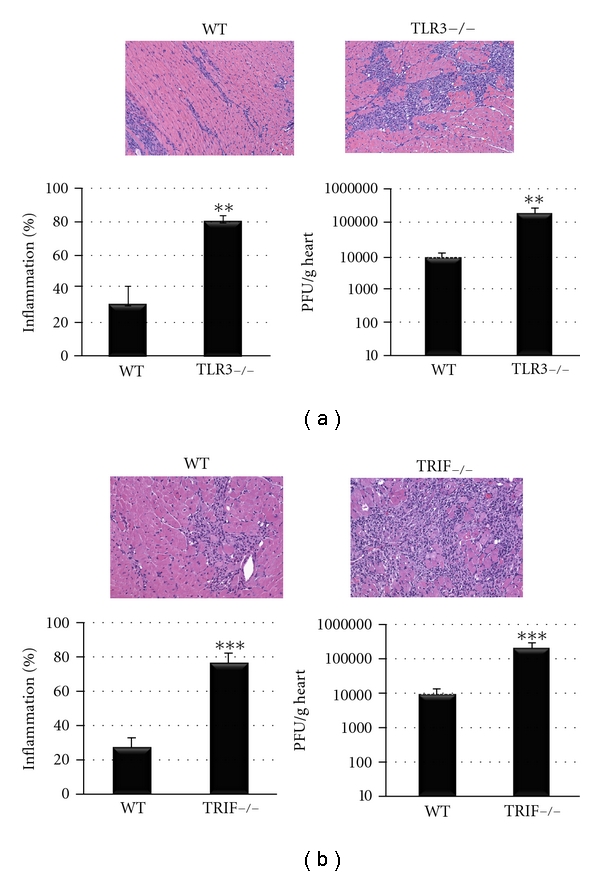
Figure 1
Figure 1
Inflammation and viral replication increase in a similar manner in TLR3-deficient (TLR3−/−) or TRIF−/− mice during acute CVB3 myocarditis. (a) TLR3−/− mice developed increased inflammation and viral replication at day 10 pi compared to WT B6.129 controls. (a) Representative histology sections of inflammation in WT and TLR3−/− hearts stained with H&E (top), magnification ×64. (b) TRIF−/− mice develop increased inflammation and viral replication at day 10 pi compared to WT BL/6 controls. (b) Representative histology sections of inflammation in WT and TRIF−/− hearts stained with H&E (top), magnification ×64. Data show the mean ± SEM of at least three separate experiments using 7 to 12 mice/group. **:  P < 0.01, ***:  P < 0.001.
Figure 2
Figure 2
Survival differs between TLR3-deficient (TLR3−/−) and TRIF−/− mice with CVB3 myocarditis/DCM. (a) Survival of TLR3−/− mice compared to WT B6.129 controls (TLR3−/− versus WT, n = 77/group). (b) Survival of TRIF−/− mice compared to WT BL/6 controls (TRIF−/− versus WT, n = 45/group), ***:  P < 0.001.
Figure 3
Figure 3
TRIF-deficient mice develop significantly worse heart function at day 10 pi. Echocardiography was used to assess heart function in (a) TLR3-deficient (TLR3−/−) versus WT B6.129 mice, (b) TRIF-deficient (TRIF−/−) versus WT BL/6 mice, or (c) TLR3- versus TRIF-deficient mice. LVEDD, left ventricular end diastolic dimension; LVESD, left ventricular end systolic dimension; FS, fractional shortening; EF, ejection fraction. Data show the mean ± SEM of at least three separate experiments using 7 to 12 mice/group. *:  P < 0.05; **:  P < 0.01; ***:  P < 0.001.
Figure 4
Figure 4
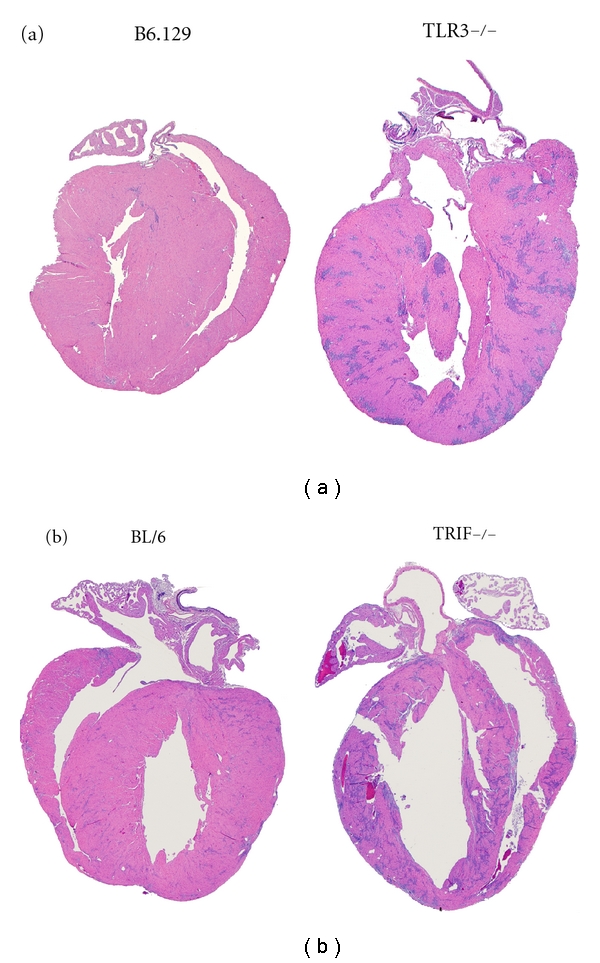
TRIF-deficient (TRIF−/−) mice develop DCM by day 10 pi, but TLR3−/− mice do not. Representative histology sections of (a) TLR3−/− compared to WT B6.129 controls at day 10 pi, magnification ×5. (b) Representative histology sections displaying dilation in TRIF−/− compared to WT BL/6 mice at day 10 pi, magnification ×5.
Figure 5
Figure 5
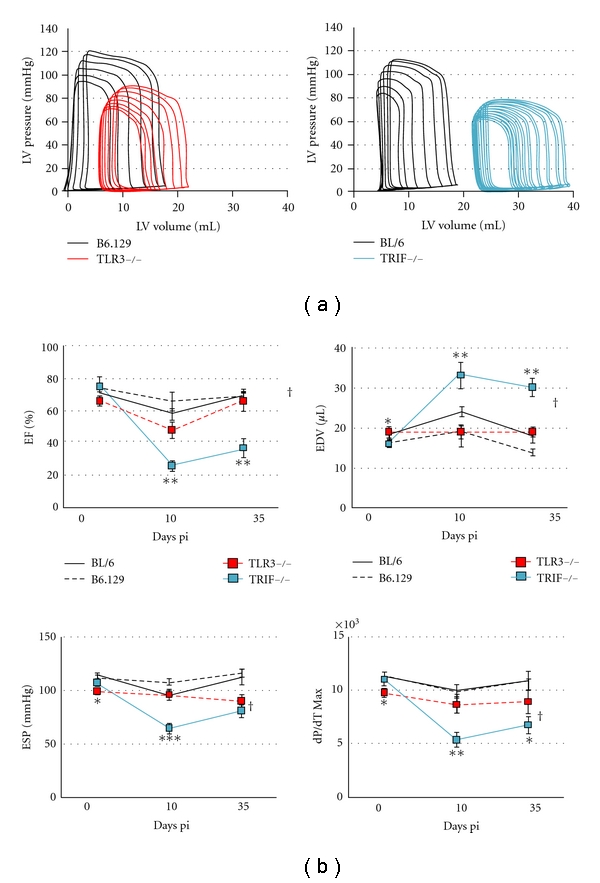
Cardiac function differs between TLR3 deficient (TLR3−/−) and TRIF−/− mice during acute and chronic CVB3 myocarditis. (a) Representative pressure-volume loops for TLR3−/− (left) and TRIF−/− (right) hearts at day 10 pi compared to their WT controls. (b) Comparison of pressure-volume relationships of TLR3−/−, TRIF−/− and WT mice at day 10 pi, n = 10 to 12 mice/group. Student's t-test compares TLR3−/− to TRIF−/− at day 0, 10 or 35 pi; *:  P < 0.05; **:  P < 0.01; ***:  P < 0.001. ANOVA compared TLR3−/− to TRIF−/− mice over time; , P < 0.05. EF: ejection fraction; dP/dT Max (mm Hg/s) measures the peak rate of pressure rise; ESP: end systolic pressure; EDV: end diastolic volume.
Figure 6
Figure 6
TLR3-deficient (TLR3−/−) mice have reduced IFN-γ and elevated IL-4 levels in the heart compared to WT B6.129 controls, while TRIF−/− mice have reduced IFN-β and increased IL-33 compared to WT BL/6 mice by ELISA. Similar results were obtained in at least three separate experiments and show the mean ± SEM of 7 to 12 mice/group. *:  P < 0.05; **:  P < 0.01.
Figure 7
Figure 7
TLR3-deficient (TLR3−/−) mice have increased markers of IL-4-driven alternative activation compared to TRIF−/− mice. Markers of alternative activation included arginase-1 (Arg1), chitinase (Ym1), IL-4R, and macrophage mannose receptor (Mrc1) by qRT-PCR. Relative gene expression (RGE) was normalized to hypoxanthine phosphoribosyltransferase 1 (HPRT). Data show the mean ± SEM of 10 mice/group. **:  P < 0.01; ***:  P < 0.001.
Figure 8
Figure 8
Recombinant IL-33 treatment increases myocarditis and cardiac dysfunction in BL/6 mice. Male BL/6 mice were treated with recombinant IL-33 (rIL-33) or PBS every other day from day 1 to 9 pi and (a,c) myocarditis, (b) cardiac IL-33 levels by ELISA and (d) heart function assessed using pressure-volume relationships at day 10 pi. (c) Representative histology sections of inflammation in PBS-treated (left) and rIL-33-treated (right) BL/6 mice stained with H&E, magnification ×64. Data show the mean ± SEM of 10 mice/group. **:  P < 0.01; ***:  P < 0.001.
Figure 9
Figure 9
Summary of pressure-volume relationships at day 10 pi in TLR3−/− mice treated with recombinant IL-33 (rIL-33) or PBS every other day from day 1 to 9 pi. dP/dT Max measures the peak rate of pressure rise (mmHg/s); Tau, time constant of diastolic relaxation; EDP, end diastolic pressure; Ea/Ees, arterial elastance normalized to Ees which is left ventricular end systolic elastance (stiffness); PMX, maximum ventricular power; PRSW, preload recruitable stroke work. n = 10 to 12 mice/group. *:  P < 0.05.

References

    1. Bui AL, Horwich TB, Fonarow GC. Epidemiology and risk profile of heart failure. Nature Reviews Cardiology. 2011;8(1):30–41. - PMC - PubMed
    1. Fairweather D, Frisancho-Kiss S, Rose NR. Sex differences in autoimmune disease from a pathological perspective. American Journal of Pathology. 2008;173(3):600–609. - PMC - PubMed
    1. Cooper LT., Jr. Myocarditis. The New England Journal of Medicine. 2009;360(15):1526–1538. - PMC - PubMed
    1. Roger VL, Go AS, Lloyd-Jones DM, et al. Heart disease and stroke statistics-2011 update. Circulation. 2011;123:e18–e209. - PMC - PubMed
    1. Kindermann I, Kindermann M, Kandolf R, et al. Predictors of outcome in patients with suspected myocarditis. Circulation. 2008;118(6):639–648. - PubMed

Publication types

MeSH terms

LinkOut - more resources