. 2012 Apr;165(7):2365-77.
doi: 10.1111/j.1476-5381.2011.01725.x.

Chronic treatment in vivo with β-adrenoceptor agonists induces dysfunction of airway β(2) -adrenoceptors and exacerbates lung inflammation in mice

Affiliations

Chronic treatment in vivo with β-adrenoceptor agonists induces dysfunction of airway β(2) -adrenoceptors and exacerbates lung inflammation in mice

Rui Lin et al. Br J Pharmacol. 2012 Apr.

Abstract

Background and purpose: Inhalation of a β-adrenoceptor agonist (β-agonist) is first-line asthma therapy, used for both prophylaxis against, and acute relief of, bronchoconstriction. However, repeated clinical use of β-agonists leads to impaired bronchoprotection and, in some cases, adverse patient outcomes. Mechanisms underlying this β(2) -adrenoceptor dysfunction are not well understood, due largely to the lack of a comprehensive animal model and the uncertainty as to whether or not bronchorelaxation in mice is mediated by β(2) -adrenoceptors. Thus, we aimed to develop a mouse model that demonstrated functional β-agonist-induced β(2) -adrenoceptor desensitization in the context of allergic inflammatory airway disease.

Experimental approach: We combined chronic allergen exposure with repeated β-agonist inhalation in allergen-treated BALB/C mice and examined the contribution of β(2) -adrenoceptors to albuterol-induced bronchoprotection using FVB/NJ mice with genetic deletion of β(2) -adrenoceptors (KO). Associated inflammatory changes - cytokines (ELISA), cells in bronchoalevolar lavage and airway remodelling (histology) and β(2) -adrenoceptor density (radioligand binding) - were also measured. KEY RESULTS β(2) -Adrenoceptors mediated albuterol-induced bronchoprotection in mice. Chronic treatment with albuterol induced loss of bronchoprotection, associated with exacerbation of the inflammatory components of the asthma phenotype.

Conclusions and implications: This animal model reproduced salient features of human asthma and linked loss of bronchoprotection with airway pathobiology. Accordingly, the model offers an advanced tool for understanding the mechanisms of the effects of chronic β- agonist treatment on β-adrenoceptor function in asthma. Such information may guide the clinical use of β-agonists and provide insight into development of novel β-adrenoceptor ligands for the treatment of asthma.


Figures

Figure 1
Figure 1
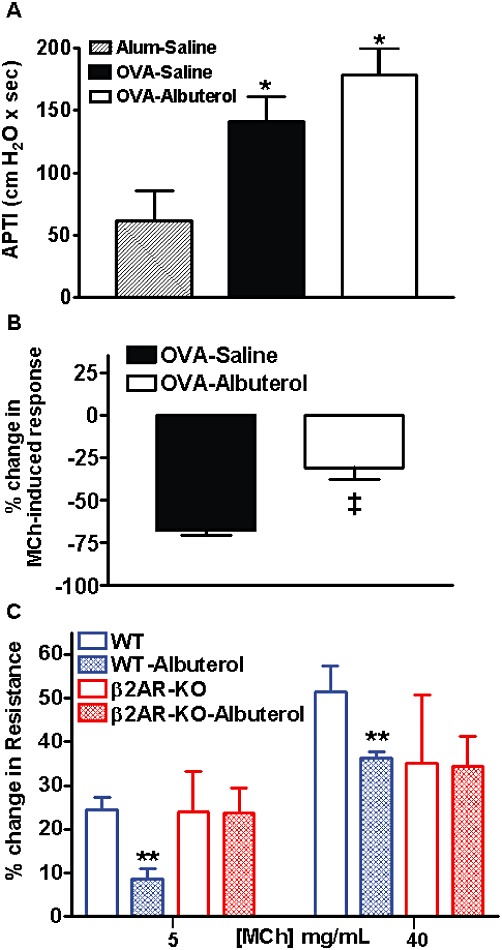
Assessment of airway responsiveness and bronchoprotection. (A) Relative to alum-treated mice, chronic OVA-treatment increased airway responsiveness to 100 µg·kg−1 MCh that is not significantly altered by additional chronic administration of albuterol (open bar). (B) The airway response to MCh in OVA-treated mice that are naïve to chronic oropharyngeal albuterol treatment is significantly abated by i.v administration of albuterol during MCh challenge. However, the effectiveness of i.v. 30 µg·kg−1 albuterol to functionally neutralize the airway response to MCh is significantly diminished in mice chronically treated with OVA and oropharyngeal albuterol. Values are mean ± SE from three to nine mice per group. (C) The percent change in airway resistance was significantly diminished by albuterol relative to vehicle at 5 and 40 mg·mL−1 aerosolized MCh in naïve wild type (WT), but not naïve β2-adrenoceptor KO (β2AR-KO) mice. Values are mean ± SE from three to four mice per group. *P < 0.05 compared with alum–saline; ‡P < 0.05 compared with OVA–saline; **P < 0.05 compared with WT using a one-tailed Student's t-test.
Figure 2
Figure 2
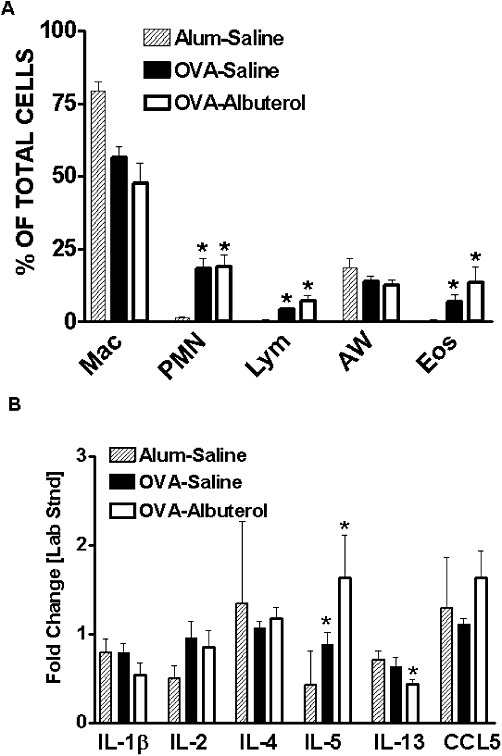
Assessment of lung inflammation. Relative to alum-treated mice, chronic OVA treatment increased (A) lung lavage neutrophils (PMNs), lymphocytes (Lym) and eosinophils (Eos), but not macrophages (Mac) or airway epithelial cells (AW). (B) Cytokine IL-5 was elevated by OVA treatment. Chronic administration of albuterol to OVA-treated mice had no significant effect on any of these measurements except that IL-13 was reduced. Values are mean ± SE from 3 to 13 mice per group. *P < 0.05 compared to alum–saline.
Figure 3
Figure 3
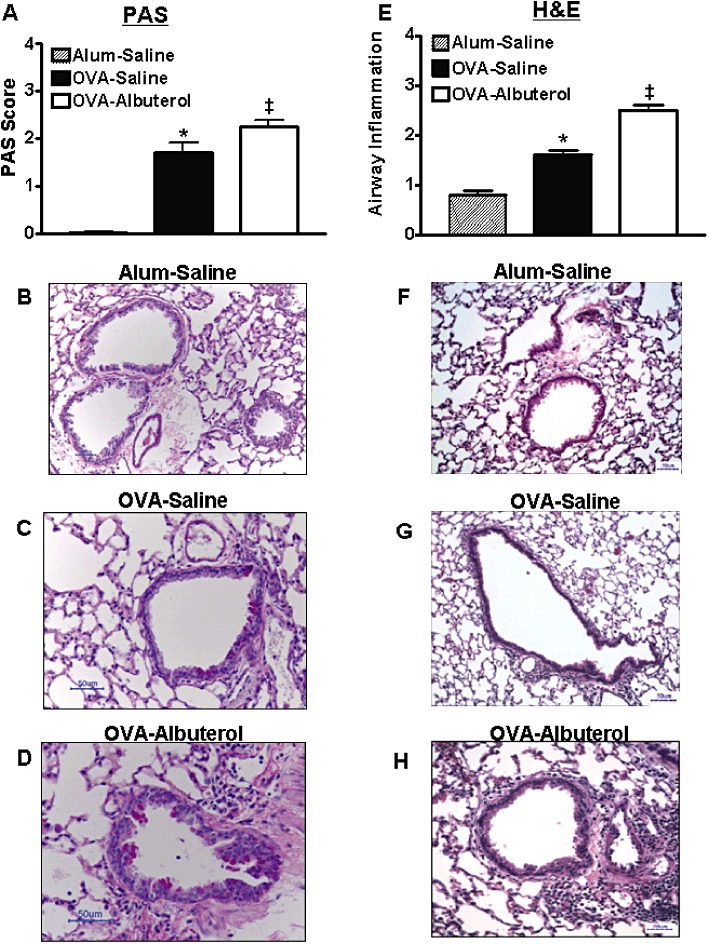
Assessment of airway mucous metaplasia and inflammation. Relative to alum–saline-treated mice, chronic OVA treatment increased(A–D) airway mucous metaplasia and (E–H) peribronchiolar and perivascular inflammation. The additional chronic administration of albuterol exacerbated both of these phenotypes. Values are mean ± SE from 8 to 10 mice per group. *P < 0.05 compared with alum–saline; ‡P < 0.05 compared with alum– and OVA–saline.
Figure 4
Figure 4
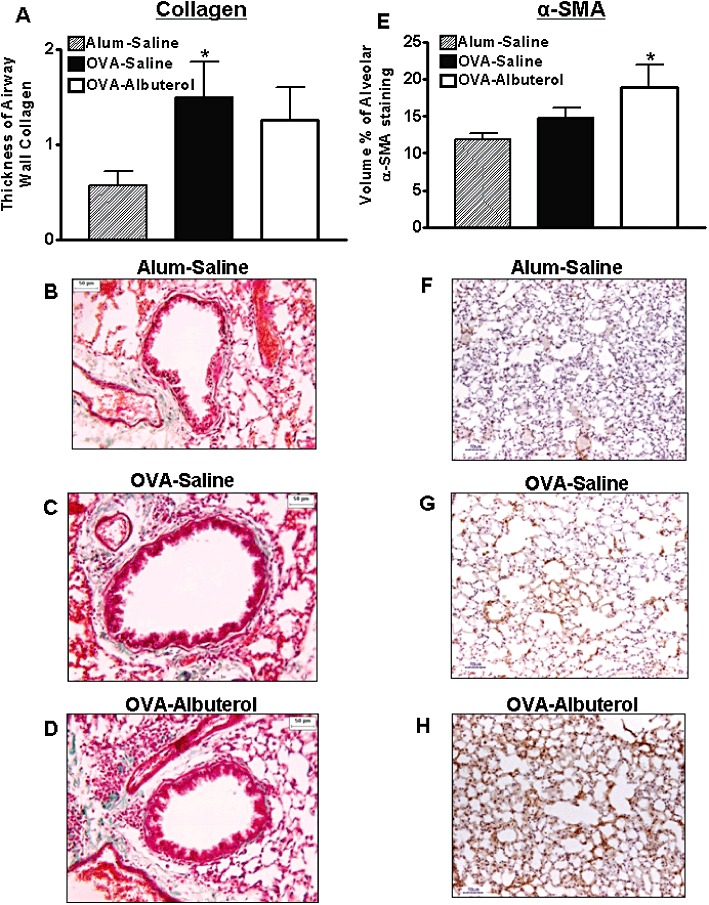
Assessment of airway remodelling. (A–D) Airway wall collagen thickness was significantly elevated in chronically OVA-treated mice, but not those that additionally received albuterol. (E–H) Only mice that chronically received combined OVA–albuterol treatment demonstrated a significant increase in alveolar α-SMA. Values are mean ± SE from 6 to 14 mice per group. *P < 0.05 compared with alum–saline.
Figure 5
Figure 5
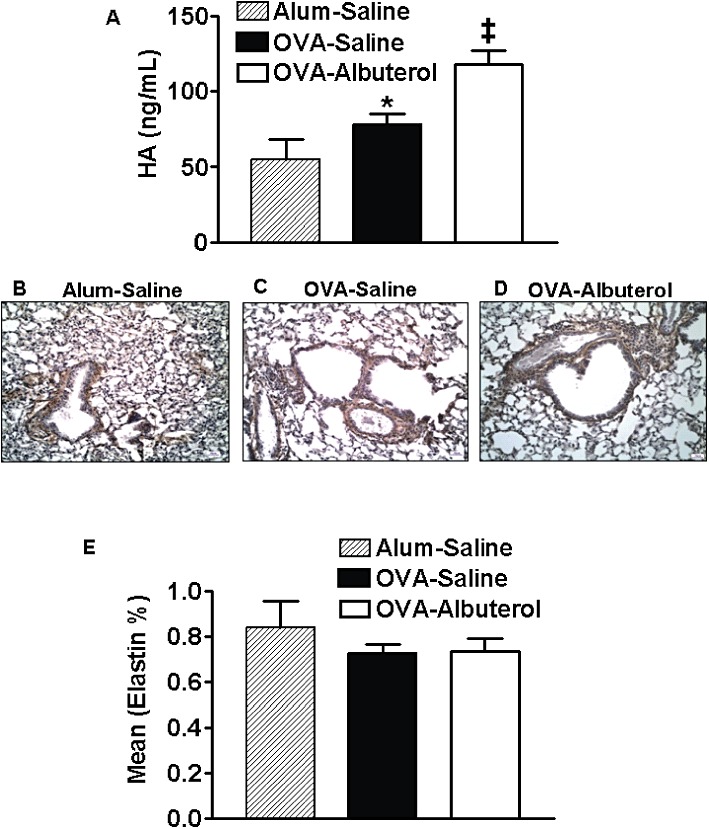
Assessment of hyaluronan and airway remodelling. (A) Hyaluronan (HA) levels in BAL were significantly elevated in chronically OVA-treated mice and this was significantly enhanced in OVA–albuterol-treated mice. (B–D) Representative micrographs of hyaluronan-stained lung slices are shown for all three treatment groups. (E) Neither OVA nor combined OVA–albuterol treatment was associated with significant changes in alveolar elastin. Values are mean ± SE from 6 to 10 mice per group. *P < 0.05 compared with alum–saline; ‡P < 0.05 compared with alum– and OVA–saline.
Figure 6
Figure 6
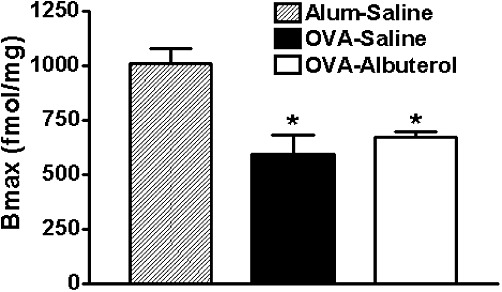
Assessment of β-adrenoceptor expression. Radioligand binding experiments showed that relative to alum–saline-treated mice, chronically OVA-treated mice demonstrate a decrease in lung β-adrenoceptor expression, that is not significantly altered by additional chronic oropharyngeal administration of albuterol. Values are mean ± SE from four mice per group. *P < 0.05 compared with alum–saline.

References

    1. Abisheganaden J, Boushey H. Long-acting inhaled beta 2-agonists and the loss of ‘bronchoprotective’ efficacy. Am J Med. 1998;104:494–497. - PubMed
    1. Baker JG. The selectivity of β-adrenoceptor antagonists at the human β1, β2 and β3 adrenoceptors. Br J Pharmacol. 2005;144:317–322. - PMC - PubMed
    1. Barnes PJ. The cytokine network in asthma and chronic obstructive pulmonary disease. J Clin Invest. 2008;118:3546–3556. - PMC - PubMed
    1. Bateman E, Nelson H, Bousquet J, Kral K, Sutton L, Ortega H, et al. Meta-analysis: effects of adding salmeterol to inhaled corticosteroids on serious asthma-related events. Ann Intern Med. 2008;149:33–42. - PubMed
    1. Bergeron C, Hauber HP, Gotfried M, Newman K, Dhanda R, Servi RJ, et al. Evidence of remodeling in peripheral airways of patients with mild to moderate asthma: effect of hydrofluoroalkane-flunisolide. J Allergy Clin Immunol. 2005;116:983–989. - PubMed

Publication types

MeSH terms