Factors associated with incorrect identification of recent HIV infection using the BED capture immunoassay
- PMID: 22014036
- PMCID: PMC3399553
- DOI: 10.1089/aid.2011.0258
Factors associated with incorrect identification of recent HIV infection using the BED capture immunoassay
Abstract
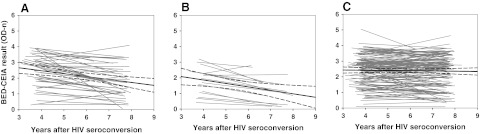
The BED capture enzyme immunoassay (BED-CEIA) was developed for estimating HIV incidence from cross-sectional data. This assay misclassifies some individuals with nonrecent HIV infection as recently infected, leading to overestimation of HIV incidence. We analyzed factors associated with misclassification by the BED-CEIA. We analyzed samples from 383 men who were diagnosed with HIV infection less than 1 year after a negative HIV test (Multicenter AIDS Cohort Study). Samples were collected 2-8 years after HIV seroconversion, which was defined as the midpoint between the last negative and first positive HIV test. Samples were analyzed using the BED-CEIA with a cutoff of OD-n ≤ 0.8 for recent infection. Logistic regression was used to identify factors associated with misclassification. Ninety-one (15.1%) of 603 samples were misclassified. In multivariate models, misclassification was independently associated with highly active antiretroviral treatment (HAART) for >2 years, HIV RNA <400 copies/ml, and CD4 cell count <50 or <200 cells/mm(3); adjusted odds ratios (OR) and 95% confidence intervals (CI) were 4.72 (1.35-16.5), 3.96 (1.53-10.3), 6.85 (2.71-17.4), and 11.5 (3.64-36.0), respectively. Among 220 men with paired samples, misclassification 2-4 years after seroconversion was significantly associated with misclassification 6-8 years after seroconversion [adjusted OR: 25.8 (95% CI: 8.17-81.5), p<0.001] after adjusting for race, CD4 cell count, HIV viral load, and HAART use. Low HIV viral load, low CD4 cell count, and >2 years of HAART were significantly associated with misclassification using the BED-CEIA. Some men were persistently misclassified as recently infected up to 8 years after HIV seroconversion.
Figures
References
-
- Brookmeyer R. Measuring the HIV/AIDS epidemic: Approaches and challenges. Epidemiol Rev. 2010;32:26–37. - PubMed
-
- Murphy G. Parry JV. Assays for the detection of recent infections with human immunodeficiency virus type 1. Euro Surveill. 2008;13:pii18966. - PubMed
-
- Busch MP. Pilcher CD. Mastro TD. Kaldor J. Vercauteren G. Rodriguez W, et al. Beyond detuning: 10 years of progress and new challenges in the development and application of assays for HIV incidence estimation. AIDS. 2010;24:2763–2771. - PubMed
Publication types
MeSH terms
Grants and funding
- R24 HD042854/HD/NICHD NIH HHS/United States
- 1R01-AI095068/AI/NIAID NIH HHS/United States
- U01-AI46745/AI/NIAID NIH HHS/United States
- U01-AI068632/AI/NIAID NIH HHS/United States
- UO1-AI35039/AI/NIAID NIH HHS/United States
- UO1-AI35042/AI/NIAID NIH HHS/United States
- UM1-AI068613/AI/NIAID NIH HHS/United States
- U01-AI068613/AI/NIAID NIH HHS/United States
- UO1-AI35041/AI/NIAID NIH HHS/United States
- UO1-AI35040/AI/NIAID NIH HHS/United States
- R01 AI095068/AI/NIAID NIH HHS/United States
- UO1-AI35043/AI/NIAID NIH HHS/United States
- U01-AI48054/AI/NIAID NIH HHS/United States
- UL1-RR025005/RR/NCRR NIH HHS/United States
- ImNIH/Intramural NIH HHS/United States
LinkOut - more resources
Full Text Sources
Medical
Research Materials